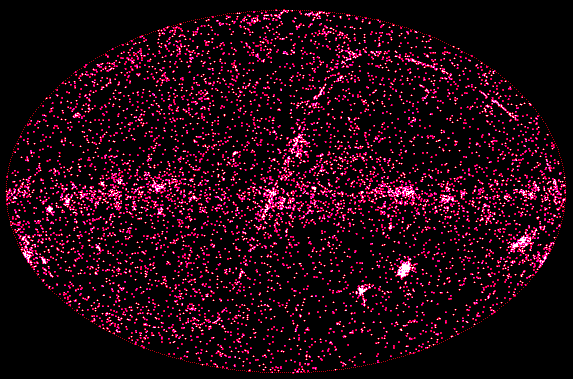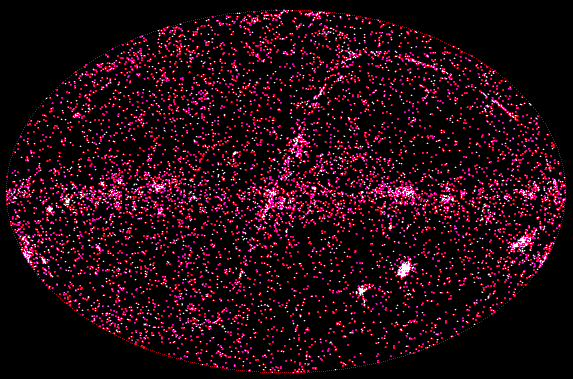
How do planets, stars, and galaxies form? How do they evolve? The International Ultraviolet Explorer (IUE) satellite was launched in 1978 and operated by NASA/ ESA/ PPARC to help provide answers to some of the most fundamental questions about the contents of our universe. IUE served as a geostationary orbiting observatory for the next 18 years acquiring over 100,000 observations with its onboard ultraviolet spectrographs. Its prodigious scientific output is only hinted at by the all-sky plot above which shows the locations of IUE's many pointed observations over its long operational history. The brightness of a point on the sky represents the the number of IUE observations. The plot is in galactic coordinates (the plane of our Galaxy runs horizontally through the middle) and reveals the positions of distant quasars, galaxies, stars, star clusters, nebulae, novae, and supernovae - testifying to IUE's broad range of capabilities. The ecliptic plane is also visible running diagonally through the center, traced out by many observations of solar system objects. After over 18 years, IUE's science operations officially end today as the final commands are transmitted to the aging satellite by controllers at NASA's Goddard Space Flight Center. Astronomers from around the world whose careers have been touched by IUE have expressed their fond farewells to this most productive and longest lived astronomical satellite and their thanks to all who have made IUE's remarkable voyage of exploration possible. News Flash: BATSE Detects Huge Gamma Ray Burst
¿Cómo se forman los planetas, las estrellas y las galaxias? ¿Cómo evolucionan? El satélite International Ultraviolet Explorer (IUE) fue lanzado en 1978 y operado por NASA/ESA/PPARC para ayudar a responder algunas de las preguntas más fundamentales sobre el contenido de nuestro universo. El IUE funcionó como observatorio en órbita geoestacionaria durante los siguientes 18 años, adquiriendo más de 100.000 observaciones con sus espectrómetros ultravioleta a bordo. Su prodigiosa producción científica queda apenas insinuada en el mapa celeste completo que se muestra arriba, el cual indica las posiciones de las numerosas observaciones dirigidas del IUE a lo largo de su prolongada historia operacional. El brillo de un punto en el cielo representa el número de observaciones realizadas por el IUE. El mapa está en coordenadas galácticas (el plano de nuestra Galaxia discurre horizontalmente por el centro) y revela las posiciones de cuásares distantes, galaxias, estrellas, cúmulos estelares, nebulosas, novas y supernovas, lo que da testimonio del amplio rango de capacidades del IUE. El plano de la eclíptica también es visible recorriendo diagonalmente el centro, trazado por numerosas observaciones de objetos del sistema solar. Tras más de 18 años, las operaciones científicas del IUE concluyen oficialmente hoy, cuando los últimos comandos son transmitidos al envejecido satélite por los controladores del Centro de Vuelo Espacial Goddard de la NASA. Astrónomos de todo el mundo, cuyas carreras han sido marcadas por el IUE, han expresado sus emotivas despedidas a este satélite astronómico más productivo y de mayor longevidad, y su agradecimiento a todos quienes han hecho posible el extraordinario viaje de exploración del IUE. Noticias de última hora: BATSE detecta una enorme explosión de rayos gamma