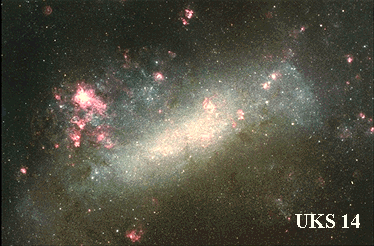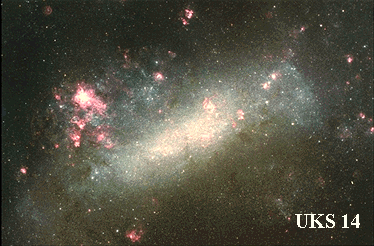
Magellan and his crew had plenty of time to study the southern sky during their famous voyage around the world. As a result, two fuzzy cloud like objects in the southern sky are now known as the Clouds of Magellan. These star clouds are small irregular galaxies, satellites of our larger Milky Way spiral galaxy. The Large Magellanic Cloud (LMC) pictured above is only about 180,000 light-years distant - the only known galaxy closer is the Sagittarius Dwarf. Both the LMC and the Small Magellanic Clouds (SMC) are joined to the Milky Way by a stream of cold hydrogen gas whose origin is still controversial. An unusual effect called gravitational lensing has recently been detected in a few LMC stars, and there is hope this could tell us important information about the true composition of our universe.
Magallanes y su tripulación tuvieron mucho tiempo para estudiar el cielo austral durante su famoso viaje alrededor del mundo. Como resultado, dos objetos difusos con aspecto de nubes en el cielo del hemisferio sur son conocidos actualmente como las Nubes de Magallanes. Estas nubes de estrellas son pequeñas galaxias irregulares, satélites de nuestra galaxia espiral mayor, la Vía Láctea. La Gran Nube de Magallanes (LMC, por sus siglas en inglés), fotografiada arriba, se encuentra a apenas unos 180.000 años-luz de distancia; la única galaxia conocida más cercana es la Galaxia Enana de Sagitario. Tanto la LMC como la Pequeña Nube de Magallanes (SMC) están unidas a la Vía Láctea por una corriente de gas hidrógeno frío cuyo origen sigue siendo objeto de debate. Un efecto inusual denominado lente gravitacional ha sido detectado recientemente en algunas estrellas de la LMC, y existe la esperanza de que esto pueda proporcionarnos información importante sobre la composición real de nuestro universo.