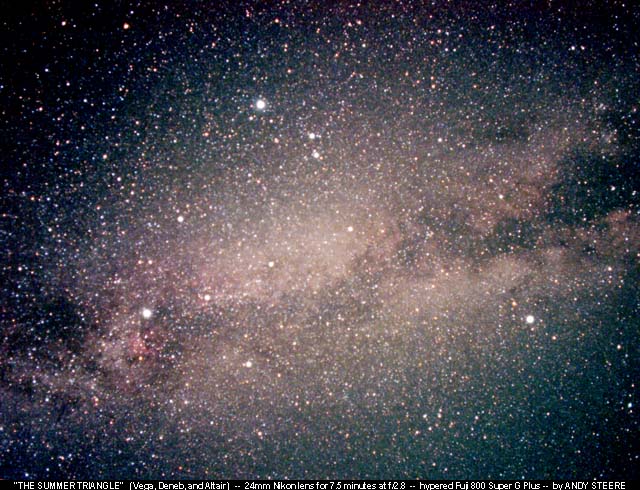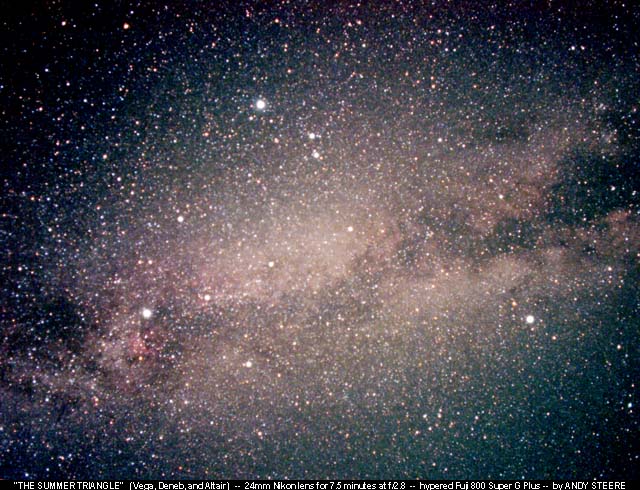
There are more than a few stars in our Galaxy. The light from many of them combines to appear as a wisp of faint light across the night sky - the Milky Way. In the northern hemisphere, away from city lights and during the summer months, part of the Milky Way can be seen behind the Summer Triangle of stars - Deneb, Vega, and Altair. These are the brightest three stars in the above photograph, listed from left to right, respectively. If you could collect light in your eyes for 10 minutes at a time (instead of the usual 1/10th of a second), you might see something like the above photograph. Behind the Summer Triangle lies some of the vast star fields of our Milky Way Galaxy, containing literally billions of stars. The dark band across the middle that seems to divide the stars is actually interstellar dust, which absorbs more visible light than it emits and so appears dark.
Hay más que unas pocas estrellas en nuestra galaxia. La luz de muchas de ellas se combina para aparecer como un tenue resplandor a través del cielo nocturno: la Vía Láctea. En el hemisferio norte, lejos de las luces de la ciudad y durante los meses de verano, parte de la Vía Láctea puede verse detrás del Triángulo de Verano, formado por las estrellas Deneb, Vega y Altair. Estas son las tres estrellas más brillantes de la fotografía anterior, enumeradas de izquierda a derecha, respectivamente. Si pudieras acumular luz en tus ojos durante 10 minutos seguidos (en lugar del habitual 1/10 de segundo), podrías ver algo parecido a la fotografía anterior. Detrás del Triángulo de Verano se encuentran algunos de los vastos campos estelares de nuestra galaxia, la Vía Láctea, que contiene literalmente miles de millones de estrellas. La banda oscura en el centro que parece dividir las estrellas es en realidad polvo interestelar, el cual absorbe más luz visible de la que emite y, por ello, aparece oscuro.