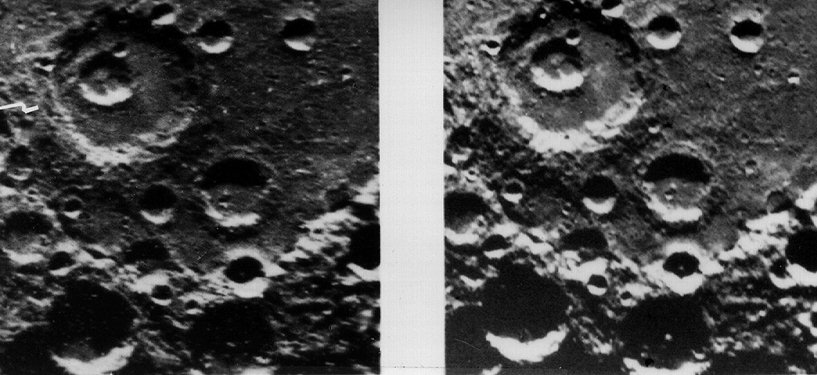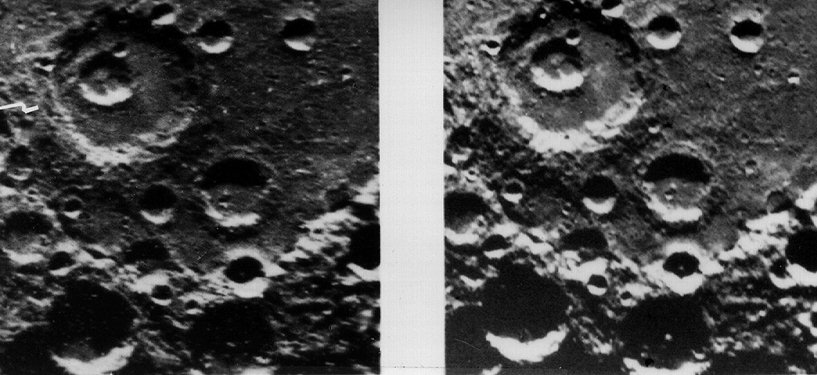
This Stereo image pair of craters on on Mercury was produced using data from NASA's robot explorer Mariner 10 which performed three close flybys of the Sun's closest companion, two in 1974 and one in 1975. However, the spacecraft was not equipped with a Stereo camera! Instead, the Stereo pair was created using two images of the same region each recorded from a slightly different angle. The image on the left was actually taken during the first flyby, the one on the right during the second. A crater within a crater is visible at the upper left, the outer one is about 70 miles in diameter. The embedded craters themselves are within the 230 mile wide Dostoevsky crater - a segment of Dostoevsky's rim runs through the lower half of the image. To get the 3D Stereo effect, your left eye should see only the left image and your right eye only the right one. (Try placing one edge of a piece of paper on the screen between the pictures and touching your nose to the other edge while viewing.)
Este par de imágenes estéreo de cráteres en Mercurio fue producido utilizando datos de la sonda exploradora robótica de la NASA Mariner 10, que realizó tres sobrevuelos cercanos al compañero más próximo del Sol: dos en 1974 y uno en 1975. Sin embargo, la nave espacial no estaba equipada con una cámara estéreo. En cambio, el par estéreo fue creado a partir de dos imágenes de la misma región, cada una registrada desde un ángulo ligeramente diferente. La imagen de la izquierda fue tomada durante el primer sobrevuelo, y la de la derecha durante el segundo. En la parte superior izquierda se puede observar un cráter dentro de otro cráter; el exterior tiene aproximadamente 70 millas de diámetro. Estos cráteres anidados se encuentran dentro del cráter Dostoevsky, de 230 millas de ancho; un segmento del borde de Dostoevsky atraviesa la mitad inferior de la imagen. Para obtener el efecto estéreo tridimensional, el ojo izquierdo debe ver únicamente la imagen de la izquierda y el ojo derecho únicamente la de la derecha. (Intente colocar un borde de una hoja de papel sobre la pantalla entre las dos imágenes y acerque su nariz al otro extremo mientras las observa.)