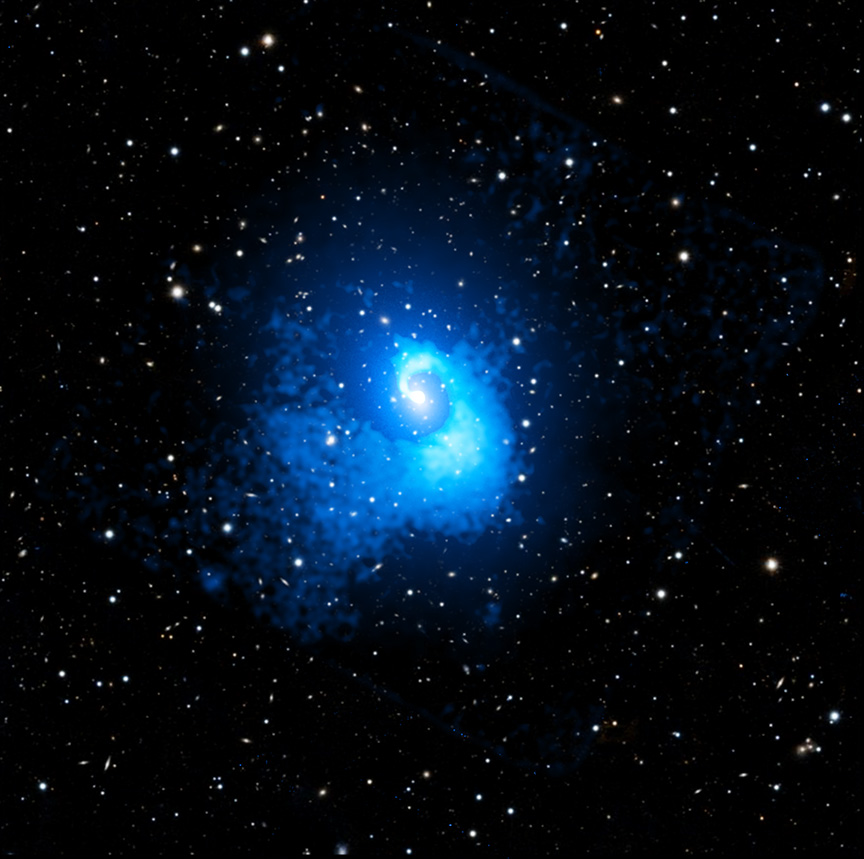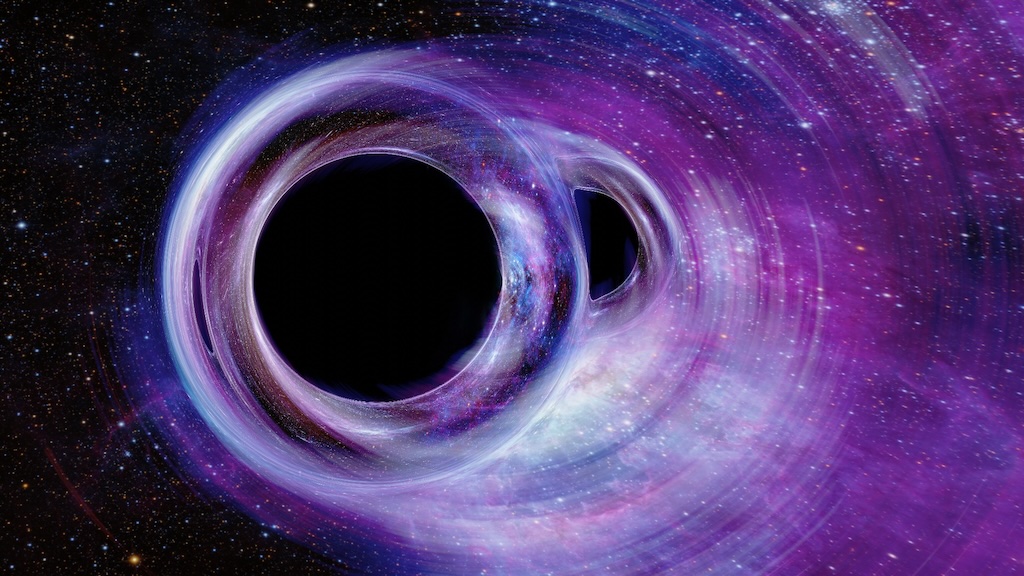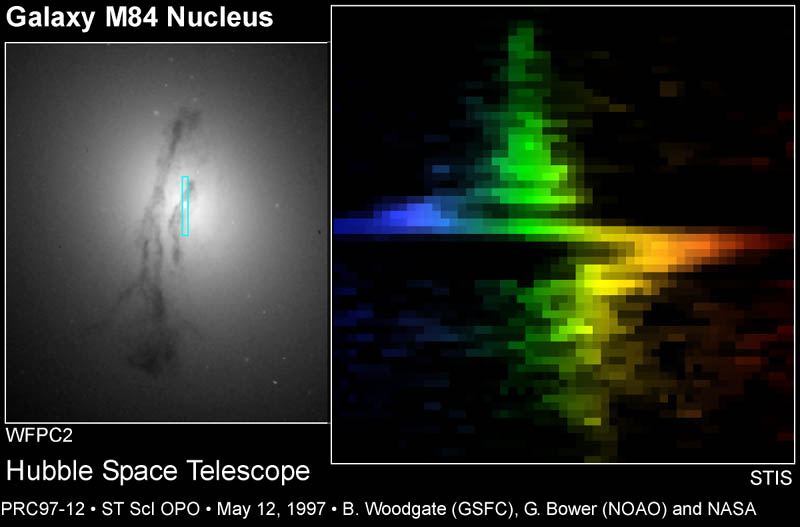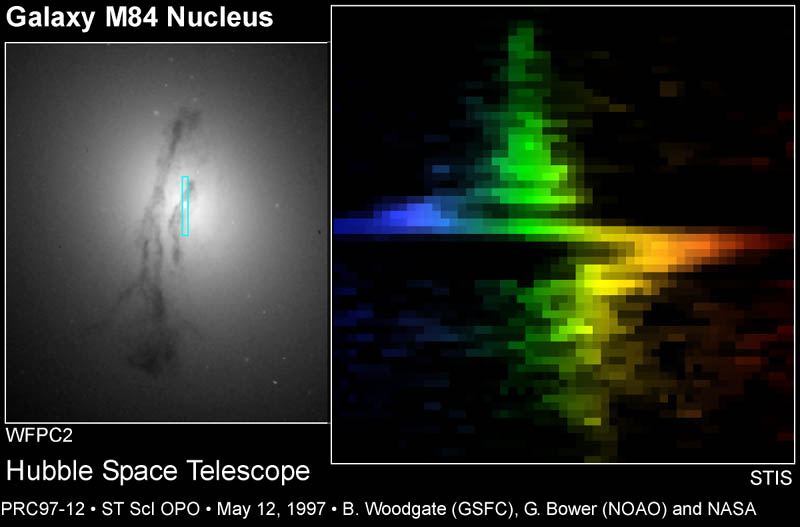
This artistic image is actually the signature of a supermassive black hole in the center of distant galaxy M84 - based on data recently recorded by Hubble's new Space Telescope Imaging Spectrograph (STIS). Very near black holes the force of gravity is so strong that even light can not escape ... but the presence of a black hole can also be revealed by watching matter fall into it. In fact, material spiraling into a black hole would find its speed increasing at a drastic rate. These extreme velocity increases provide a "signature" of the black hole's presence. STIS relies on the Doppler effect to measure gas velocity rapidly increasing to nearly 240 miles per second within 26 light years of the center of M84, a galaxy in the Virgo Cluster about 50 million light years away. The STIS data show that radiation from approaching gas, shifted to blue wavelengths left of the centerline, is suddenly redshifted to the right of center indicating a rapidly rotating disk of material near the galactic nucleus. The resulting sharp S-shape is effectively the signature of a black hole estimated to contain at least 300 million solar masses. Do all galaxies have central black holes?
Esta imagen artística es en realidad la firma de un agujero negro supermasivo en el centro de la lejana galaxia M84, basada en datos registrados recientemente por el nuevo Espectrógrafo de Imágenes del Telescopio Espacial (STIS, por sus siglas en inglés) del Hubble. Muy cerca de los agujeros negros, la fuerza de gravedad es tan intensa que ni siquiera la luz puede escapar... pero la presencia de un agujero negro también puede revelarse observando la materia que cae hacia él. De hecho, el material que se precipita en espiral hacia un agujero negro experimenta un incremento drástico en su velocidad. Estos aumentos extremos de velocidad proporcionan una "firma" de la presencia del agujero negro. El STIS se basa en el efecto Doppler para medir la velocidad del gas, que aumenta rápidamente hasta casi 240 millas por segundo dentro de un radio de 26 años luz del centro de M84, una galaxia en el Cúmulo de Virgo situada a unos 50 millones de años luz de distancia. Los datos del STIS muestran que la radiación proveniente del gas que se aproxima, desplazada hacia longitudes de onda azules a la izquierda de la línea central, se desplaza súbitamente hacia el rojo a la derecha del centro, lo que indica la existencia de un disco de material en rápida rotación cerca del núcleo galáctico. La característica forma de S resultante es efectivamente la firma de un agujero negro estimado en al menos 300 millones de masas solares. ¿Acaso todas las galaxias poseen agujeros negros centrales?