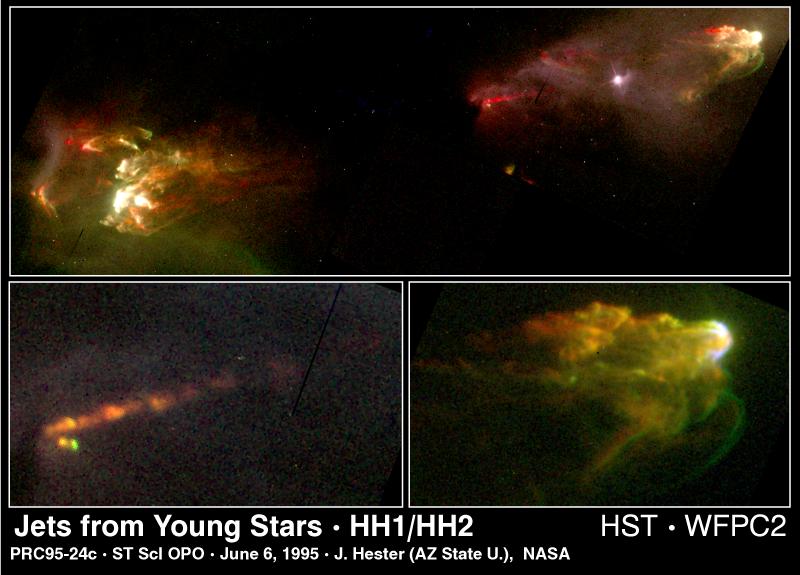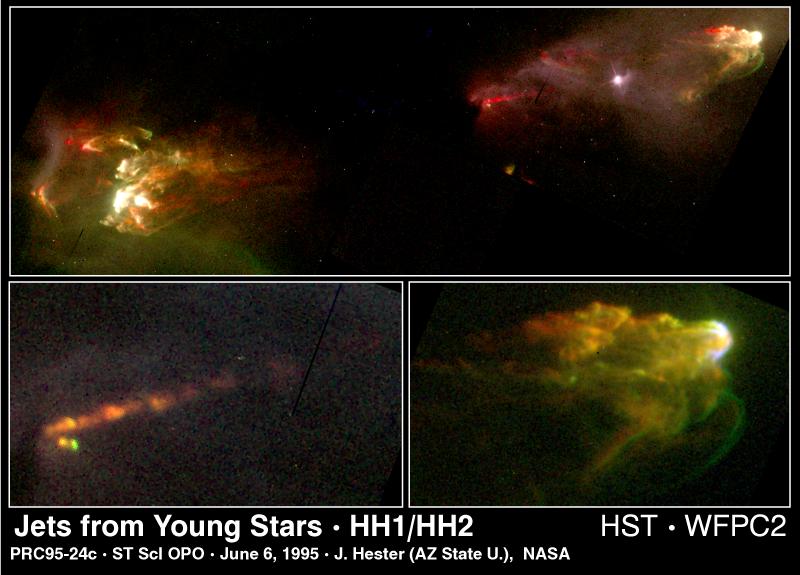
A cloud of interstellar gas and dust collapses and a star is born. At its core temperatures rise, a nuclear furnace ignites, and a rotating dusty disk forms surrounding the newborn star. According to current understanding, as material continues to fall onto the disk it is heated and blasted back out along the disk's axis of rotation, forming a pair of high speed jets. This Hubble Space Telescope image shows two nebulosities at the ends of opposing jets from a young star. The bright blobs at either end are where the jet material has slammed into interstellar gas. Tip to tip, the distance is about one light-year. Located near the Orion Nebula, these nebulosities have catalog designations HH1 and HH2 for their discoverers astronomers George Herbig and Guillermo Haro. The nascent star which produced the jets is in the middle, hidden by a cloud of obscuring dust. Yet the structures and details visible in the star jets offer clues to events which also occured in our own Solar System - when the Sun was formed from a collapsing interstellar cloud 4.5 billion years ago.
Una nube de gas y polvo interestelar se contrae y nace una estrella. En su núcleo las temperaturas aumentan, se enciende un horno nuclear y se forma un disco de polvo en rotación que rodea a la estrella recién nacida. Según la comprensión actual, a medida que la materia continúa cayendo sobre el disco, se calienta y es expulsada a lo largo del eje de rotación del disco, formando un par de chorros de alta velocidad. Esta imagen del Telescopio Espacial Hubble muestra dos nebulosas en los extremos de chorros opuestos provenientes de una estrella joven. Las brillantes concentraciones en cada extremo son los lugares donde el material de los chorros ha chocado contra el gas interestelar. De extremo a extremo, la distancia es de aproximadamente un año luz. Ubicadas cerca de la Nebulosa de Orión, estas nebulosas tienen las designaciones de catálogo HH1 y HH2, en honor a sus descubridores, los astrónomos George Herbig y Guillermo Haro. La estrella naciente que produjo los chorros se encuentra en el centro, oculta por una nube de polvo oscurecedor. Sin embargo, las estructuras y los detalles visibles en los chorros estelares ofrecen pistas sobre eventos que también ocurrieron en nuestro propio Sistema Solar, cuando el Sol se formó a partir de una nube interestelar en contracción hace 4.500 millones de años.