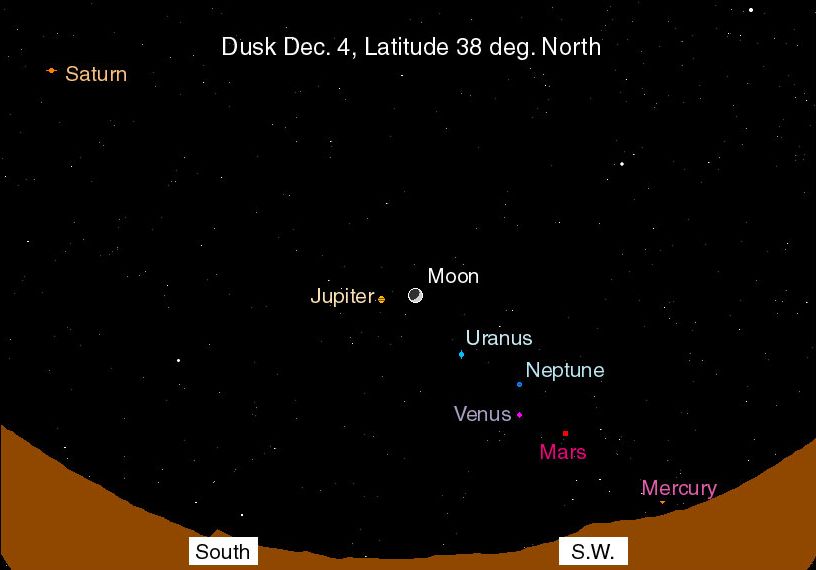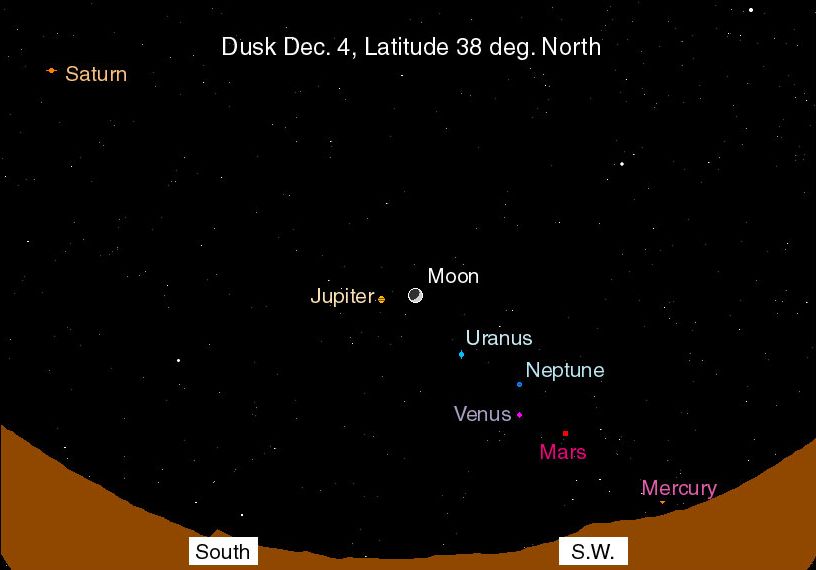
Look up tonight. Just after sunset, the crescent moon and all five "naked-eye" planets (Mercury, Venus, Mars, Jupiter, and Saturn) will be visible (depending on your latitude), lying near our solar system's ecliptic plane. Venus and Jupiter will shine brilliantly as the brightest "stars" in the sky, but Mercury will be near the horizon and hard to see. A pair of binoculars will also reveal Uranus and Neptune and observers with a telescope and a good site may even be able to glimpse faint Pluto just above the Western horizon in the fading twilight (not shown on the chart above). Enjoy this lovely spectacle any clear night through about December 8. A similar gathering is expected in May 2000 but the planets will be hidden from view by the solar glare. A night sky as full of planets as this one will occur again though ... in about 100 years.
Mire hacia arriba esta noche. Justo después del atardecer, la luna creciente y los cinco planetas visibles a simple vista (Mercurio, Venus, Marte, Júpiter y Saturno) serán observables (dependiendo de su latitud), ubicados cerca del plano de la eclíptica de nuestro sistema solar. Venus y Júpiter brillarán intensamente como las "estrellas" más luminosas del cielo, pero Mercurio estará cerca del horizonte y será difícil de observar. Un par de binoculares también permitirá distinguir Urano y Neptuno, y los observadores con telescopio y un buen sitio de observación podrían incluso vislumbrar a Plutón, tenue, justo por encima del horizonte occidental en el crepúsculo menguante (no mostrado en el mapa superior). Disfrute de este hermoso espectáculo cualquier noche despejada hasta aproximadamente el 8 de diciembre. Se espera una reunión similar en mayo del año 2000, pero los planetas estarán ocultos a la vista por el resplandor solar. Un cielo nocturno tan lleno de planetas como este volverá a ocurrir... en aproximadamente 100 años.