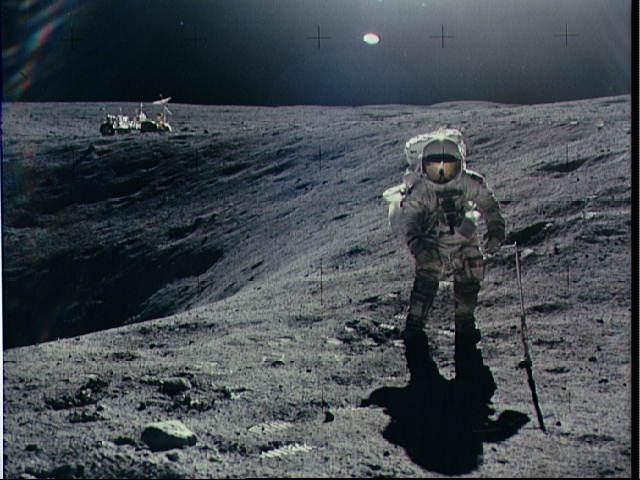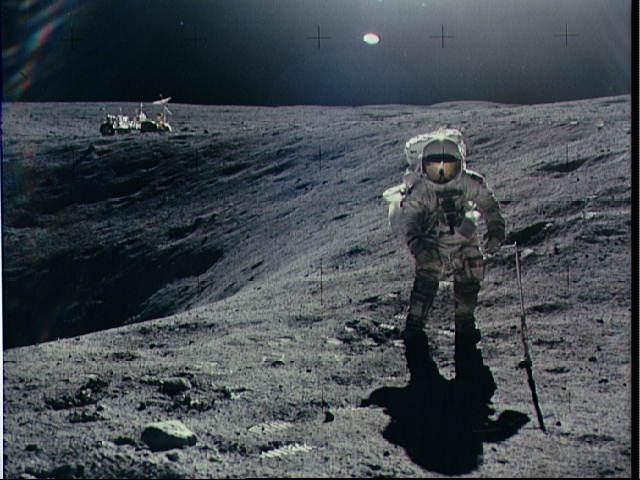
Apollo 16 spent three days on Earth's Moon in April 1972. The fifth lunar landing mission out of six, Apollo 16 was famous for deploying and using an ultraviolet telescope as the first lunar observatory, and for collecting rocks and data on the mysterious lunar highlands. In the above picture, astronaut John W. Young photographs Charles M. Duke, Jr. collecting rock samples at the Descartes landing site. Duke stands by Plum Crater while the Lunar Roving Vehicle waits parked in the background. The Lunar Roving Vehicle allowed the astronauts to travel great distances to investigate surface features and collect rocks. High above, Thomas K. Mattingly orbits in the Command Module.
El Apolo 16 pasó tres días en la Luna de la Tierra en abril de 1972. Como quinta misión de alunizaje de un total de seis, el Apolo 16 fue célebre por desplegar y utilizar un telescopio ultravioleta como primer observatorio lunar, y por recolectar rocas y datos sobre las misteriosas tierras altas lunares. En la imagen, el astronauta John W. Young fotografía a Charles M. Duke, Jr. mientras este recolecta muestras de rocas en el sitio de aterrizaje de Descartes. Duke se encuentra junto al Cráter Plum mientras el Vehículo Explorador Lunar aguarda estacionado al fondo. El Vehículo Explorador Lunar permitió a los astronautas desplazarse grandes distancias para investigar accidentes geográficos de la superficie y recolectar rocas. En lo alto, Thomas K. Mattingly orbitaba en el Módulo de Mando.