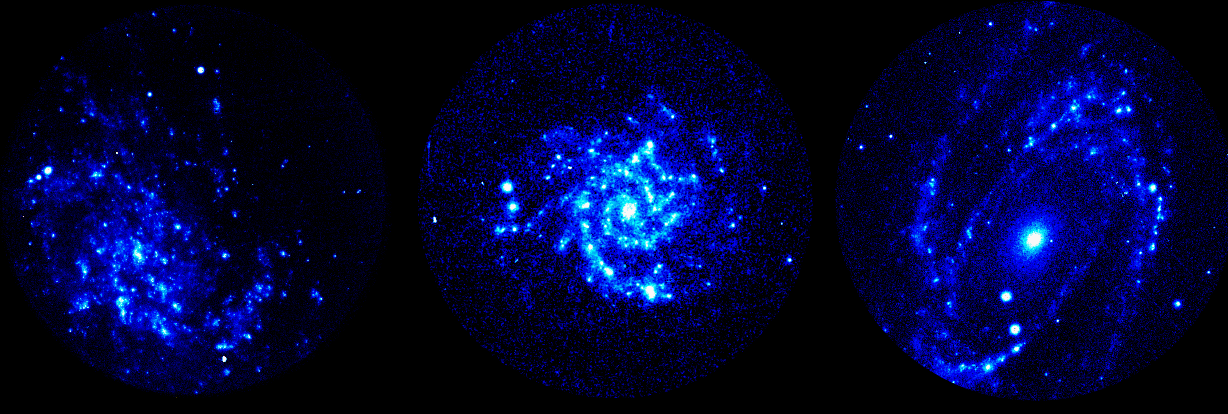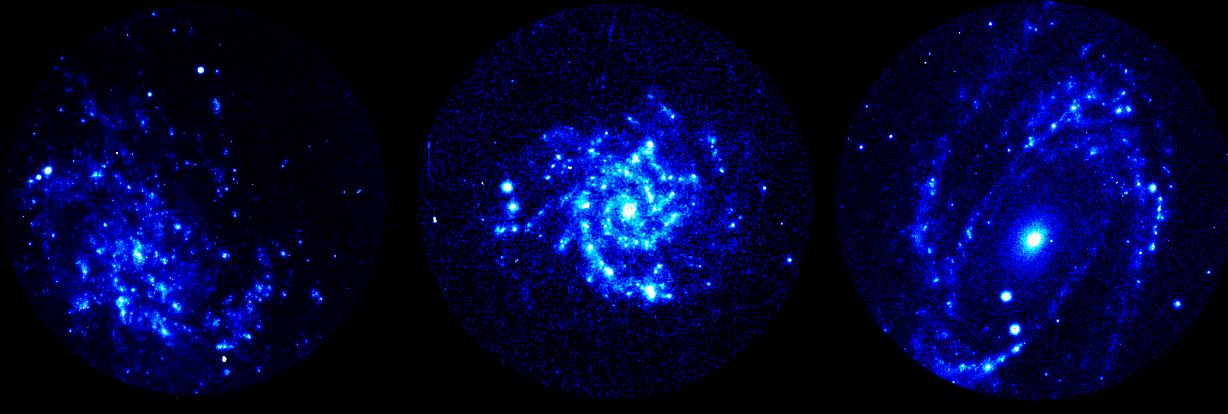
A progression of beautiful spiral galaxies is illustrated above with three photographs from NASA's Ultraviolet Imaging Telescope (UIT). Flying above the Earth's obscuring layer of atmosphere on the Space Shuttle Columbia during the Astro-1 mission in 1990, UIT's cameras were able to image these distant spirals in the ultraviolet light produced by hot, young stars. These bright stars, newly condensed from gas and dust clouds, give away the location of the spiral arms they are born in. Because they are massive (many times the mass of the Sun), they are shortlived. Dying and fading before they move too far from their birth place they make excellent tracers of spiral structure. From left to right the galaxies are known as M33, M74, and M81 and have progressively more tightly wound spiral arms. Astronomers would classify these as Scd, Sc, and Sb type spirals using a galaxy classification scheme first worked out by Edwin Hubble.
Una progresión de hermosas galaxias espirales se ilustra arriba con tres fotografías del Telescopio de Imágenes Ultravioleta (UIT) de la NASA. Volando por encima de la capa opaca de la atmósfera terrestre a bordo del transbordador espacial Columbia durante la misión Astro-1 en 1990, las cámaras del UIT fueron capaces de capturar imágenes de estas espirales distantes en la luz ultravioleta producida por estrellas jóvenes y calientes. Estas estrellas brillantes, recientemente condensadas a partir de nubes de gas y polvo, revelan la ubicación de los brazos espirales en los que nacen. Dado que son masivas (muchas veces la masa del Sol), tienen una vida corta. Al morir y desvanecerse antes de alejarse demasiado de su lugar de nacimiento, constituyen excelentes trazadoras de la estructura espiral. De izquierda a derecha, las galaxias se conocen como M33, M74 y M81, y presentan brazos espirales progresivamente más cerrados. Los astrónomos clasificarían estas galaxias como espirales de tipo Scd, Sc y Sb, utilizando un esquema de clasificación de galaxias elaborado por primera vez por Edwin Hubble.