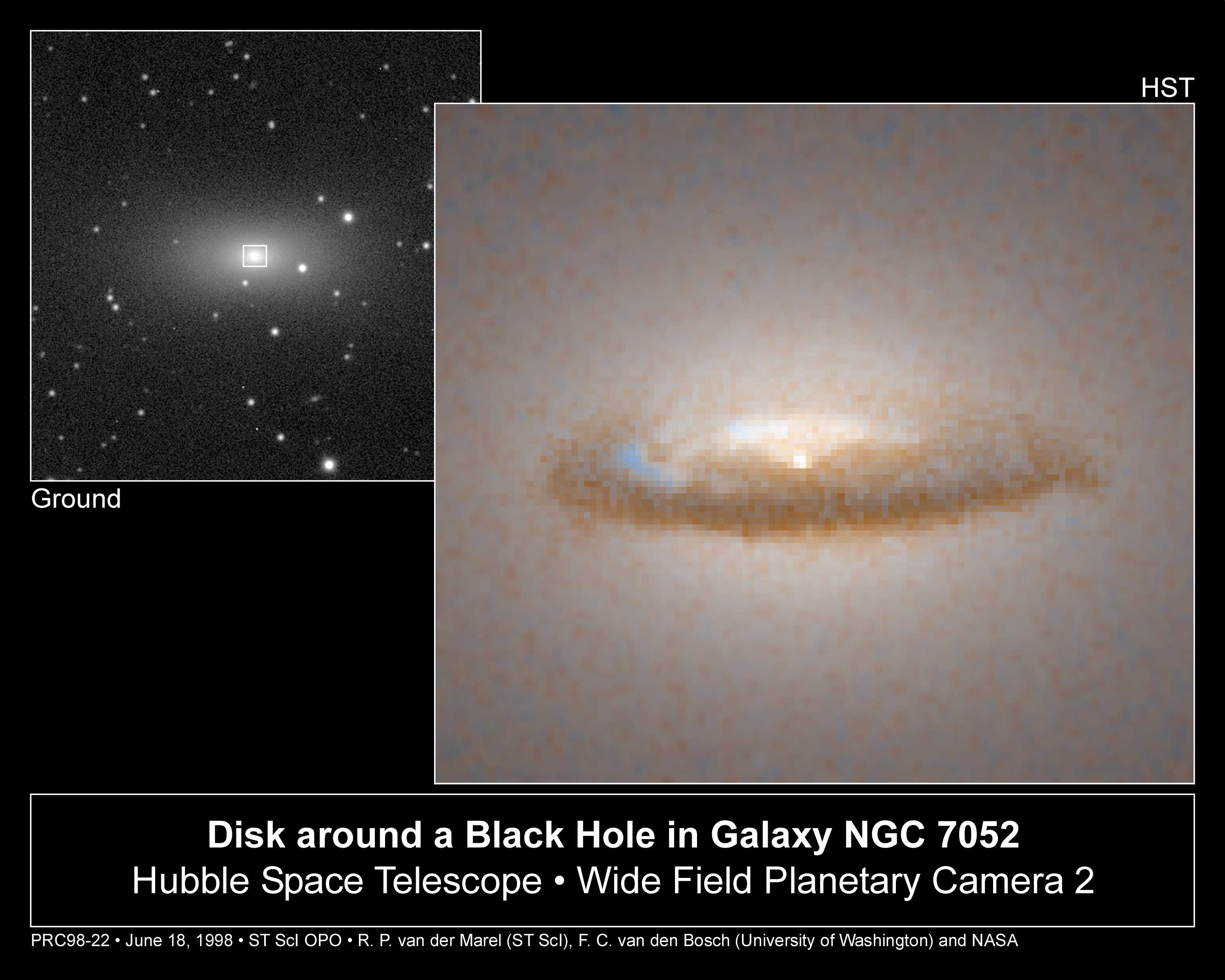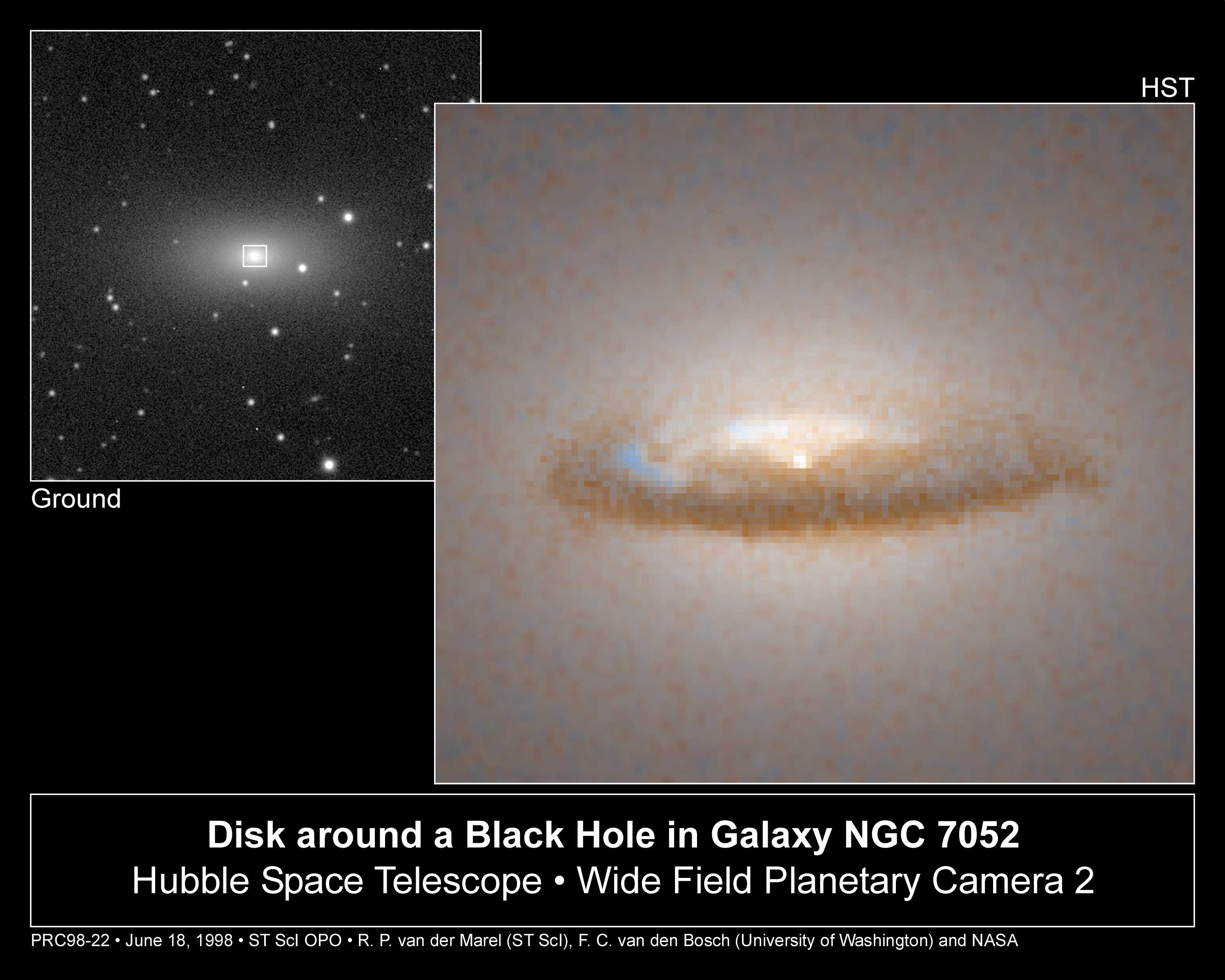
What created the dust disk in the center of NGC 7052, and what keeps it spinning? Although the disk might appear as a relatively tame "hubcap in space", the unusual center of elliptical galaxy NGC 7052 is probably the remnant of a titanic collision between galaxies. What's more, the disk's spin indicates the tremendous gravity of a massive central black hole. Analysis of this recently released photo by the Hubble Space Telescope indicates that the disk is thousands of light-years across, rotates faster than 100 kilometers per second, at a distance of 150 light-years from the center, and contains more mass than a million Suns. The theorized central black hole is thought to be yet 100 times more massive, and may swallow the entire disk in the next few million years.
¿Qué originó el disco de polvo en el centro de NGC 7052, y qué lo mantiene en rotación? Aunque el disco podría parecer una relativamente apacible "tapa de rueda en el espacio", el inusual centro de la galaxia elíptica NGC 7052 es probablemente el remanente de una titánica colisión entre galaxias. Es más, la rotación del disco revela la tremenda gravedad de un masivo agujero negro central. El análisis de esta fotografía recientemente publicada por el Telescopio Espacial Hubble indica que el disco abarca miles de años-luz de diámetro, rota a más de 100 kilómetros por segundo a una distancia de 150 años-luz del centro, y contiene una masa superior a la de un millón de Soles. Se estima que el agujero negro central teorizado es aún 100 veces más masivo, y podría engullir el disco completo en los próximos pocos millones de años.