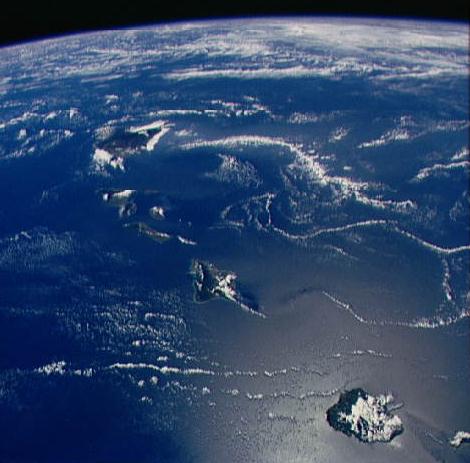
Aloha! With the graceful arc of the Earth's limb in the background, the Hawaiian Island archipelago is visible in this stunning photo taken by the astronauts onboard the shuttle Discovery in October of 1988. Along with popular beaches and tropical resorts, these volcanic islands offer extreme elevations with dark, dry, cloudless skies. Consequently they have also become popular sites for large and sophisticated ground based telescopes. The peak of Mauna Kea, on the Big Island (upper left), boasts an impressive array of astronomical instruments including the Keck, the Canada-France-Hawaii Telescope, the NASA IRTF, the JCMT and UKIRT, and the Gemini Telescope Project. The dormant volcanic cone of Haleakala on Maui (just below the Big Island) is home to the Air Force Maui Optical Station and the Mees Solar Observatory. Mahalo nui loa!
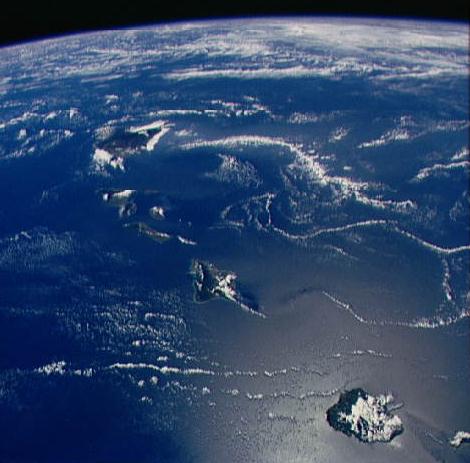
¡Aloha! Con el grácil arco del horizonte terrestre como fondo, el archipiélago de las islas Hawaianas es visible en esta impresionante fotografía tomada por los astronautas a bordo del transbordador Discovery en octubre de 1988. Además de sus populares playas y centros turísticos tropicales, estas islas volcánicas ofrecen grandes elevaciones con cielos oscuros, secos y despejados. Por ello, también se han convertido en sitios populares para telescopios terrestres de gran tamaño y alta sofisticación. La cima del Mauna Kea, en la Isla Grande (parte superior izquierda), alberga una impresionante colección de instrumentos astronómicos, entre ellos el Keck, el Canada-France-Hawaii Telescope, el NASA IRTF, el JCMT y el UKIRT, y el Gemini Telescope Project. El cono volcánico inactivo del Haleakalā, en Maui (justo debajo de la Isla Grande), es sede del Air Force Maui Optical Station y del Mees Solar Observatory. ¡Mahalo nui loa!