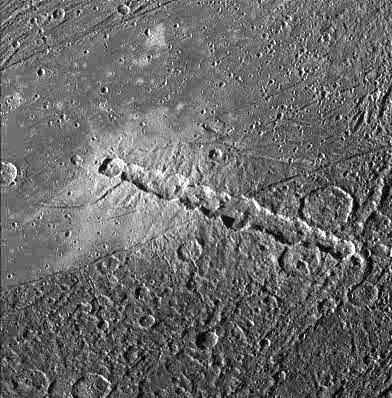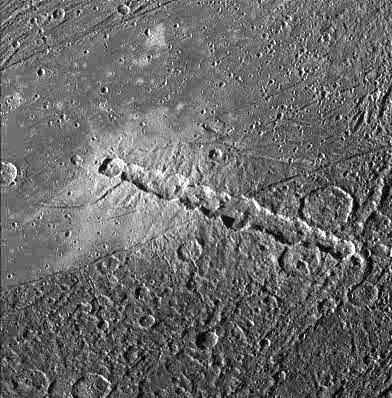
This remarkable line of 13 closely spaced craters on Jupiter's moon Ganymede was photographed by the Galileo spacecraft in 1997. The picture covers an area about 120 miles wide and the chain of craters cuts across a sharp boundary between dark and light terrain. What caused this crater chain? During the exploration of the Solar System, crater chains like this one have been discovered in several places and were considered mysterious until a dramatic object lesson was offered by comet Shoemaker-Levy 9. In 1994 many denizens of planet Earth watched as huge pieces of this torn comet slammed into Jupiter itself in a spectacular series of sequential impacts. It is very likely that similar torn comets from the early history of the Solar System are responsible for this and other crater chains.
Esta notable alineación de 13 cráteres estrechamente espaciados en Ganímedes, luna de Júpiter, fue fotografiada por la sonda Galileo en 1997. La imagen cubre un área de aproximadamente 190 kilómetros de ancho, y la cadena de cráteres atraviesa una marcada frontera entre terreno oscuro y terreno claro. ¿Qué originó esta cadena de cráteres? Durante la exploración del Sistema Solar, cadenas de cráteres como esta fueron descubiertas en varios lugares y permanecieron como un misterio hasta que el cometa Shoemaker-Levy 9 ofreció una espectacular lección objetiva. En 1994, numerosos habitantes del planeta Tierra observaron cómo enormes fragmentos de este cometa destrozado impactaron contra el propio Júpiter en una espectacular serie de impactos secuenciales. Es muy probable que cometas similares, desintegrados durante los primeros tiempos del Sistema Solar, sean los responsables de esta y otras cadenas de cráteres.