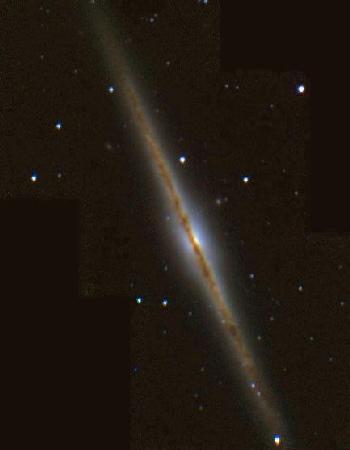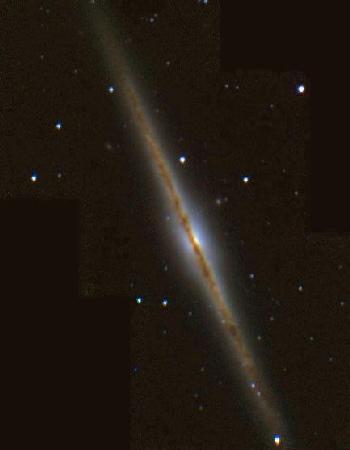
Is our Galaxy this thin? We believe so. The Milky Way, like NGC 891 pictured above, has the width of a typical spiral galaxy. Spirals have most of their bright stars, gas, and obscuring dust in a thin disk. This disk can be so thin the spiral galaxy appears edge-on like a compact disk seen sideways. The dark band across the middle is a lane of dust which absorbs light. Some of the billions of stars that orbit the center of NGC 891, however, appear to be moving too fast to just be traveling in circles. What causes this peculiar motion? One hypothesis is that NGC 891 has a large bar across its center -- a bar that would be obvious were we to see this galaxy face-on instead of edge-on. This false color picture was constructed from 3 near infrared images.
¿Es nuestra Galaxia tan delgada? Así lo creemos. La Vía Láctea, al igual que NGC 891 mostrada arriba, tiene el grosor típico de una galaxia espiral. Las espirales concentran la mayor parte de sus estrellas brillantes, gas y polvo oscurecedor en un disco muy delgado. Este disco puede ser tan delgado que la galaxia espiral aparezca de perfil, como un disco compacto visto de lado. La banda oscura que cruza el centro es un surco de polvo que absorbe la luz. Sin embargo, algunas de las miles de millones de estrellas que orbitan el centro de NGC 891 parecen moverse demasiado rápido como para simplemente estar describiendo círculos. ¿Qué causa este movimiento peculiar? Una hipótesis es que NGC 891 tiene una gran barra atravesando su centro — una barra que sería evidente si pudiéramos ver esta galaxia de cara en lugar de de perfil. Esta imagen en falso color fue construida a partir de 3 imágenes en infrarrojo cercano.