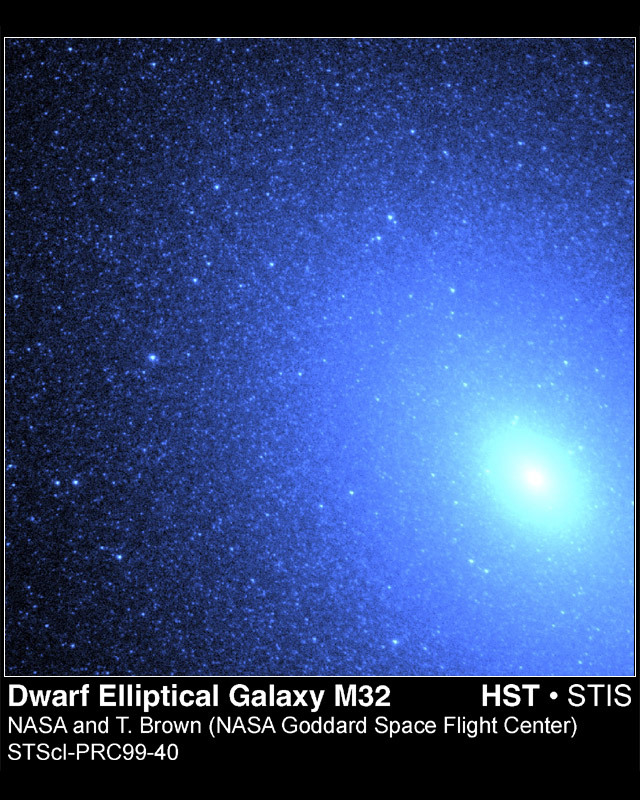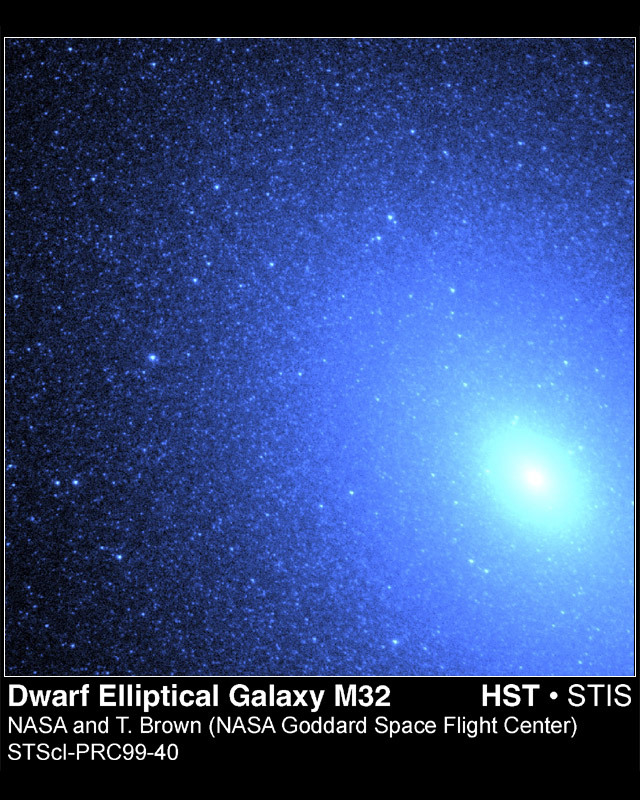
cal galaxies are known for their old, red stars. But is this old elliptical up to new tricks? In recent years, the centers of elliptical galaxies have been found to emit unexpectedly high amounts of blue and ultraviolet light. Most blue light from spiral galaxies originates from massive young hot stars, in contrast to the red light from the old cool stars thought to compose ellipticals. In the above recently released, false-color photograph by the Hubble Space Telescope, the center of nearby dwarf elliptical M32 has actually been resolved and does indeed show thousands of bright blue stars. The answer is probably that these blue stars are also old and glow blue, reaching relatively high temperatures by the advanced process of fusing helium, rather than hydrogen, in their cores. M32 appears in many pictures as the companion galaxy to the massive Andromeda Galaxy (M31).
Las galaxias elípticas son conocidas por sus estrellas antiguas y rojizas. Pero, ¿está acaso esta vieja galaxia elíptica adoptando nuevos comportamientos? En años recientes, se ha descubierto que los centros de las galaxias elípticas emiten cantidades inesperadamente elevadas de luz azul y ultravioleta. La mayor parte de la luz azul proveniente de las galaxias espirales tiene su origen en estrellas masivas, jóvenes y calientes, en contraste con la luz roja de las estrellas antiguas y frías que se creía componían las galaxias elípticas. En la fotografía de color falso recientemente publicada por el Telescopio Espacial Hubble que se muestra arriba, el centro de la cercana galaxia elíptica enana M32 ha sido efectivamente resuelto y muestra, en efecto, miles de estrellas azules brillantes. La respuesta probable es que estas estrellas azules también son antiguas y brillan en azul, alcanzando temperaturas relativamente altas mediante el proceso avanzado de fusión de helio —en lugar de hidrógeno— en sus núcleos. M32 aparece en numerosas imágenes como la galaxia compañera de la masiva Galaxia de Andrómeda (M31).