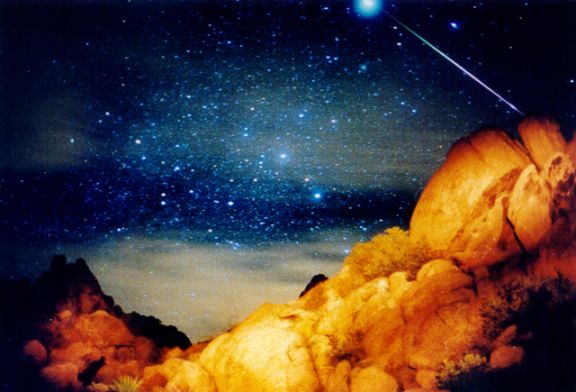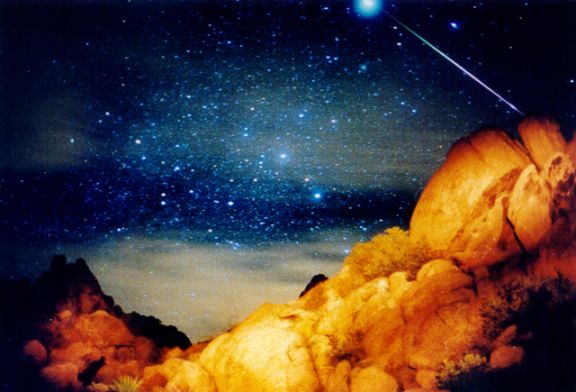
In the sky or on the web, did you watch this year's Leonid meteor shower? If you did, meteors flashing through the night sky should be a familiar sight. Recorded last year during the 1998 apparition of the Leonids, this time-exposure of the sky around the constellation Canis Major (big dog) shows the trail of a spectacular fireball meteor. The meteor, by chance, seems to leap from the constellation's brightest star Sirius, near the top right. In the foreground is the beautiful desert scenery of Joshua Tree National Park. At this year's peak of the cosmic dust storm, observers in Europe and Africa reported intense rates of over 1600 meteors per hour for a brief period near 0215 November 18 (UTC). Awe inspiring as they were, the Leonids posed no danger to earthbound skywatchers.
En el cielo o en la web, ¿observaste la lluvia de meteoros Leónidas de este año? Si lo hiciste, los meteoros cruzando el cielo nocturno deberían ser una imagen familiar. Registrado el año pasado durante la aparición de las Leónidas de 1998, este posado de larga exposición del cielo alrededor de la constelación de Canis Major (el Can Mayor) muestra la estela de un espectacular bólido meteórico. El meteoro, por azar, parece saltar desde la estrella más brillante de la constelación, Sirio, cerca de la esquina superior derecha. En primer plano se aprecia el hermoso paisaje desértico del Parque Nacional Joshua Tree. En el momento de mayor intensidad de esta tormenta de polvo cósmico de este año, observadores en Europa y África reportaron tasas de más de 1600 meteoros por hora durante un breve período alrededor de las 02:15 del 18 de noviembre (UTC). Tan impresionantes como fueron, las Leónidas no representaron ningún peligro para los observadores terrestres.