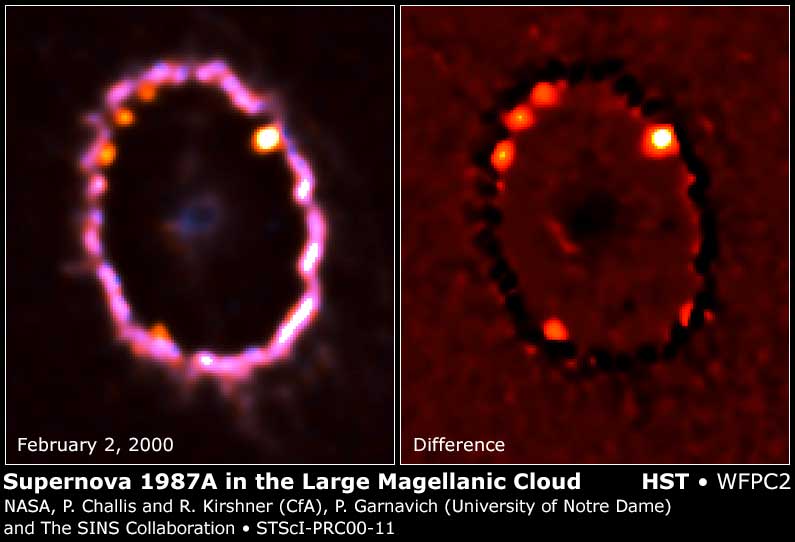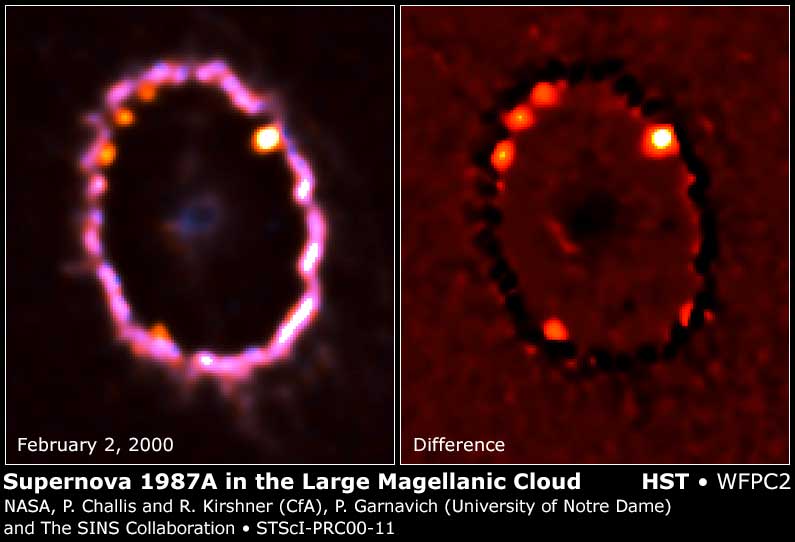
In February of 1987, astronomers witnessed the brightest supernova of modern times - supernova 1987A in the Large Magellanic Cloud. Mysterious rings of material surrounding the expanding stellar debris were soon emitting a visible glow excited by intense light from the explosion. After fading over the intervening years, the interior ring has just been seen to sprout four new hotspots, as illustrated in these two versions of a Hubble Space Telescope image recorded on February 2nd. The abrupt appearance of the new features suggests that matter from the stellar blast wave itself has begun to slam into the ring in earnest, shock-heating the gas and producing the bright hotspots. The left-hand picture shows the glowing ring, initially excited by light from the explosion, along with the shocked hotspots. The right-hand picture has been further computer enhanced to emphasize the hotspots. The brightest spot at the right was first observed in 1997, while the four spots on the left half of the ring are new. Astronomers now eagerly anticipate a dramatic rejuvenation of the glowing ring as the bulk of the blast wave material, traveling at about 60 million kilometers per hour, continues to plow into it.
En febrero de 1987, los astrónomos fueron testigos de la supernova más brillante de los tiempos modernos: la supernova 1987A, ubicada en la Gran Nube de Magallanes. Los misteriosos anillos de material que rodean los restos estelares en expansión comenzaron a emitir pronto un resplandor visible, excitado por la intensa luz de la explosión. Tras ir desvaneciendo su brillo a lo largo de los años siguientes, se ha observado recientemente que el anillo interior ha desarrollado cuatro nuevos puntos calientes, tal como se ilustra en estas dos versiones de una imagen del Telescopio Espacial Hubble registrada el 2 de febrero. La aparición repentina de estas nuevas estructuras sugiere que la materia procedente de la onda de choque de la explosión estelar ha comenzado a colisionar con fuerza contra el anillo, calentando el gas por efecto del choque y generando los brillantes puntos calientes. La imagen de la izquierda muestra el anillo luminoso, inicialmente excitado por la luz de la explosión, junto con los puntos calientes producidos por el choque. La imagen de la derecha ha sido procesada computacionalmente para realzar dichos puntos calientes. El punto más brillante, situado a la derecha, fue observado por primera vez en 1997, mientras que los cuatro puntos en la mitad izquierda del anillo son nuevos. Los astrónomos aguardan ahora con gran expectación una espectacular reactivación del anillo luminoso, a medida que la mayor parte del material de la onda de choque, que viaja a unos 60 millones de kilómetros por hora, continúa impactando contra él.