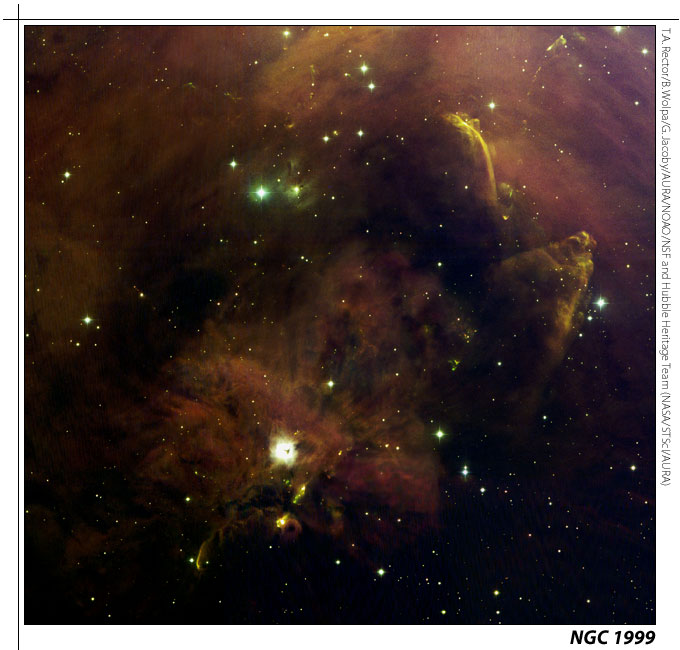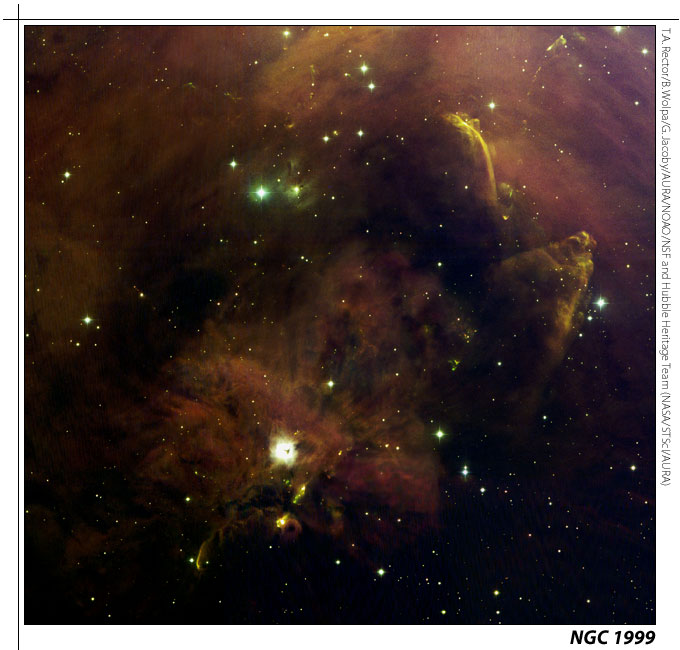
New stars, fast jets, and shocked gas clouds all occupy Orion A, a giant molecular cloud just south of the Orion Nebula. The bright object visible below and slightly left of center of this recently released picture is the reflection nebula NGC 1999. Wind from NGC 1999's central star, V380 Orionis, appears to have created the surrounding billows of red and brown gas. Several bright young stars illuminate reflecting dust at the top right of the image. Jets shoot from dozens of young stars creating glowing compressed shocked waves known Herbig-Haro objects. One such shock is the unusual Waterfall, the bright streak on the upper right, which is a source of unusual radio waves. The cone-shaped shock to the Waterfall's lower right may result from a jet emitted HH1 and HH2, located 10 light-years away below NGC 1999. The unusual and energetic oddities that occur and interact in star forming regions are often as complex as they are beautiful.
Estrellas nuevas, chorros de alta velocidad y nubes de gas en choque coexisten en Orion A, una nube molecular gigante ubicada justo al sur de la Nebulosa de Orión. El objeto brillante visible por debajo y ligeramente a la izquierda del centro de esta imagen recientemente publicada es la nebulosa de reflexión NGC 1999. El viento procedente de la estrella central de NGC 1999, V380 Orionis, parece haber creado los billones de gas rojo y marrón que la rodean. Varias estrellas jóvenes y brillantes iluminan el polvo reflectante en la parte superior derecha de la imagen. Chorros emitidos por docenas de estrellas jóvenes generan ondas de choque comprimidas y luminosas conocidas como objetos Herbig-Haro. Uno de estos choques es la inusual Cascada (Waterfall), la franja brillante en la parte superior derecha, que es una fuente de ondas de radio poco comunes. El choque de forma cónica situado en la parte inferior derecha de la Cascada podría ser resultado de un chorro emitido por HH1 y HH2, ubicados a 10 años luz de distancia por debajo de NGC 1999. Las curiosidades inusuales y energéticas que ocurren e interactúan en las regiones de formación estelar son tan complejas como hermosas.