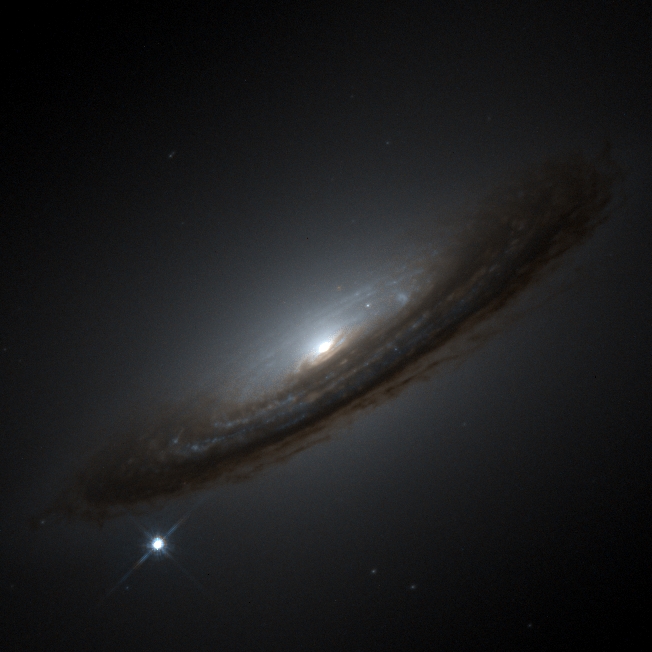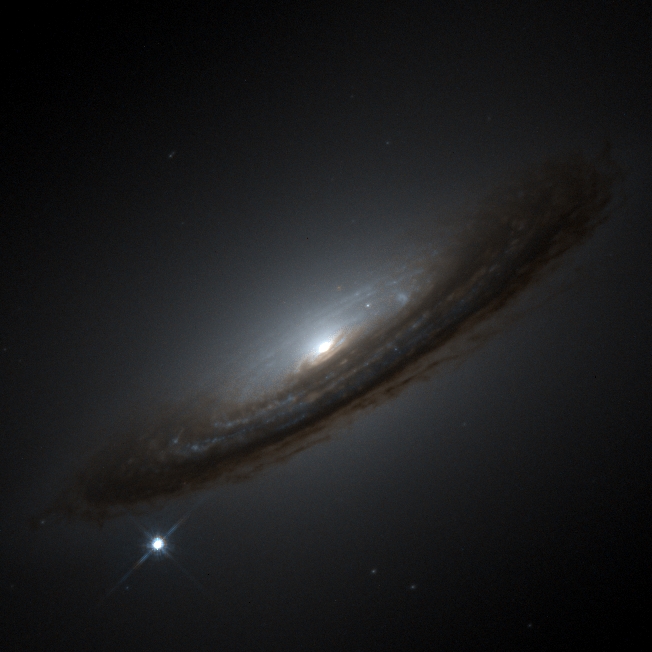
Far away, long ago, a star exploded. Supernova 1994D, visible as the bright spot on the lower left, occurred in the outskirts of disk galaxy NGC 4526. Supernova 1994D was not of interest for how different it was, but rather for how similar it was to other supernovae. In fact, the light emitted during the weeks after its explosion caused it to be given the familiar designation of a Type Ia supernova. If all Type 1a supernovae have the same intrinsic brightness, then the dimmer a supernova appears, the farther away it must be. By calibrating a precise brightness-distance relation, astronomers are able to estimate not only the expansion rate of the universe (parameterized by the Hubble Constant), but also the geometry of the universe we live in (parameterized by Omega and Lambda). The large number and great distances to supernovae measured over the past few years have been interpreted as indicating that we live in a previously unexpected universe.
Hace mucho tiempo y muy lejos, una estrella explotó. La Supernova 1994D, visible como el punto brillante en la parte inferior izquierda, ocurrió en los bordes de la galaxia de disco NGC 4526. La Supernova 1994D no fue de interés por sus diferencias respecto a otras supernovas, sino por sus similitudes con ellas. De hecho, la luz emitida durante las semanas posteriores a su explosión llevó a clasificarla con la conocida designación de supernova de Tipo Ia. Si todas las supernovas de Tipo Ia tienen el mismo brillo intrínseco, entonces cuanto más tenue aparezca una supernova, más lejos debe encontrarse. Al calibrar una relación precisa entre brillo y distancia, los astrónomos pueden estimar no solo la tasa de expansión del universo (parametrizada por la Constante de Hubble), sino también la geometría del universo en que vivimos (parametrizada por Omega y Lambda). El gran número de supernovas y las enormes distancias a las que se han medido durante los últimos años han sido interpretados como indicativos de que vivimos en un universo previamente inesperado.