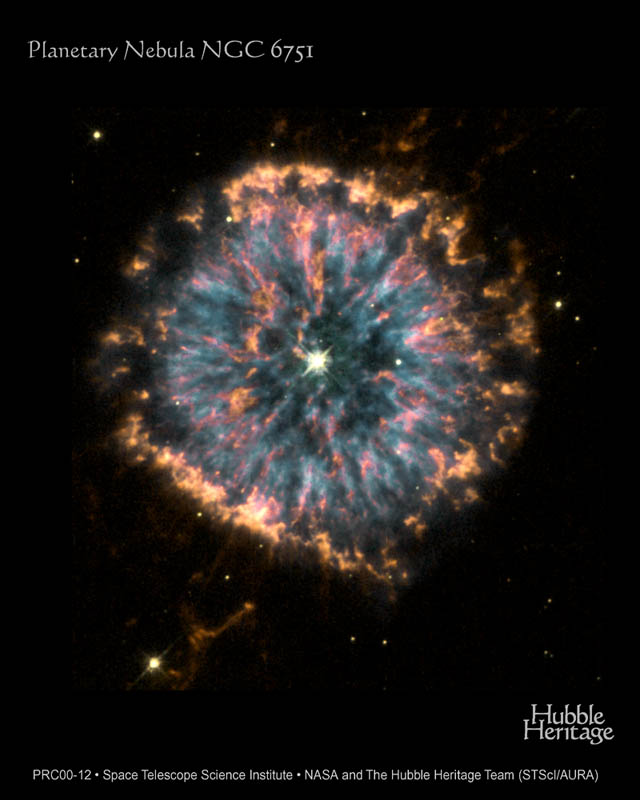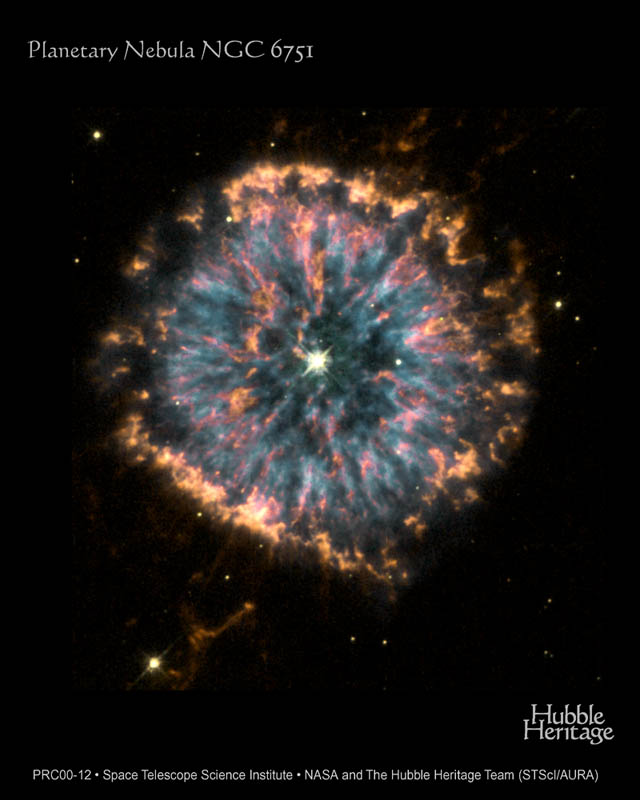
Planetary nebulae do look simple, round, and planet-like in small telescopes. But images from the orbiting Hubble Space Telescope have become well known for showing these fluorescent gas shrouds of dying Sun-like stars to possess a staggering variety of detailed symmetries and shapes. This composite color Hubble image of NGC 6751 is a beautiful example of a classic planetary nebula with complex features and was selected to commemorate the tenth anniversary of Hubble in orbit. The colors were chosen to represent the relative temperature of the gas - blue, orange, and red indicating the hottest to coolest gas. Winds and radiation from the intensely hot central star (140,000 degrees Celsius) have apparently created the nebula's streamer-like features. The nebula's actual diameter is approximately 0.8 light-years or about 600 times the size of our solar system. NGC 6751 is 6,500 light-years distant in the constellation Aquila.
Las nebulosas planetarias parecen simples, redondas y similares a planetas cuando se observan con telescopios pequeños. Sin embargo, las imágenes del Telescopio Espacial Hubble en órbita se han hecho famosas por revelar que estos mantos de gas fluorescente que envuelven a estrellas moribundas similares al Sol poseen una asombrosa variedad de simetrías y formas detalladas. Esta imagen compuesta en color del Hubble de NGC 6751 es un hermoso ejemplo de una nebulosa planetaria clásica con características complejas, y fue seleccionada para conmemorar el décimo aniversario del Hubble en órbita. Los colores fueron elegidos para representar la temperatura relativa del gas: el azul, el naranja y el rojo indican el gas más caliente al más frío, respectivamente. Los vientos y la radiación provenientes de la estrella central intensamente caliente (140.000 grados Celsius) parecen haber creado las estructuras filamentosas de la nebulosa. El diámetro real de la nebulosa es de aproximadamente 0,8 años luz, es decir, unas 600 veces el tamaño de nuestro sistema solar. NGC 6751 se encuentra a 6.500 años luz de distancia, en la constelación de Aquila.