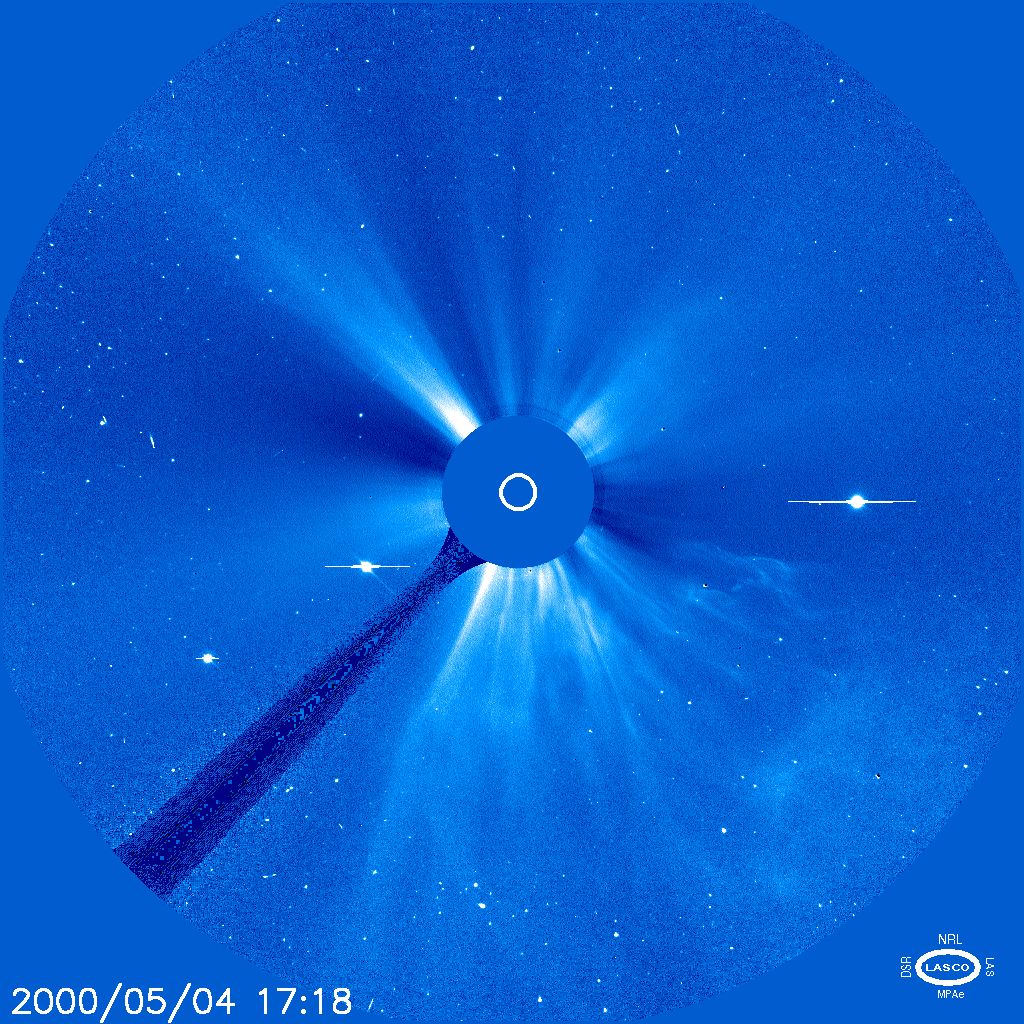
Today, all five naked-eye planets (Mercury, Venus, Mars, Jupiter, Saturn) plus the Moon and the Sun will at least approximately line-up. As viewed from planet Earth, they will be clustered within about 26 degrees, the closest alignment for all these celestial bodies since February 1962, when there was a solar eclipse! Such planetary alignments are not dangerous, except of course that the Sun might hurt your eyes when you look at it. So it might be easier to appreciate today's solar system spectacle if you use a space-based coronagraph ... like the LASCO instrument onboard the SOHO observatory. In this recent LASCO image, an occulting disk supported by a structure seen projecting from the lower left blocks out the overwhelming sunlight. It shows three of the planets along with the Sun's location and bright solar wind regions against a background of stars, but Mars and Venus are unfortunately outside LASCO's roughly 15 degree field of view. The horizontal bars through the planets are digital image artifacts. And what about the Moon? The SOHO spacecraft is positioned well beyond lunar orbit where its view of the Sun is never interrupted by the Moon.
Hoy, los cinco planetas visibles a simple vista (Mercurio, Venus, Marte, Júpiter y Saturno), junto con la Luna y el Sol, se alinearán al menos de forma aproximada. Vistos desde la Tierra, estarán agrupados en un arco de unos 26 grados, constituyendo la alineación más cercana de todos estos cuerpos celestes desde febrero de 1962, ¡cuando ocurrió un eclipse solar! Tales alineaciones planetarias no son peligrosas, salvo que, por supuesto, el Sol podría dañar sus ojos si lo mira directamente. Por ello, puede resultar más sencillo apreciar el espectáculo del sistema solar de hoy utilizando un coronógrafo espacial... como el instrumento LASCO a bordo del observatorio SOHO. En esta imagen reciente de LASCO, un disco ocultador sostenido por una estructura visible que se proyecta desde la parte inferior izquierda bloquea la abrumadora luz solar. La imagen muestra tres de los planetas junto con la posición del Sol y brillantes regiones de viento solar sobre un fondo de estrellas; sin embargo, Marte y Venus se encuentran desafortunadamente fuera del campo visual de LASCO, que abarca aproximadamente 15 grados. Las barras horizontales sobre los planetas son artefactos digitales de la imagen. ¿Y qué hay de la Luna? La nave espacial SOHO se encuentra posicionada mucho más allá de la órbita lunar, por lo que su vista del Sol nunca es interrumpida por la Luna.