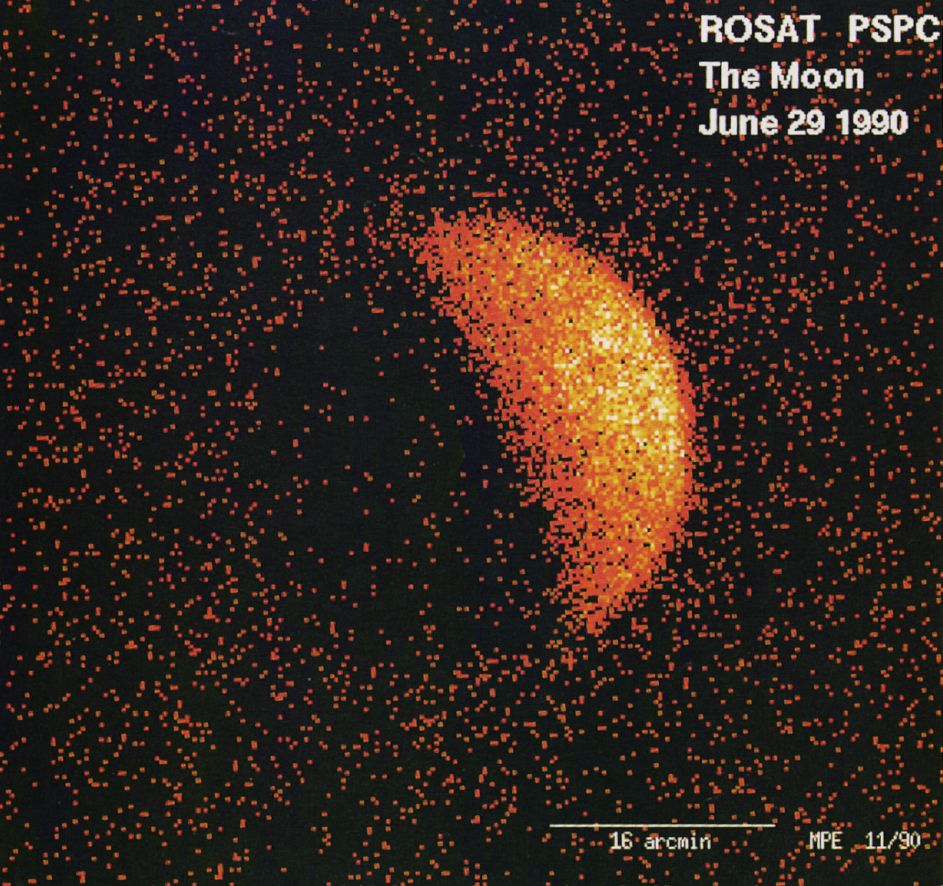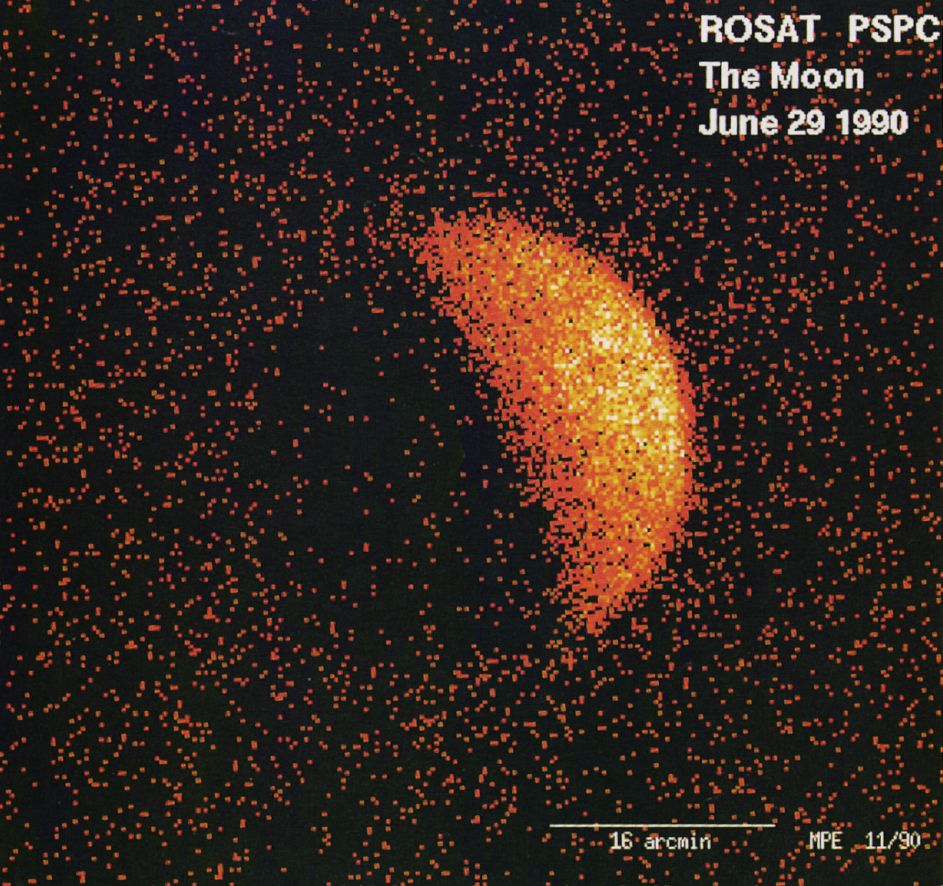
This x-ray image of the Moon was made by the orbiting ROSAT (Röntgensatellit) Observatory in 1990. In this digital picture, pixel brightness corresponds to x-ray intensity. Consider the image in three parts: the bright hemisphere of the x-ray moon, the darker half of the moon, and the x-ray sky background. The bright lunar hemisphere shines in x-rays because it reflects x-rays emitted by the sun ... just as it shines at night by reflecting visible sunlight. The background sky has an x-ray glow in part due to the myriad of distant, powerful active galaxies, unresolved in the ROSAT picture but recently detected in Chandra Observatory x-ray images. But why isn't the dark half of the moon completely dark? It's true that the dark lunar face is in shadow and so is not reflecting solar x-rays. Still, the few x-ray photons which seem to come from the moon's dark half are currently thought to be caused by energetic particles in the solar wind bombarding the lunar surface.
Esta imagen de rayos X de la Luna fue tomada por el observatorio en órbita ROSAT (Röntgensatellit) en 1990. En esta imagen digital, el brillo de cada píxel corresponde a la intensidad de los rayos X. Considere la imagen en tres partes: el hemisferio brillante de la Luna en rayos X, la mitad más oscura de la Luna y el fondo del cielo en rayos X. El hemisferio lunar brillante resplandece en rayos X porque refleja los rayos X emitidos por el Sol... del mismo modo que brilla por las noches al reflejar la luz solar visible. El fondo del cielo presenta un resplandor en rayos X debido, en parte, a la miríada de lejanas y poderosas galaxias activas, no resueltas en la imagen del ROSAT pero detectadas recientemente en imágenes de rayos X del Observatorio Chandra. Pero, ¿por qué la mitad oscura de la Luna no está completamente oscura? Es cierto que la cara oscura de la Luna se encuentra en sombra y, por lo tanto, no refleja los rayos X solares. Sin embargo, los escasos fotones de rayos X que parecen provenir de la mitad oscura de la Luna se atribuyen actualmente al bombardeo de la superficie lunar por partículas energéticas del viento solar.