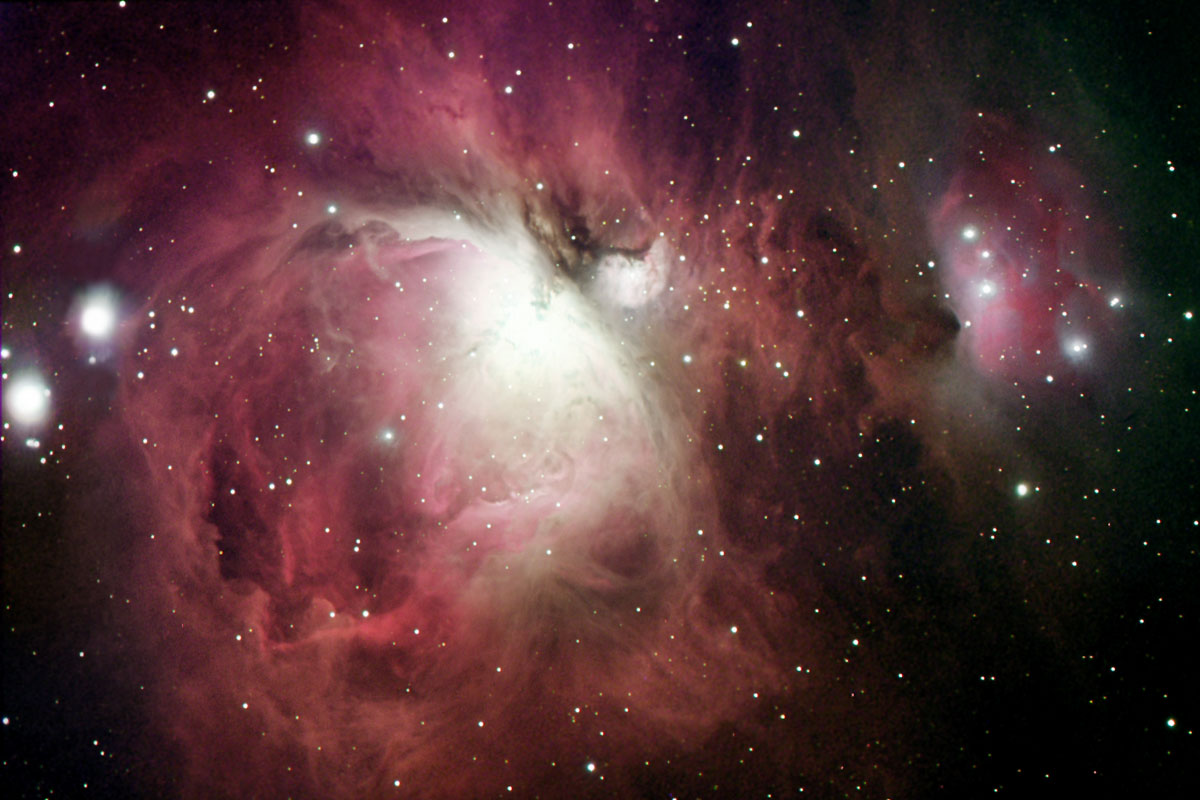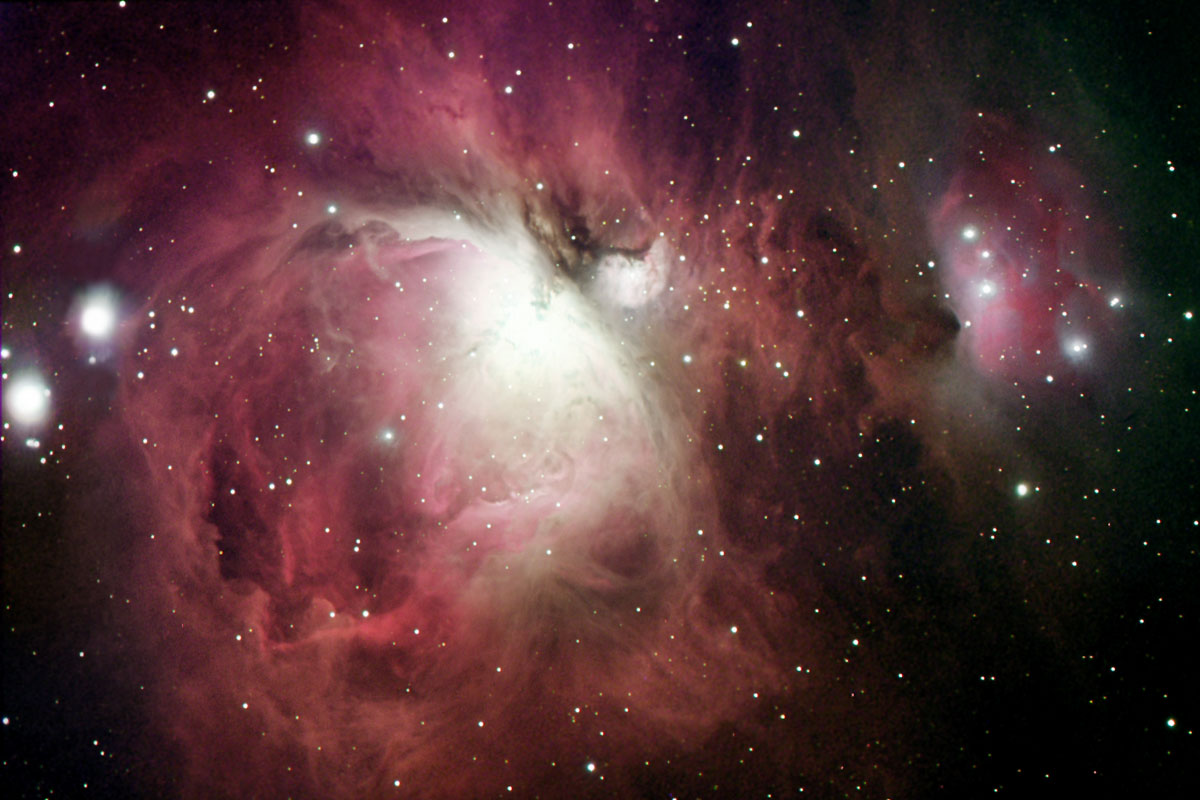
The Great Nebula in Orion can be found just below and to the left of the easily identifiable belt of three stars in the popular constellation Orion. This fuzzy patch, visible to the unaided eye, contains one of the closest stellar nurseries, lying at a distance of about 1500 light years. The above picture highlights red light emitted by the nebula's hydrogen gas. Dark dust filaments punctuate regions of this glowing hydrogen gas and reflect light from the nebula's brightest stars. Recent observations of the Orion Nebula by the Hubble Space Telescope have located solar-system sized regions that are thought to be planet-forming circumstellar disks.
La Gran Nebulosa de Orión puede encontrarse justo debajo y a la izquierda del fácilmente identificable cinturón de tres estrellas de la popular constelación de Orión. Esta mancha difusa, visible a simple vista, contiene una de las guarderías estelares más cercanas, situada a una distancia de aproximadamente 1500 años luz. La imagen destacada resalta la luz roja emitida por el gas de hidrógeno de la nebulosa. Filamentos de polvo oscuro puntúan las regiones de este gas de hidrógeno luminoso y reflejan la luz de las estrellas más brillantes de la nebulosa. Observaciones recientes de la Nebulosa de Orión realizadas por el Telescopio Espacial Hubble han localizado regiones del tamaño de un sistema solar que se cree son discos circunestelares en proceso de formación planetaria.