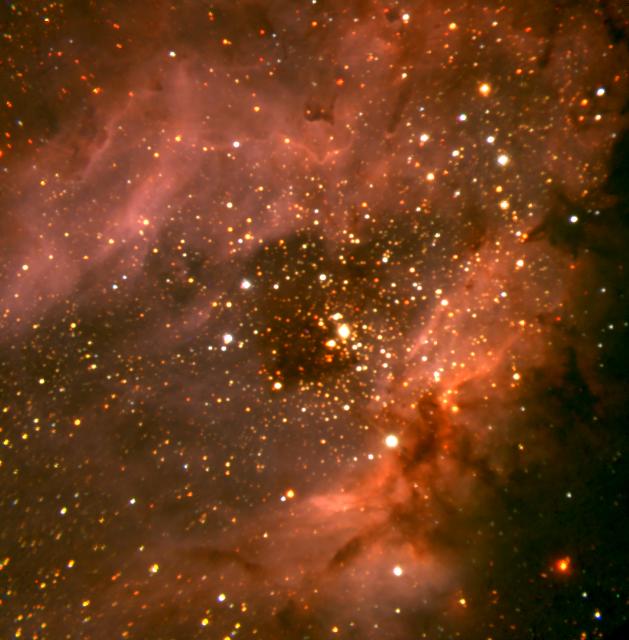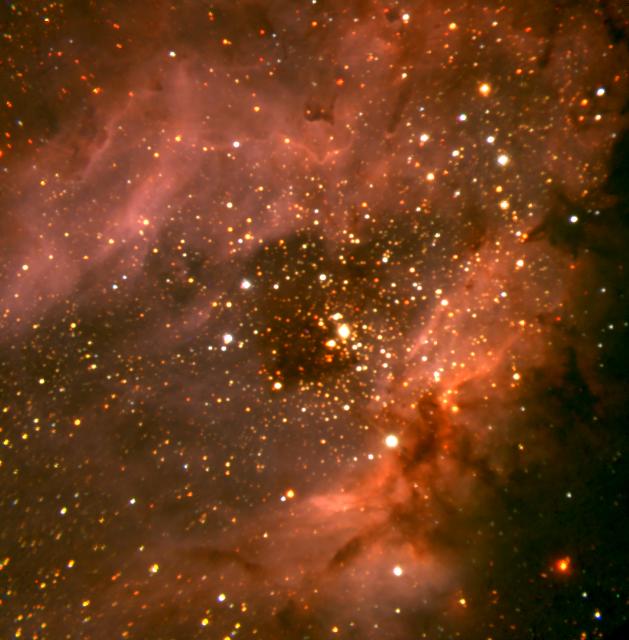
The Omega Nebula is a massive, complex cloud of dust and gas from which new stars are continually forming. The similarity to the Greek letter capital Omega gives the molecular cloud its popular name, but the nebula is also known as the Swan Nebula, the Horseshoe Nebula, and M17. Detailed features such as thin filaments of emission by diffuse dust and dark clouds of absorption by dense dust are visible in this recently released picture. The image highlights infrared light emitted by large molecules known as polycyclic aromatic hydrocarbons (PAHs), a gas similar to car exhaust that traces carbon and interstellar dust. PAHs may be an intermediate step between smaller molecules and large interstellar dust grains. The origin of PAHs is currently unknown but thought by some astronomers to form in the cool atmospheres of young carbon stars and to be dispersed by their stellar winds.
La Nebulosa Omega es una nube masiva y compleja de polvo y gas en la que continuamente se forman nuevas estrellas. La similitud con la letra griega mayúscula Omega le da a la nube molecular su nombre popular, aunque la nebulosa también es conocida como la Nebulosa del Cisne, la Nebulosa de la Herradura y M17. En esta imagen recientemente publicada son visibles detalles como finos filamentos de emisión de polvo difuso y nubes oscuras de absorción por polvo denso. La imagen resalta la luz infrarroja emitida por grandes moléculas conocidas como hidrocarburos aromáticos policíclicos (HAPs), un gas similar al escape de los automóviles que rastrea el carbono y el polvo interestelar. Los HAPs podrían representar un paso intermedio entre moléculas más pequeñas y los grandes granos de polvo interestelar. El origen de los HAPs es actualmente desconocido, aunque algunos astrónomos consideran que se forman en las frías atmósferas de jóvenes estrellas de carbono y son dispersados por sus vientos estelares.