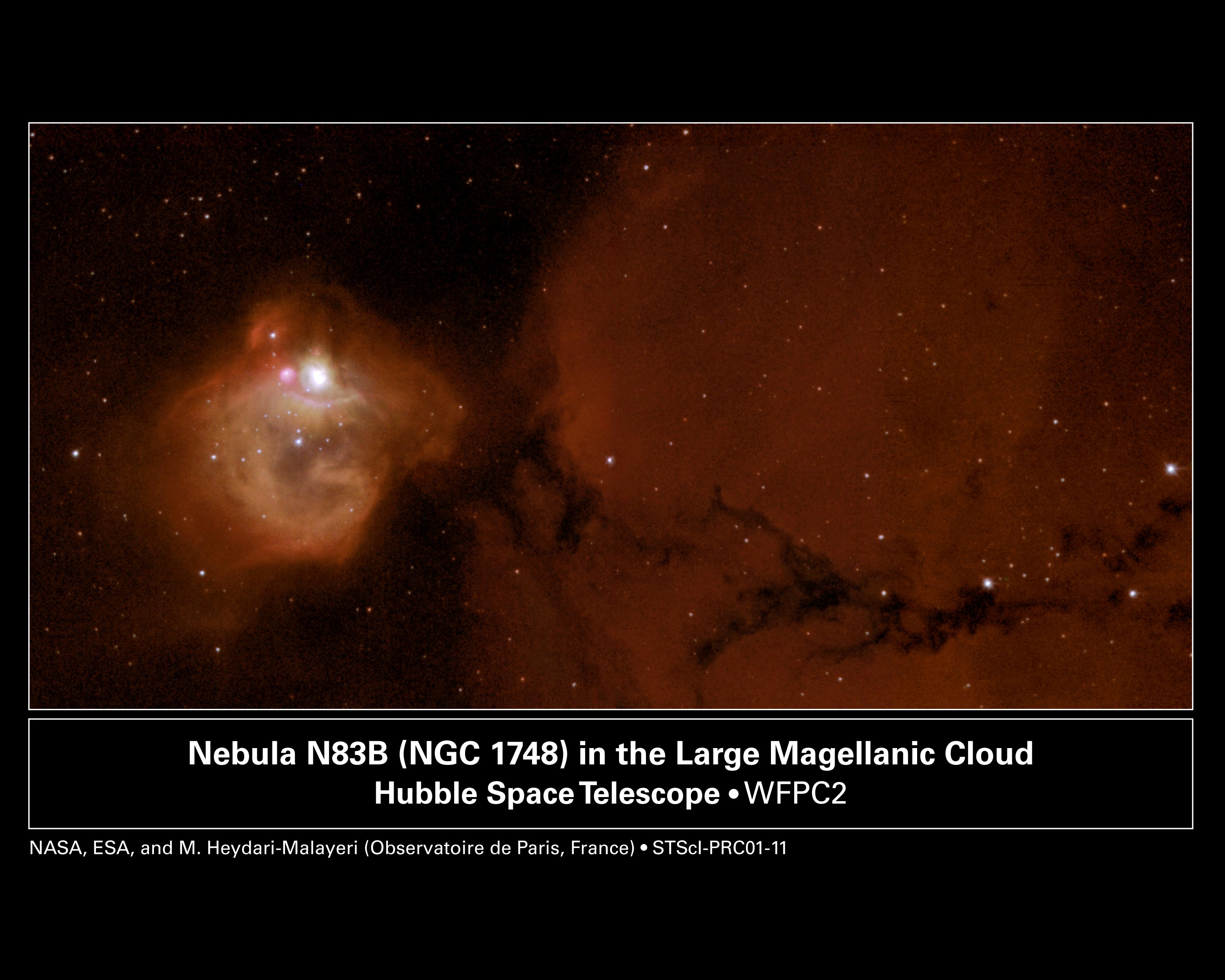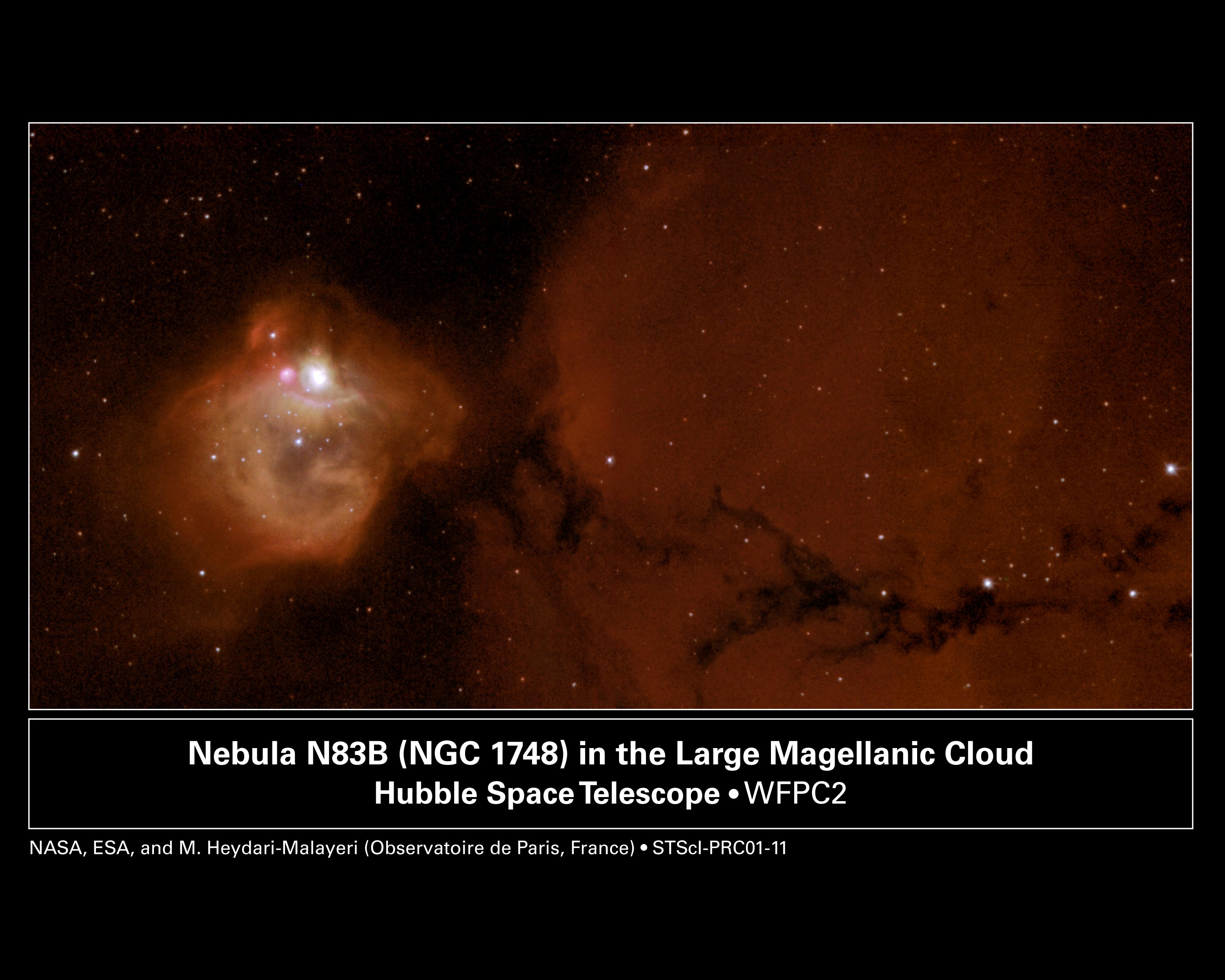
NGC 1748 cannot contain all the new stars it has formed. The young stars, the most massive of which are bright blue, emit so much energy they are pushing out and dispersing the gas and dust that comprise this star forming nebula. Within only the past hundred thousand years, these stars have altered the bubble-like shape of the nebula and will likely destroy the nebula over the next few million years. Of particular interest is a bright region surrounded by a pink ring of dust and gas visible on the left of the above recently released picture by the Hubble Space Telescope. The center of this region is being evacuated by the wind of the brightest star in the nebula. A lane of cooler dust connects NGC 1748 to a larger more diffuse nebula seen on the right. NGC 1748 spans about 25 light-years in diameter and can be found in our galactic neighbor: the Large Magellanic Cloud.
NGC 1748 no puede contener todas las estrellas nuevas que ha formado. Las estrellas jóvenes, cuyas más masivas son azules brillantes, emiten tanta energía que están empujando y dispersando el gas y el polvo que componen esta nebulosa de formación estelar. En solo los últimos cien mil años, estas estrellas han alterado la forma en burbuja de la nebulosa y probablemente la destruirán en los próximos millones de años. De particular interés es una región brillante rodeada por un anillo rosa de gas y polvo visible en el lado izquierdo de la imagen recientemente publicada por el Telescopio Espacial Hubble. El centro de esta región está siendo evacuado por el viento de la estrella más brillante de la nebulosa. Un canal de polvo más frío conecta NGC 1748 con una nebulosa más grande y difusa visible en el lado derecho. NGC 1748 tiene un diámetro de aproximadamente 25 años luz y se encuentra en nuestro vecino galáctico: la Nube Mayor de Magallanes.