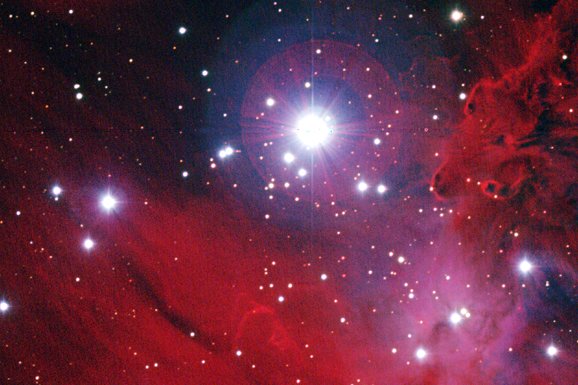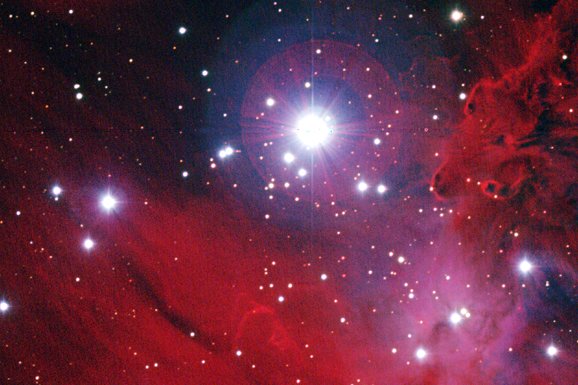
The nebula surrounding bright star S Mon is filled with dark dust and glowing gas. The strange shapes that haunt this star forming region originate from fine interstellar dust reacting in complex ways to the energetic light and hot gas being expelled by the young stars. The above picture, in representative color, isolates the northern part of a greater nebula designated NGC 2264, which lies about 2500 light-years away and includes the Cone Nebula. The blue glow directly surrounding S Mon results from reflection, where neighboring dust reflects light from the bright star. The more diffuse red glow results from emission, where starlight ionizes hydrogen gas. Pink areas are lit by a combination of the two processes. A small group of stars surrounds S Mon, the brightest star in the picture and a star visible with the naked eye toward the constellation of Monoceros.
La nebulosa que rodea la brillante estrella S Mon está llena de polvo oscuro y gas luminoso. Las formas extrañas que aparecen en esta región de formación estelar provienen del fino polvo interestelar que reacciona de maneras complejas ante la luz energética y el gas caliente expulsado por las estrellas jóvenes. La imagen anterior, en color representativo, muestra la parte norte de una nebulosa más grande designada NGC 2264, que se encuentra a unos 2500 años luz de distancia y que incluye la Nebulosa del Cono. El brillo azul que rodea directamente a S Mon es el resultado de la reflexión, donde el polvo cercano refleja la luz de la estrella brillante. El brillo rojo más difuso proviene de la emisión, donde la luz estelar ioniza el gas de hidrógeno. Las áreas rosadas están iluminadas por una combinación de ambos procesos. Un pequeño grupo de estrellas rodea a S Mon, la estrella más brillante en la imagen y una estrella visible a simple vista en dirección a la constelación de Monoceros.