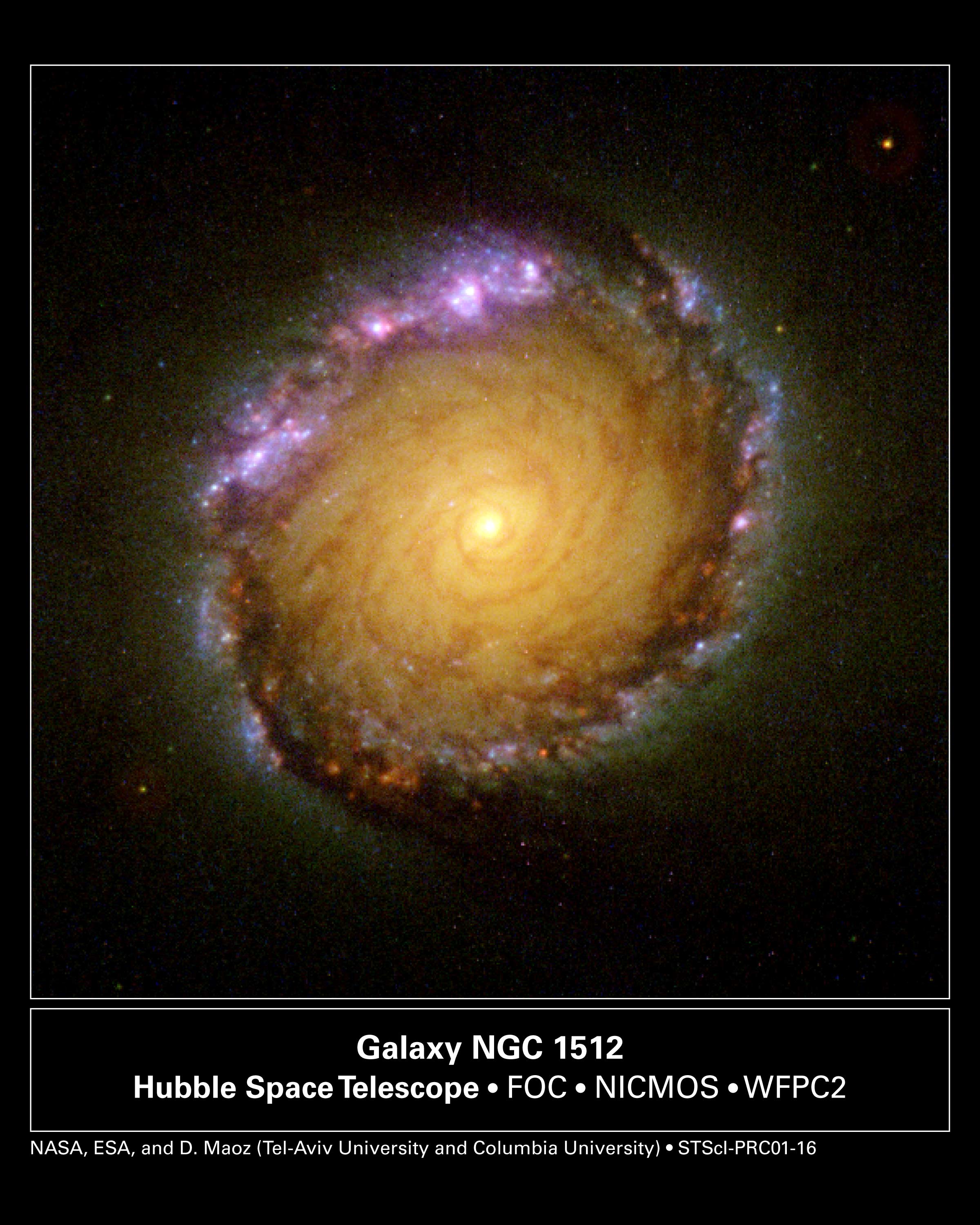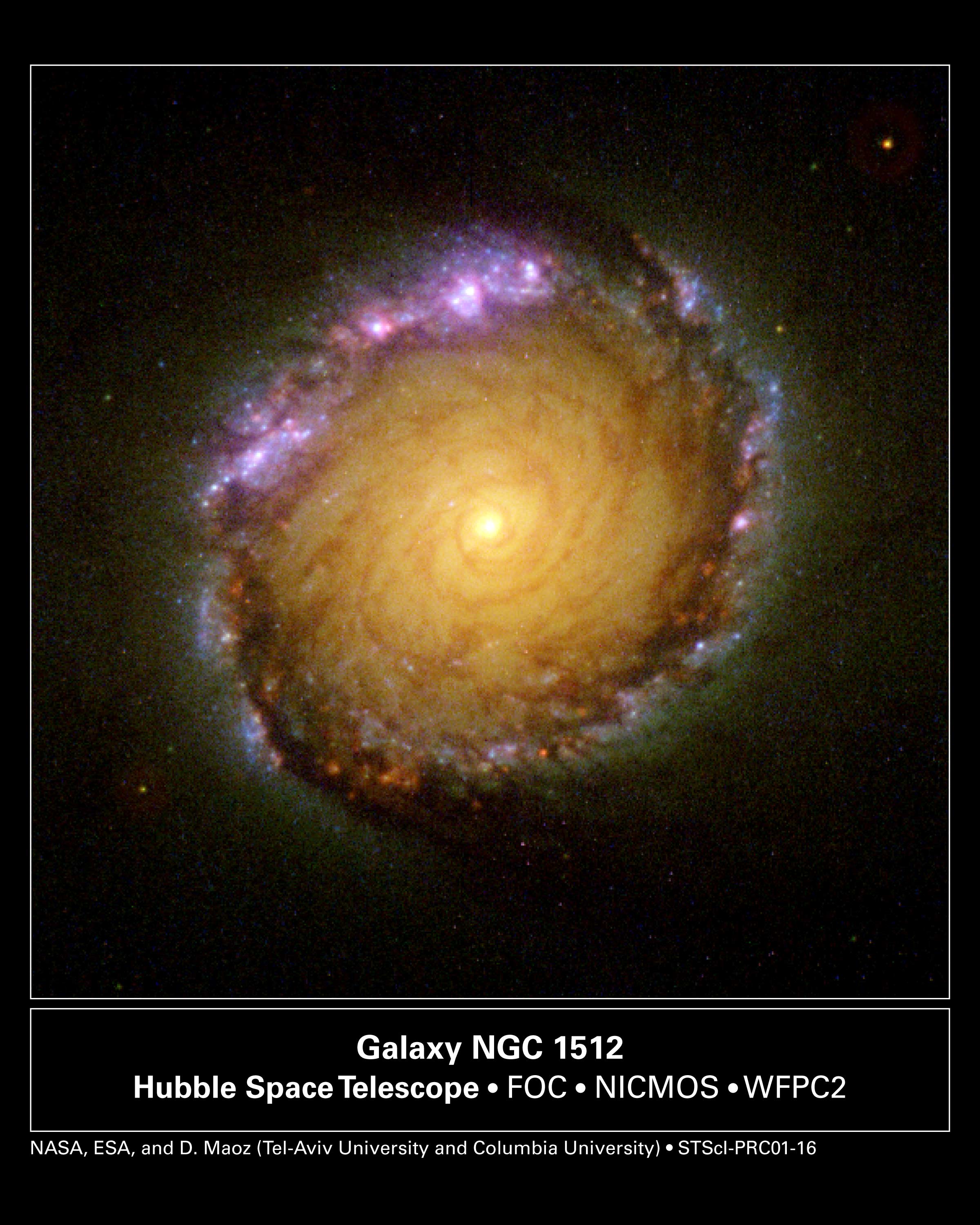
This spectacular color picture of the core of barred spiral galaxy NGC 1512 (bottom panel) is a composite of the seven Hubble Space Telescope images arrayed along the top. Each top panel image was made with a filter and camera sensitive to a different wavelength band in the electromagnetic spectrum. Arranged by increasing wavelength, at the far left are two ultraviolet images from Hubble's Faint Object Camera. Next are two visible light images from its Wide Field Planetary Camera 2, followed on the right by three infrared images from the Near Infrared Camera and Multi-Object Spectrograph. To make a pleasing composite color image, blue tones were assigned to the invisible ultraviolet, greenish colors were used for the visible bands, and yellow/red for the invisible infrared band images. These images show that the center of NGC 1512 appears dramatically altered when viewed in different wavelength bands. In particular, the ultraviolet images highlight clusters of young, hot stars in a ring 2,400 light-years wide surrounding the core. What caused this cosmic starburst ring?
Esta espectacular imagen en color del núcleo de la galaxia espiral con barra NGC 1512 (panel inferior) es un compuesto de las siete imágenes del Telescopio Espacial Hubble dispuestas a lo largo del borde superior. Cada imagen del panel superior fue capturada con un filtro y una cámara sensibles a una banda de longitud de onda diferente en el espectro electromagnético. Ordenadas por longitud de onda creciente, en el extremo izquierdo se encuentran dos imágenes en ultravioleta del Faint Object Camera de Hubble. A continuación, dos imágenes en luz visible de su Wide Field Planetary Camera 2, seguidas a la derecha por tres imágenes en infrarrojo cercano del Near Infrared Camera and Multi-Object Spectrograph. Para crear una imagen en color agradable, se asignaron tonos azules a las invisibles longitudes de onda ultravioleta, colores verdosos para las bandas visibles, y amarillo-rojo para las imágenes en la banda infrarroja invisible. Estas imágenes muestran que el centro de NGC 1512 aparece dramáticamente alterado cuando se observa en diferentes bandas de longitud de onda. En particular, las imágenes en ultravioleta resaltan agrupaciones de estrellas jóvenes y calientes en un anillo de 2.400 años luz de ancho que rodea el núcleo. ¿Qué causó este anillo de formación estelar cósmica?