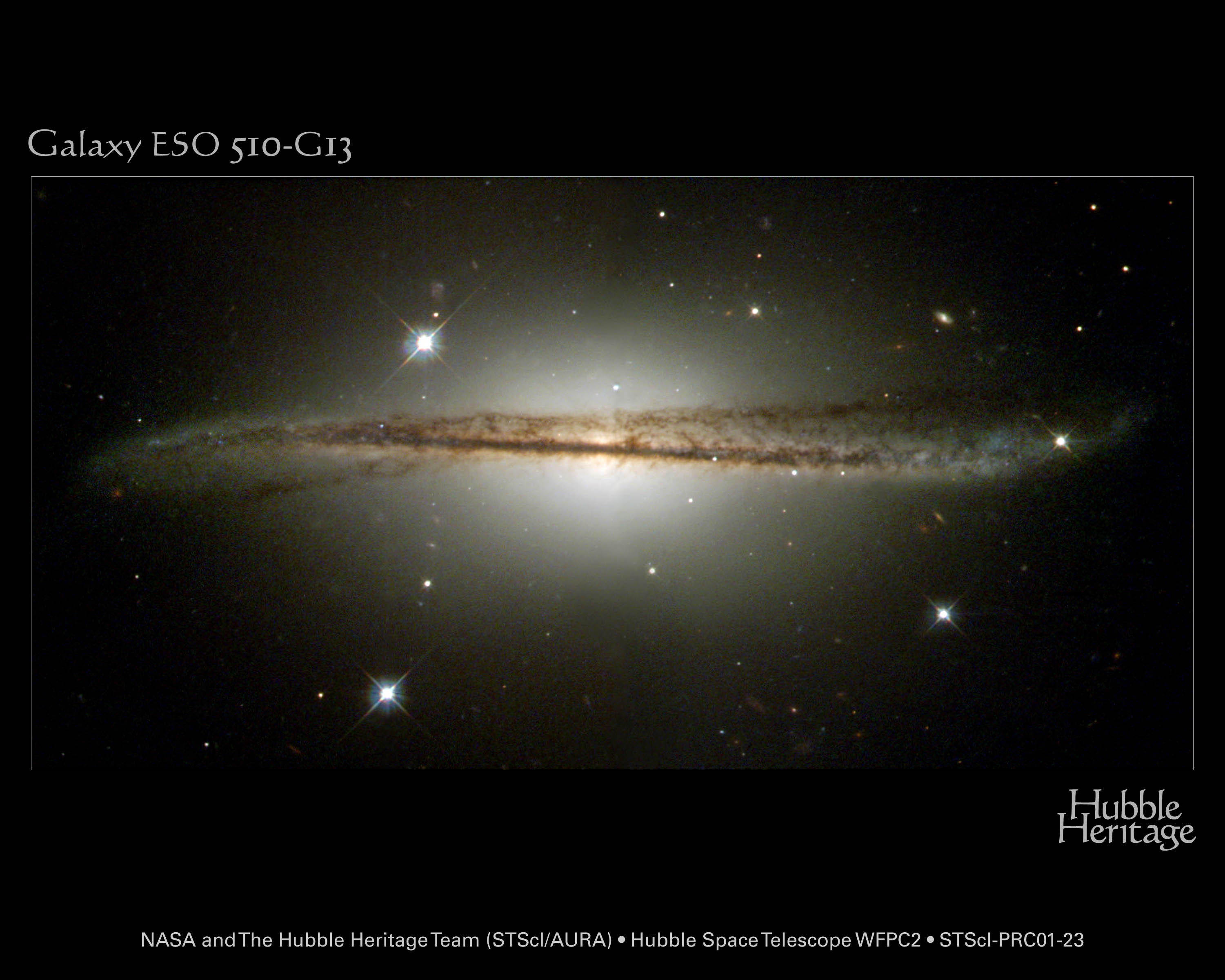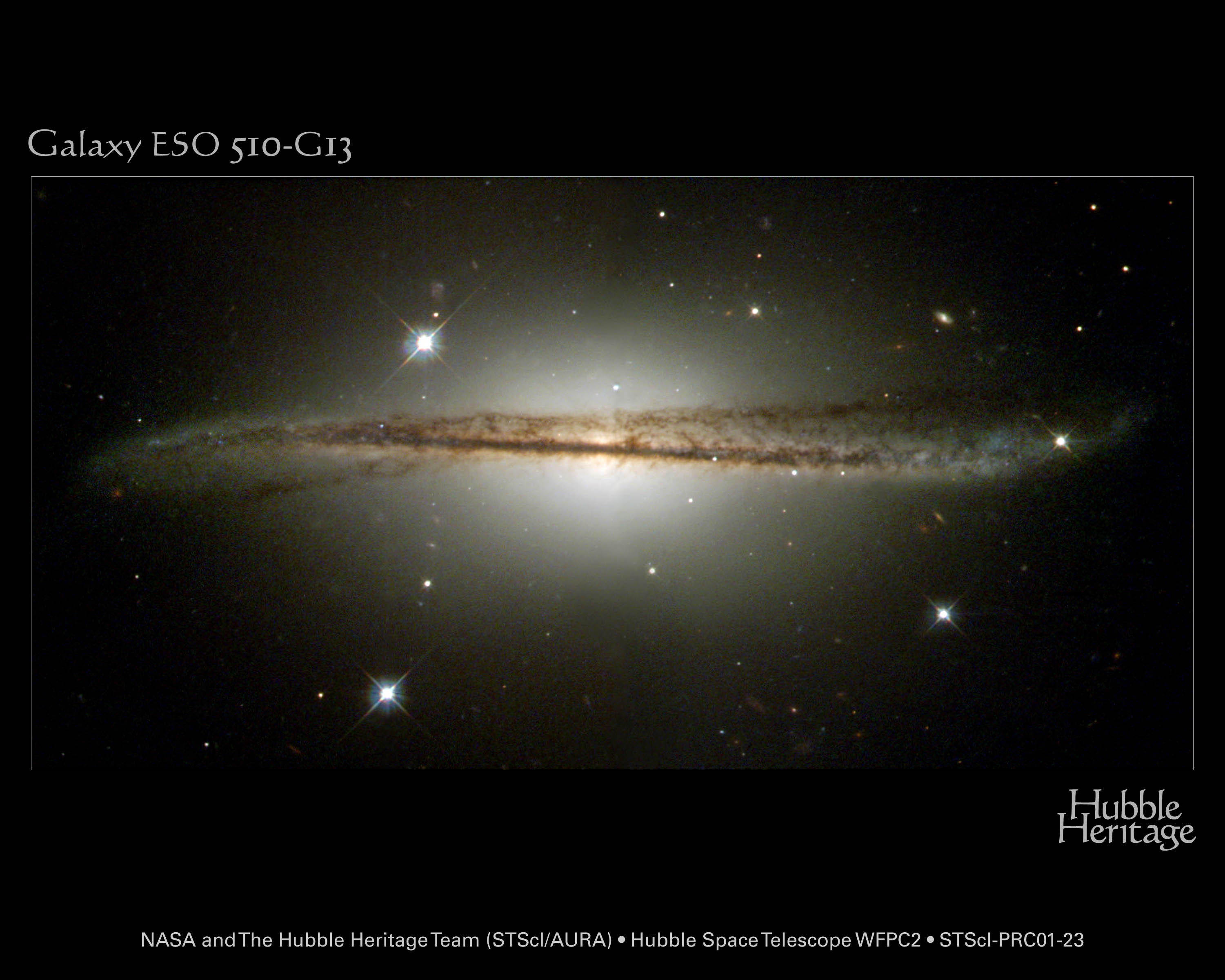
How did spiral galaxy ESO 510-13 get bent out of shape? The disks of many spirals are thin and flat, but not solid. Spiral disks are loose conglomerations of billions of stars and diffuse gas all gravitationally orbiting a galaxy center. A flat disk is thought to be created by sticky collisions of large gas clouds early in the galaxy's formation. Warped disks are not uncommon, though, and even our own Milky Way Galaxy is thought to have a small warp. The causes of spiral warps are still being investigated, but some warps are thought to result from interactions or even collisions between galaxies. ESO 510-13, pictured above, is about 150 million light years away and about 100,000 light years across.
¿Cómo se deformó la galaxia en espiral ESO 510-13? Los discos de muchas espirales son delgados y planos, pero no sólidos. Los discos espirales son agrupaciones sueltas de miles de millones de estrellas y gas difuso, todos orbitando gravitacionalmente alrededor del centro galáctico. Se cree que un disco plano se forma por colisiones cohesivas de nubes de gas grandes durante la formación temprana de la galaxia. Sin embargo, los discos retorcidos no son inusuales, y se piensa que incluso nuestra propia galaxia, la Vía Láctea, tiene un pequeño retorcimiento. Las causas de los retorcimientos espirales aún se investigan, pero se cree que algunos de ellos resultan de interacciones, o incluso colisiones entre galaxias. ESO 510-13, mostrada arriba, se encuentra a unos 150 millones de años luz de distancia y tiene aproximadamente 100 000 años luz de diámetro.