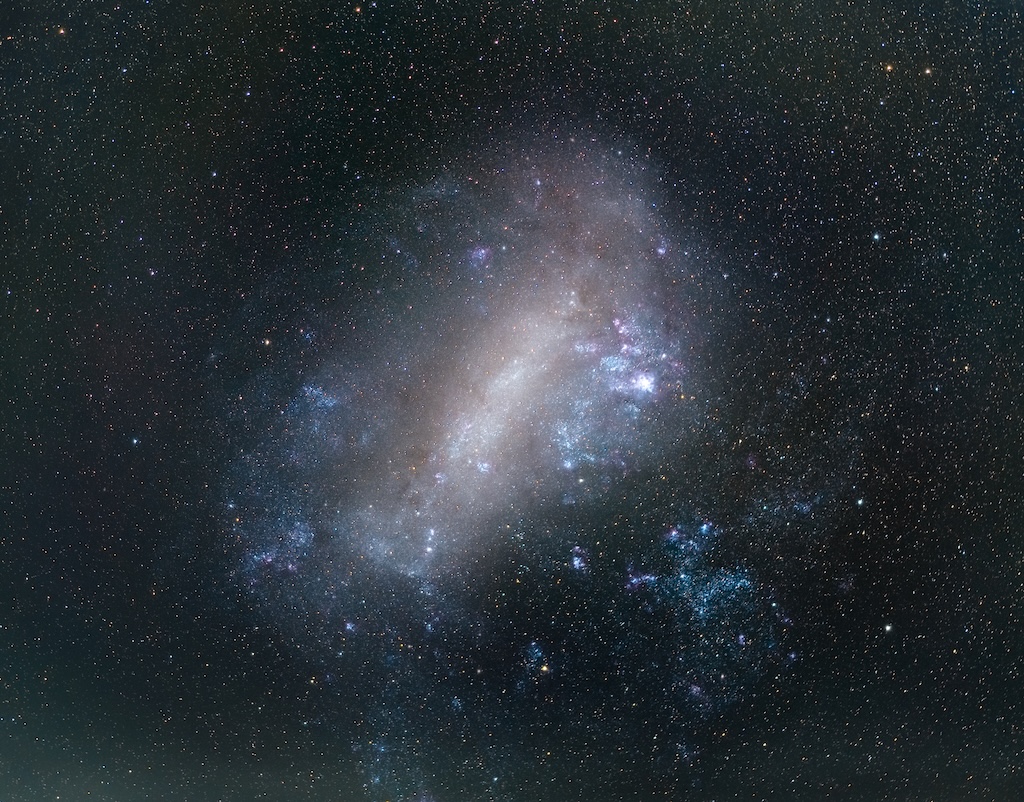
In February 2000, the orbiting Chandra X-ray Observatory spent 27 hours staring into the plane of our Milky Way galaxy. Its target was a spot in the small constellation Scutum, within the Milky Way's zone of avoidance where galactic gas and dust clouds block visible light, making a poor window for optical telescopes. However the penetrating x-ray observations looked through the obscurations revealing the Milky Way and the Universe beyond. The x-ray view is reconstructed above in false color. Distant active galaxies emitting high energy x-rays appear as blue dots, while reddish dots are sources of lower energy x-rays, likely stars within the Milky Way itself. Intriguing is the diffuse blue glow of high energy x-rays, distinct from the individual sources in the picture. Astronomers have long debated whether our galactic plane's apparently extended x-ray emission was due to discrete sources or diffuse hot gas. As these results suggest diffuse interstellar gas with a temperature of tens of millions of degrees Celsius is indeed the answer, other questions arise. What heats the gas to these incredible temperatures? Why does this energetic gas linger in the galactic plane?
En febrero de 2000, la observatorio orbital Chandra de rayos X dedicó 27 horas a observar el plano de nuestra galaxia, la Vía Láctea. Su objetivo fue un punto en la pequeña constelación de Escudo, dentro de la zona de evitación de la Vía Láctea, donde las nubes de gas y polvo galáctico bloquean la luz visible, creando una ventana pobre para los telescopios ópticos. Sin embargo, las observaciones penetrantes en rayos X lograron atravesar estas obstrucciones, revelando la Vía Láctea y el universo más allá. La vista en rayos X se reconstruye arriba en color falso. Galaxias activas distantes que emiten rayos X de alta energía aparecen como puntos azules, mientras que los puntos de color rojizo son fuentes de rayos X de menor energía, probablemente estrellas dentro de la propia Vía Láctea. Intrigante es el resplandor difuso azul de rayos X de alta energía, distinto de las fuentes individuales en la imagen. Los astrónomos han debatido durante mucho tiempo si la emisión aparentemente extendida de rayos X del plano galáctico se debía a fuentes discretas o a gas caliente y difuso. Según estos resultados, parece que la respuesta es efectivamente un gas interestelar difuso con una temperatura de decenas de millones de grados Celsius, lo que plantea otras preguntas. ¿Qué calienta el gas a estas increíbles temperaturas? ¿Por qué este gas energético permanece en el plano galáctico?