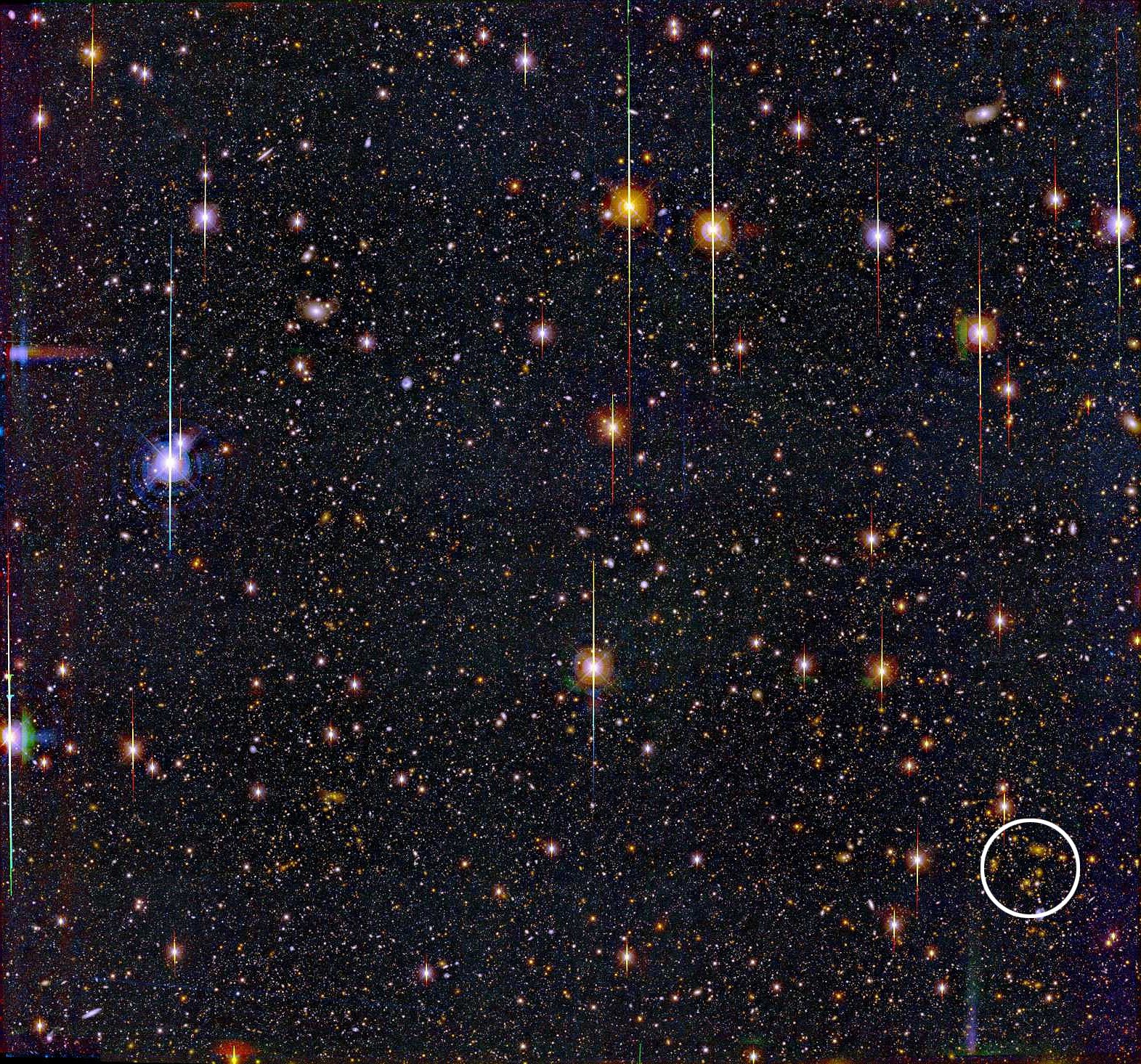
This stunning color deep sky view toward the constellation Pisces was made with data from a fast, sensitive, digital detector known as the Big Throughput Camera operating at Cerro Tololo Inter-American Observatory in Chile. Hardly noticeable in the original picture is the small cluster of about 15 galaxies nearly 3 billion light-years distant, circled at the lower right. In fact, this distant cluster was not discovered by noticing its appearance in the image at all, but instead by mapping the subtle distortions created by its gravity. As predicted by Einstein's General Relativity theory, the cluster's gravitational mass acts like a lens, bending light and distorting the shape of background galaxies. The effect is known as gravitational lensing. Computer mapping of weak distortions of background galaxy shapes across the Big Throughput image revealed that the large scale distribution of mass in that part of the sky was concentrated in a small region. That region turned out to correspond to the galaxy cluster -- the first time such an object has been discovered on the basis of its mass properties rather than its light.
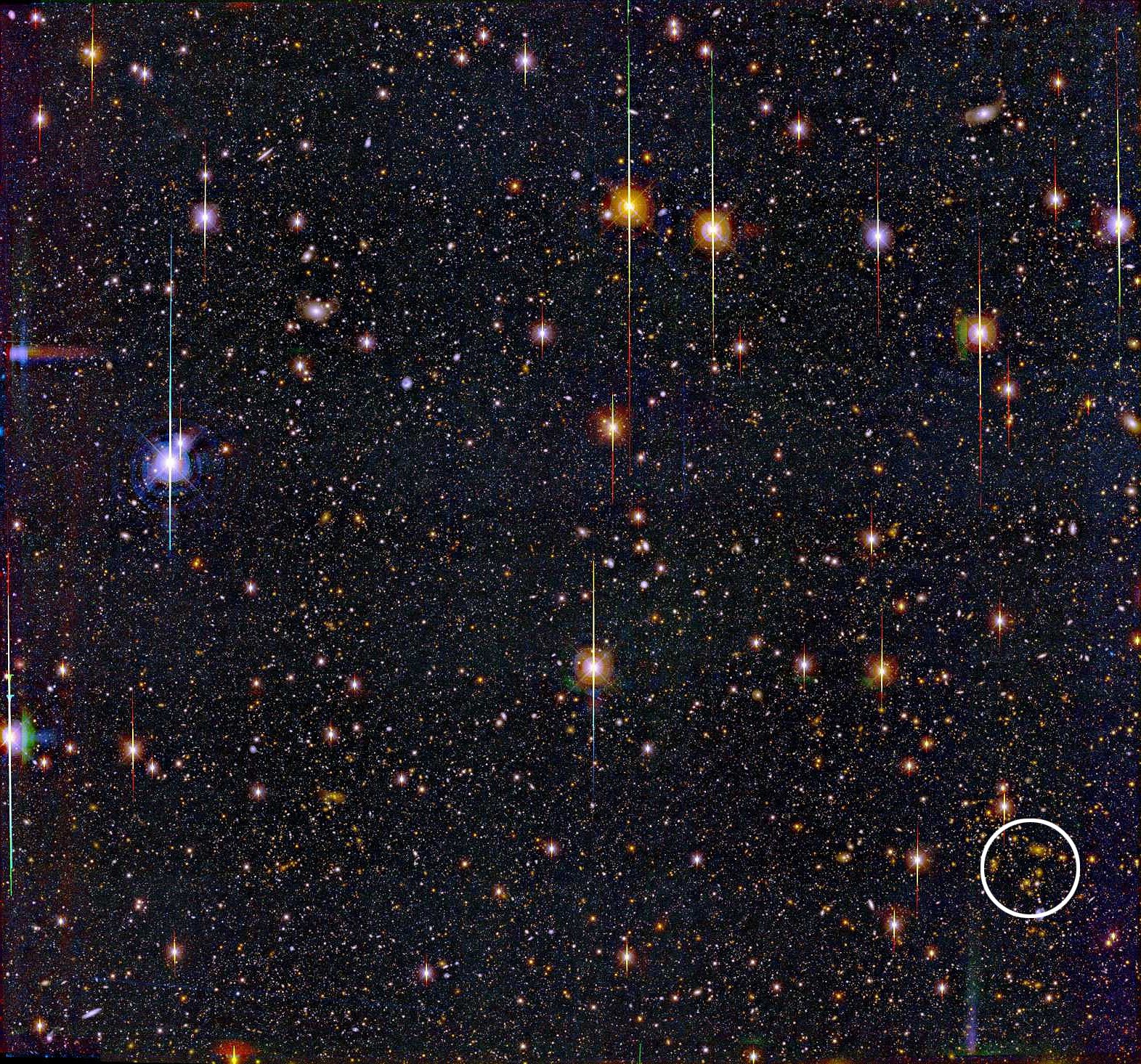
Crédito: NASA, CGRO SSC Esta asombrosa imagen en color de cielo profundo hacia la constelación de Piscis fue creada con datos obtenidos mediante un detector digital rápido, sensible y de alta capacidad conocido como la Big Throughput Camera, operando en el Observatorio Interamericano Cerro Tololo en Chile. Casi imperceptible en la imagen original es el pequeño cúmulo de aproximadamente 15 galaxias situado a casi 3 mil millones de años luz de distancia, señalado en la parte inferior derecha. De hecho, este cúmulo distante no fue descubierto observando su apariencia en la imagen, sino mapeando las sutiles distorsiones creadas por su gravedad. Como predijo la teoría de la Relatividad General de Einstein, la masa gravitacional del cúmulo actúa como una lente, doblando la luz y distorsionando la forma de las galaxias de fondo. Este efecto se conoce como lente gravitacional. El mapeo por computadora de las débiles distorsiones en las formas de las galaxias de fondo en la imagen de Big Throughput reveló que la distribución a gran escala de la masa en esa parte del cielo estaba concentrada en una pequeña región. Esa región resultó corresponder al cúmulo de galaxias — el primer objeto de este tipo descubierto en base a sus propiedades de masa en lugar de su luz.