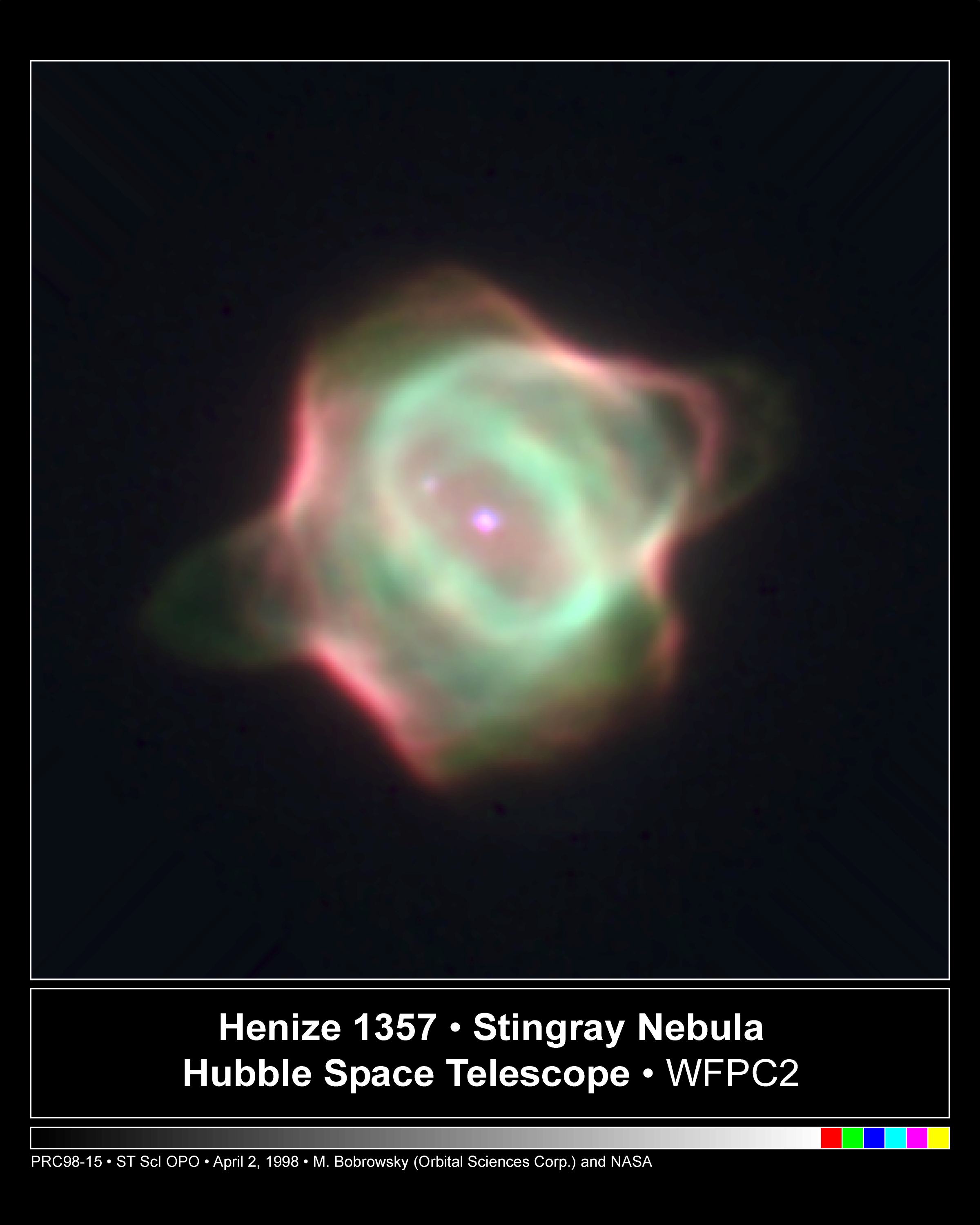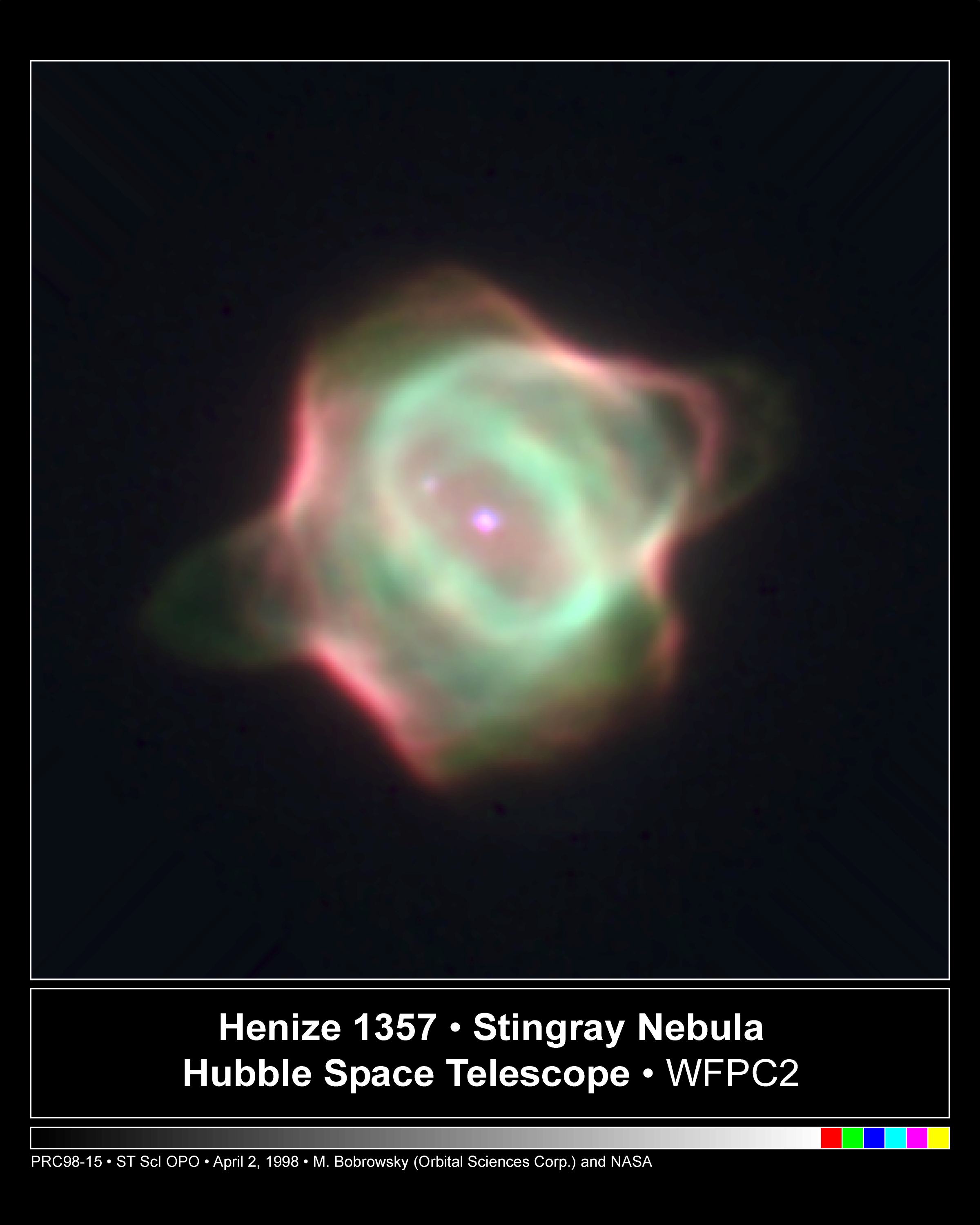
This Hubble Space Telescope snapshot shows Hen-1357, the youngest known planetary nebula. Graceful, gentle curves and symmetry suggest its popular name - The Stingray Nebula. Observations in the 1970s detected no nebular material, but this image from March 1996 clearly shows the Stingray's emerging bubbles and rings of shocked and ionized gas. The gas is energized by the hot central star as it nears the end of its life, evolving toward a final white dwarf phase. The image also shows a companion star (at about 10 o'clock) within the nebula. Astronomers suspect that such companions account for the complex shapes and rings of this and many other planetary nebulae. This cosmic infant is about 130 times the size of our own solar system and growing. It is 18,000 light-years distant, in the southern constellation Ara.
Esta imagen capturada por el Telescopio Espacial Hubble muestra Hen-1357, la nebulosa planetaria más joven conocida. Sus curvas gráciles y su simetría sugieren su nombre popular: la Nebulosa Rayo de Cometa. Observaciones realizadas en la década de 1970 no detectaron material nebuloso, pero esta imagen tomada en marzo de 1996 muestra claramente las burbujas y anillos emergentes de gas ionizado y en estado de choque. El gas es energizado por la estrella central caliente, que se acerca al final de su vida y evoluciona hacia una fase final como enana blanca. La imagen también muestra una estrella compañera (aproximadamente a las 10 en punto) dentro de la nebulosa. Los astrónomos sospechan que tales estrellas compañeras son responsables de las formas complejas y anillos de esta y de muchas otras nebulosas planetarias. Este bebé cósmico tiene aproximadamente 130 veces el tamaño de nuestro propio sistema solar y sigue creciendo. Se encuentra a 18 000 años luz de distancia, en la constelación austral Ara.