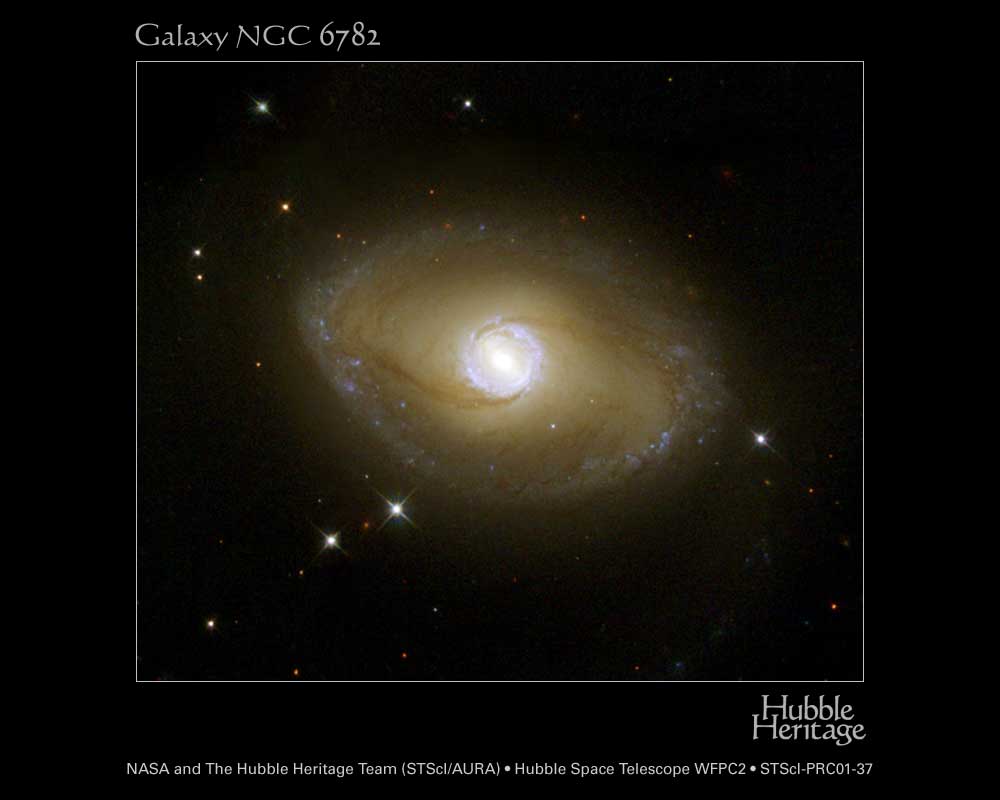
Do spiral galaxies look the same in every color? NGC 6782 demonstrates colorfully that they do not. In visible light, NGC 6782 appears to be a normal spiral galaxy with a bright bar across its center. In ultraviolet light, however, the central region blossoms into a spectacular and complex structure highlighted by a circumnuclear ring, as shown in the above representative color Hubble Space Telescope image. Many of the young stars that formed in a recent burst of star formation emit the ultraviolet light. Astronomers are studying possible relationships between the central bar and the ring. Light we see today from NGC 6782 left about 180 million years ago, while dinosaurs roamed the Earth. The galaxy spans about 80,000 light-years and can be seen with a telescope toward the constellation of Pavo.
¿Las galaxias espirales se ven igual en todos los colores? NGC 6782 demuestra coloridamente que no es así. En luz visible, NGC 6782 parece una galaxia espiral normal con una barra brillante atravesando su centro. Sin embargo, en luz ultravioleta, la región central florece en una estructura espectacular y compleja resaltada por un anillo circunuclear, como se muestra en la imagen de color representativa del Telescopio Espacial Hubble. Muchas de las estrellas jóvenes que se formaron en una reciente explosión de formación estelar emiten luz ultravioleta. Los astrónomos están estudiando posibles relaciones entre la barra central y el anillo. La luz que vemos hoy en día de NGC 6782 salió hace aproximadamente 180 millones de años, cuando los dinosaurios paseaban por la Tierra. La galaxia tiene un diámetro de unos 80 000 años luz y se puede observar con un telescopio hacia la constelación de Pavo.