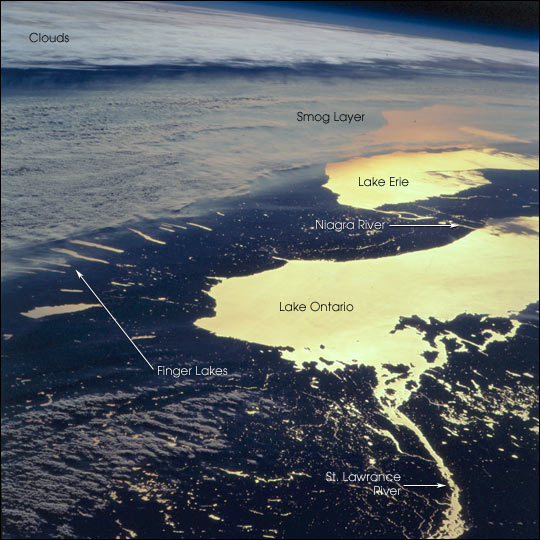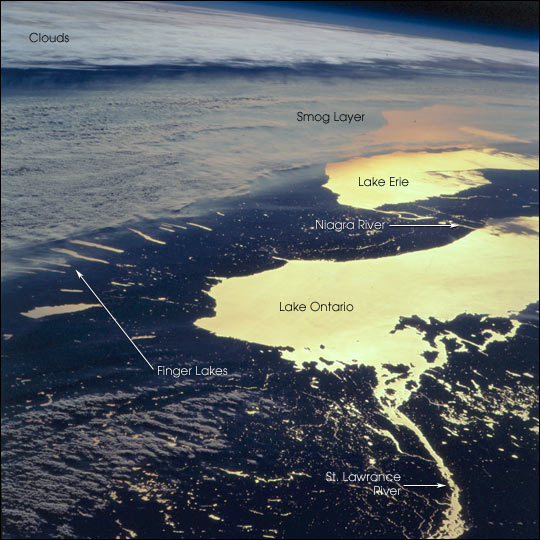
What is not pretty about the above picture? In a word: smog. In 2000 October the orbiting Space Shuttle Discovery photographed upstate New York just at sunset. Visible is golden sunlight reflecting from two of the Great Lakes (Erie and Ontario), and several of the Finger Lakes. Between the clouds at the top and ground at the bottom, however, is a trapped layer of smog. Smog is mostly ozone but may contain small amounts of volatile organic compounds. As opposed to "good smog" in the upper atmosphere, "bad smog" near the ground is created mostly by humans. In the upper atmosphere, ozone reflects back harmful ultraviolet radiation, but when it occurs near the ground, it can be inhaled. Smog continues to be studied with an eye for how it develops and how it affects human health.
¿Qué no es atractivo en la imagen anterior? En una palabra: smog. En octubre de 2000, el transbordador espacial Discovery en órbita fotografió el norte del estado de Nueva York justo al atardecer. Visible es la luz dorada del sol reflejándose en dos de los Grandes Lagos (Erie y Ontario), y varios de los Lagos de los Dedos. Entre las nubes en la parte superior y el terreno en la parte inferior, sin embargo, hay una capa atrapada de smog. El smog está compuesto principalmente por ozono pero puede contener pequeñas cantidades de compuestos orgánicos volátiles. A diferencia del «buen smog» en la atmósfera superior, el «malo smog» cerca del terreno es creado principalmente por los humanos. En la atmósfera superior, el ozono refleja la radiación ultravioleta dañina, pero cuando ocurre cerca del terreno, puede ser inhalado. El smog continúa siendo estudiado con el objetivo de entender cómo se desarrolla y cómo afecta la salud humana.