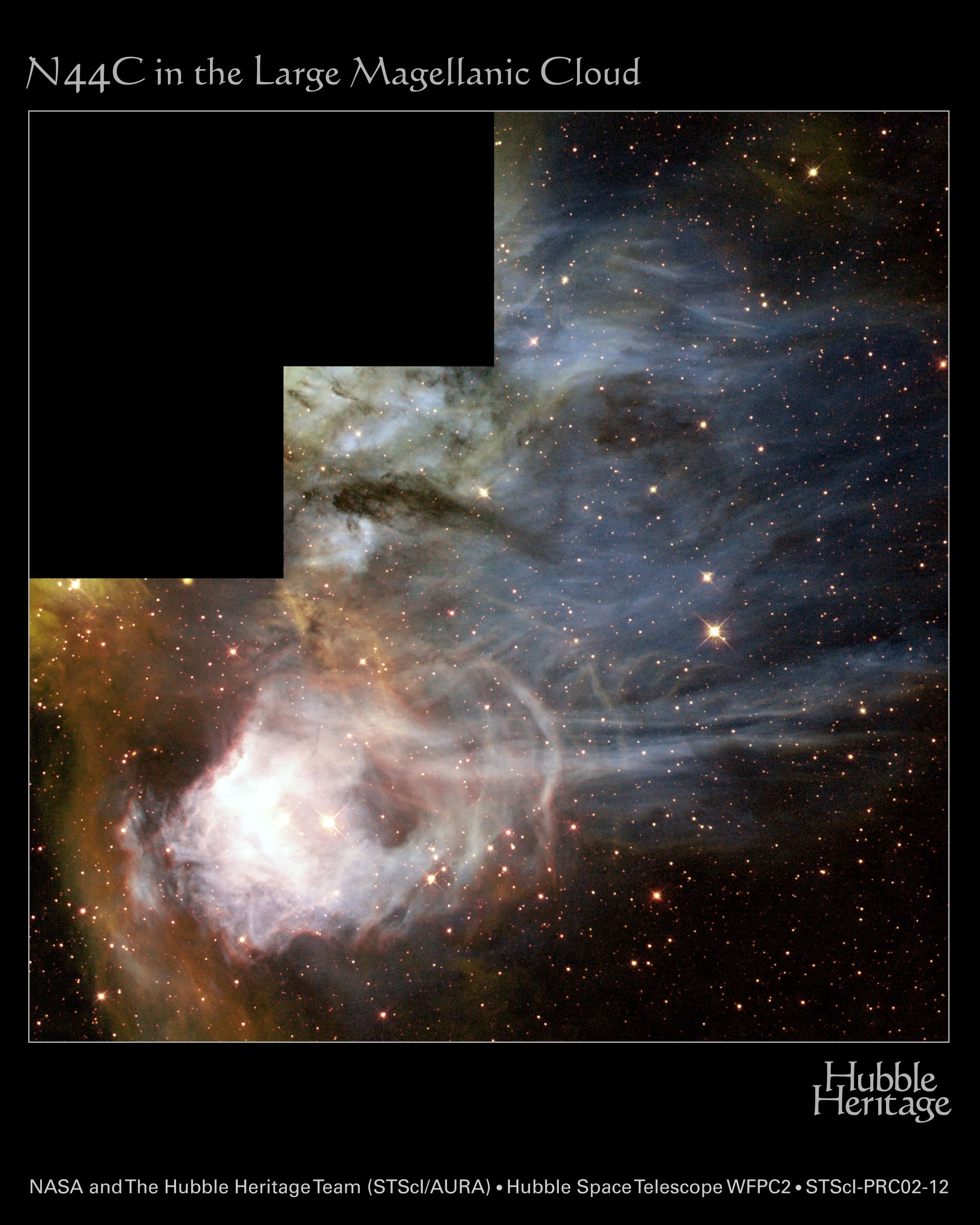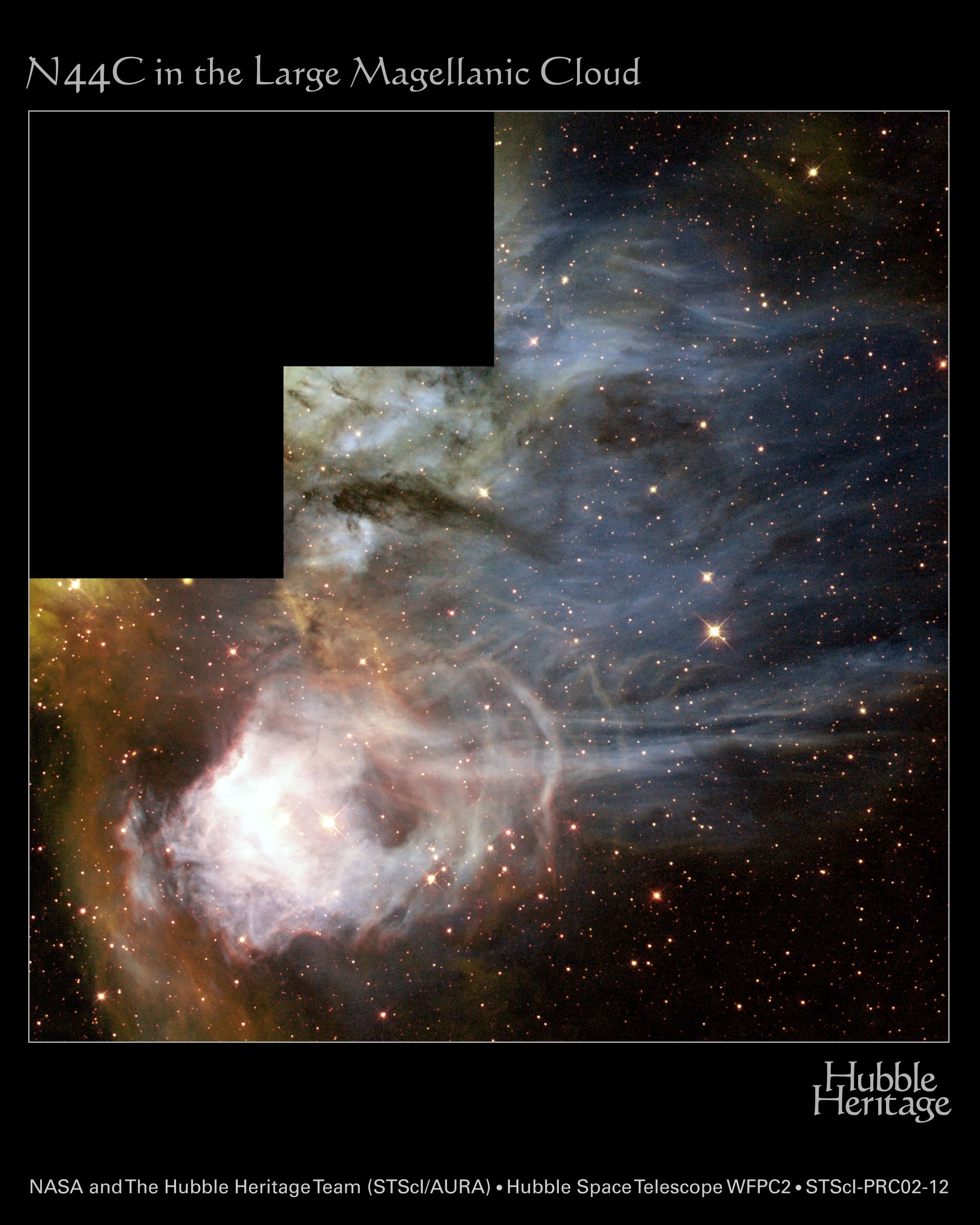
Why is N44C glowing so strangely? The star that appears to power the nebula, although young and bright, does not seem hot enough to create some of the colors observed. A search for a hidden hotter star in X-rays has come up empty. One hypothesis is that the known central star has a neutron star companion in a very wide orbit. Hot X-rays might only then be emitted during brief periods when the neutron star nears the known star and crashes through a disk of surrounding gas. Future observations might tell. N44C, pictured in the above Hubble Space Telescope image, is an emission nebula in the Large Magellanic Cloud, a neighboring galaxy to our Milky Way Galaxy. Flowing filaments of colorful gas and dark dust far from the brightest region are likely part of the greater N44 complex. It would take light about 125 years to cross N44C.
¿Por qué brilla N44C de manera tan extraña? La estrella que parece alimentar la nebulosa, aunque joven y brillante, no parece ser lo suficientemente caliente para crear algunos de los colores observados. Una búsqueda de una estrella más caliente oculta mediante rayos X no ha arrojado resultados. Una hipótesis es que la estrella central conocida tiene una compañera de estrella de neutrones en una órbita muy amplia. Los rayos X calientes podrían emitirse solo durante breves períodos cuando la estrella de neutrones se acerca a la estrella conocida y se abre paso a través de un disco de gas circundante. Observaciones futuras podrían revelar la respuesta. N44C, mostrada en la imagen anterior del Telescopio Espacial Hubble, es una nebulosa de emisión en la Gran Nube de Magalanes, una galaxia vecina a nuestra Vía Láctea. Los filamentos fluidos de gas colorido y polvo oscuro lejos de la región más brillante probablemente forman parte del complejo mayor N44. La luz tardaría aproximadamente 125 años en cruzar N44C.