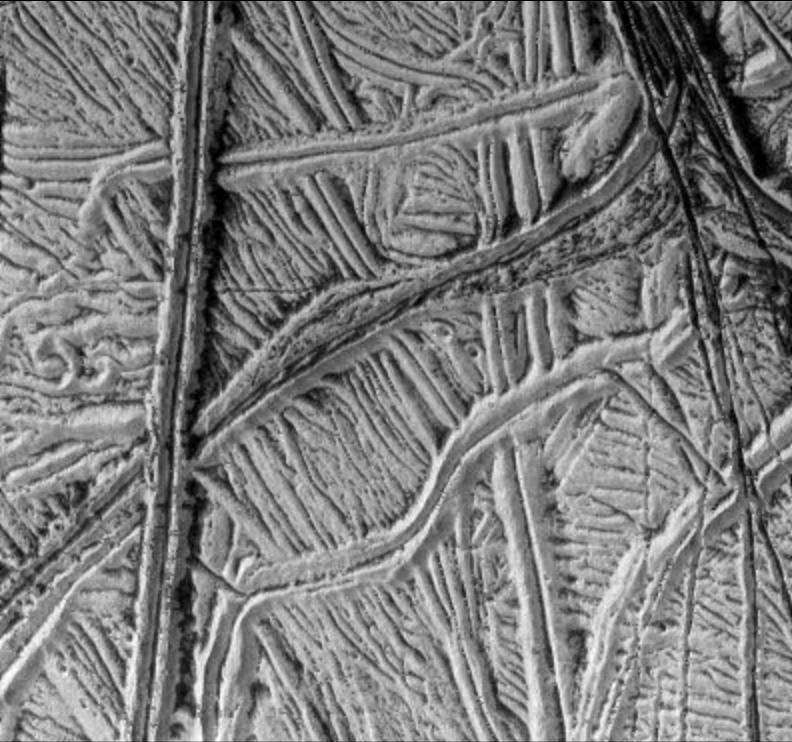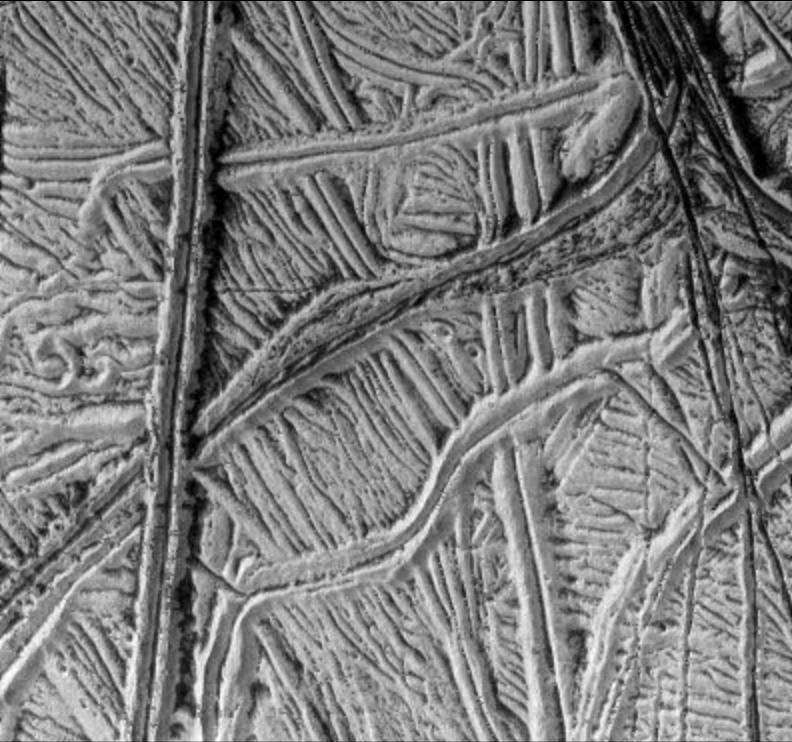
Which way to the interstate? What appears to be a caricature of a complex highway system on Earth is actually a system of ridges and cracks on the icy surface of Jupiter's moon Europa. The distance between parallel ridges in the above photograph is typically about 1 kilometer. The complexity of the cracks and ridges tell a story of Europa's past that is mostly undecipherable -- planetary geologists try to understand just the general origin of the overall features. One noteworthy feature is the overall white sheen, possibly indicating the presence of frost. Another is the dark centers between parallel ridges, which might indicate that dirty water from an underground ocean recently welled up in the cracks and froze. Recent research indicates that enough carbon exists to support an underwater biosphere, but that Europa's ice crust may be over three kilometers thick in some places.
¿Cuál es el camino hacia la carretera interestatal? Lo que parece ser una caricatura de un complejo sistema de carreteras en la Tierra es en realidad un sistema de crestas y grietas en la superficie helada de la luna Europa de Júpiter. La distancia entre crestas paralelas en la fotografía anterior es típicamente de unos 1 kilómetro. La complejidad de las grietas y crestas revela una historia del pasado de Europa que es en gran medida indescifrable — los geólogos planetarios tratan de comprender únicamente el origen general de las características generales. Una característica notable es el brillo blanco general, que posiblemente indica la presencia de escarcha. Otra es los centros oscuros entre crestas paralelas, que podrían indicar que agua sucia de un océano subterráneo brotó recientemente en las grietas y se congeló. Investigaciones recientes indican que existe carbono suficiente para mantener una biosfera submarina, pero que la corteza de hielo de Europa podría tener más de tres kilómetros de espesor en algunos lugares.