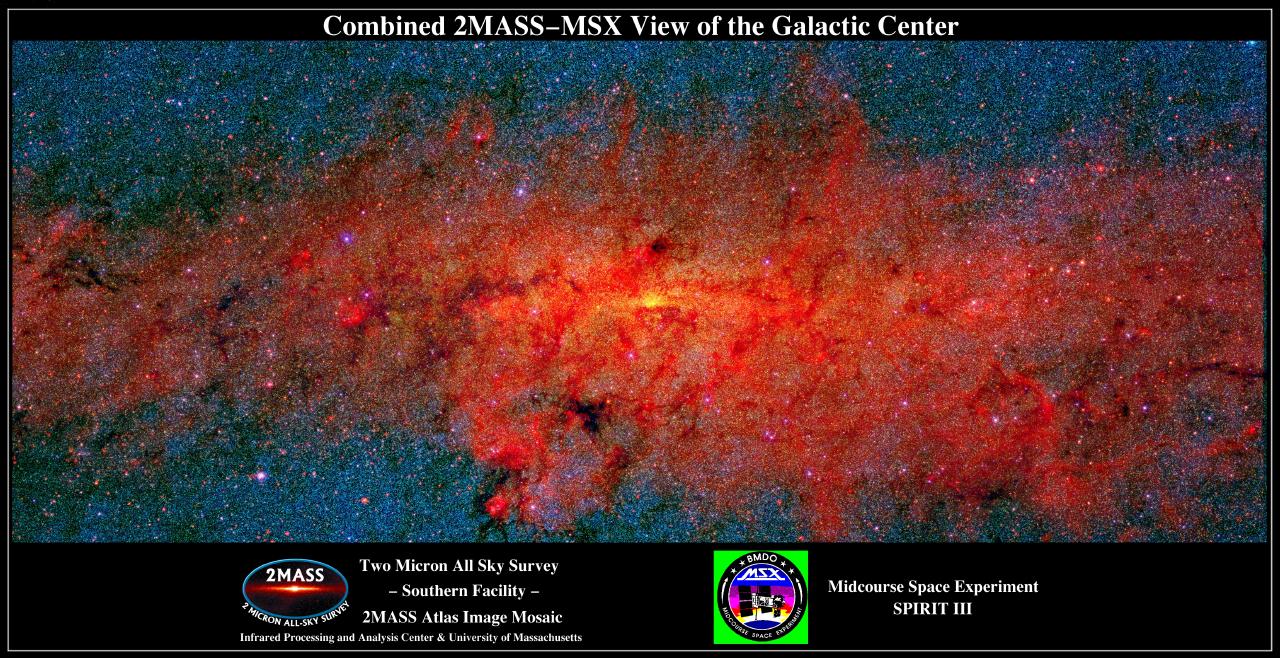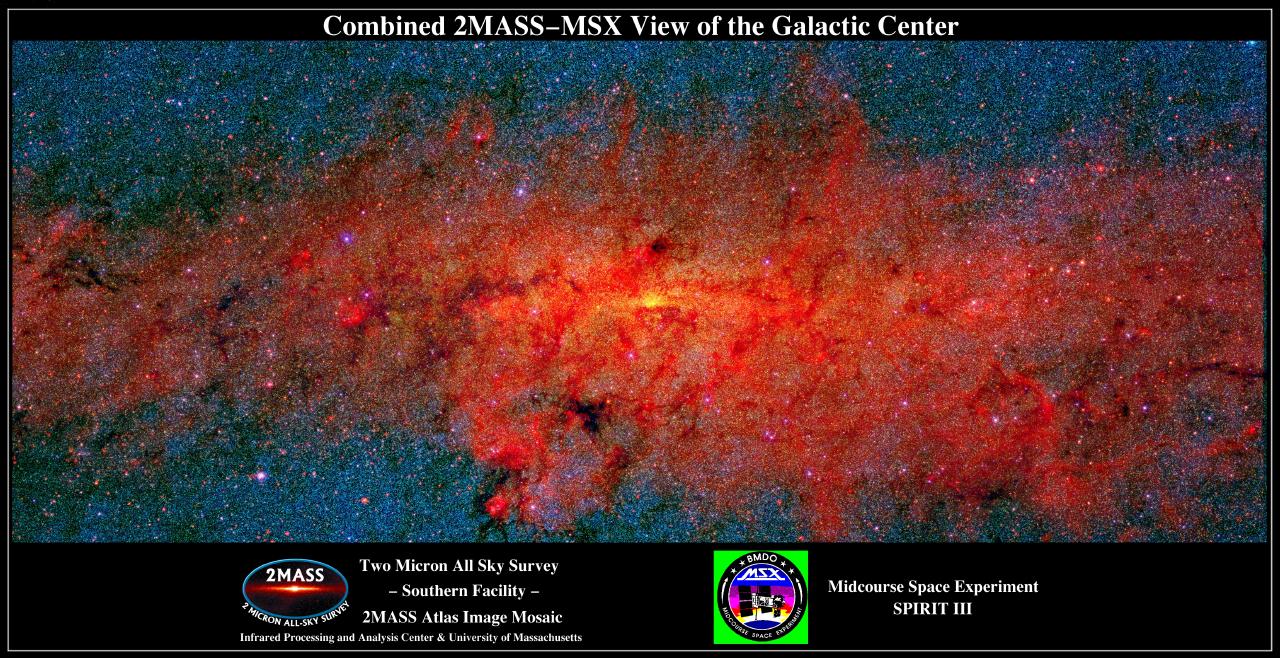
The center of our Galaxy is obscured in visible light by dark dust that rotates with the stars in the Galactic Plane. In this century, however, sensors have been developed that can detect light more red that humans can see - light called infrared. The above picture shows what the Galactic Center looks like in three increasingly red bands of near-infrared light. The picture results from a digital combination of data recently taken by the 2MASS and MSX Galactic surveys. In near-infrared light (shown in blue) the dust is less opaque and many previously shrouded red giant stars become visible. In the mid-infrared (shown in red) the dust itself glows brightly, but allows us a view very close to our tumultuous and mysterious Galactic Center.
El centro de nuestra Galaxia está obscurecido en luz visible por polvo oscuro que rota con las estrellas en el Plano Galáctico. Sin embargo, en este siglo se han desarrollado sensores capaces de detectar luz más roja de la que los humanos pueden ver, luz llamada infrarroja. La imagen anterior muestra cómo se ve el Centro Galáctico en tres bandas cada vez más rojas de luz infrarroja cercana. La imagen resulta de una combinación digital de datos recientemente obtenidos por los estudios galácticos 2MASS y MSX. En luz infrarroja cercana (mostrada en azul), el polvo es menos opaco y muchas estrellas gigantes rojas previamente ocultas se hacen visibles. En el infrarrojo medio (mostrado en rojo), el polvo mismo brilla intensamente, permitiéndonos una vista muy cercana a nuestro tumultuoso y misterioso Centro Galáctico.