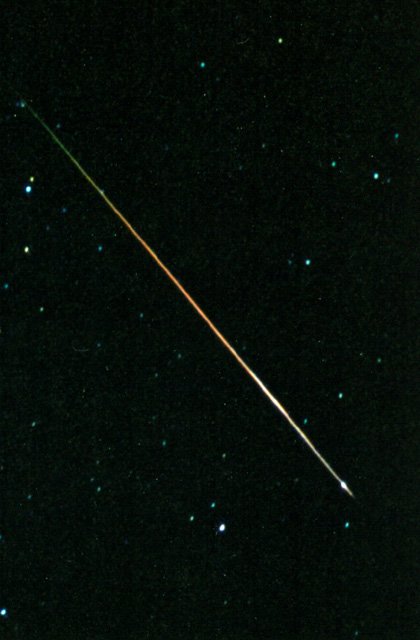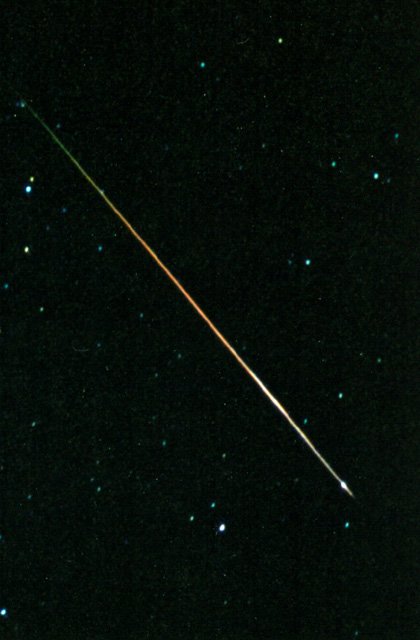
While meteors do show colors, the colors aren't always seen with the unaided eye. Still, high speed color film recorded this rainbow-like trail as a meteor streaked through the early morning sky on August 13 above Sedona, Arizona, USA. Part of the annual Perseid meteor shower, this bit of dust from the tail of Comet Swift-Tuttle entered Earth's atmosphere at over 200,000 kilometers per hour. The trail it left glowed briefly as friction with the atmosphere vaporized the dust grain and ionized atoms along its path. The initial green color is thought to be the glow from oxygen in the atmosphere at altitudes above 100 kilometers or so, while sodium atoms and other constituents of the cometary dust grain itself contribute to the orange hues.
Aunque los meteoros sí muestran colores, estos no siempre se ven a simple vista. Sin embargo, película de color de alta velocidad registró este rastro similar a un arcoíris mientras un meteoro surcaba el cielo de la madrugada del 13 de agosto sobre Sedona, Arizona, EE.UU. Parte de la lluvia de meteoros Perseidas anual, esta partícula de polvo de la cola del Cometa Swift-Tuttle entró en la atmósfera terrestre a más de 200.000 kilómetros por hora. El rastro que dejó brilló brevemente cuando la fricción con la atmósfera vaporizó el grano de polvo e ionizó los átomos a lo largo de su trayectoria. Se cree que el color verde inicial proviene del brillo del oxígeno en la atmósfera a altitudes superiores a 100 kilómetros aproximadamente, mientras que los átomos de sodio y otros componentes del grano de polvo cometario contribuyen a los tonos anaranjados.