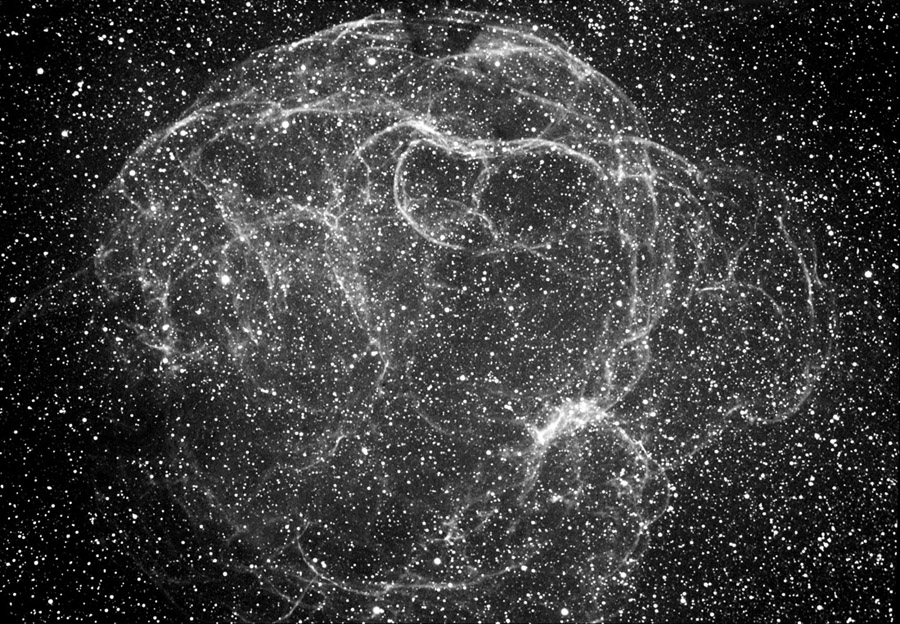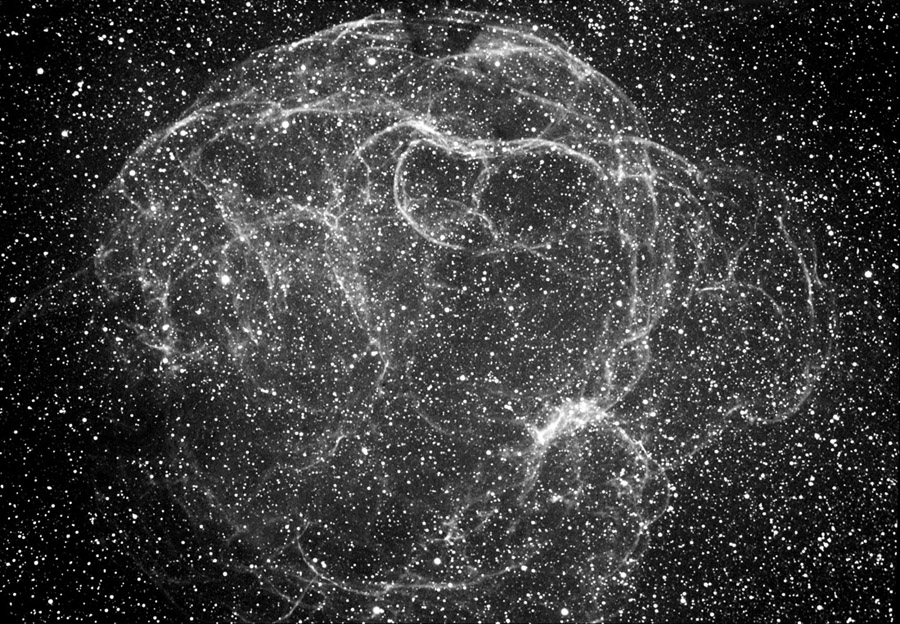
It's easy to get lost following the intricate filaments in this stunningly detailed image of faint supernova remnant Simeis 147. Seen towards the constellation Taurus it covers nearly 3 degrees (6 full moons) on the sky corresponding to a width of 150 light-years at the stellar debris cloud's estimated distance of 3,000 light-years. On three separate nights in December 2001 and January 2002 astronomer Steve Mandel accumulated a total of over eight hours of exposure time to compose this image. He used an astronomical CCD camera, telephoto lens, and his specially designed adapter to allow such wide-field digital imaging. He also used a narrow H-alpha filter to transmit only the the light from recombining hydrogen atoms in the expanding nebulosity, defining the regions of shocked, glowing gas. This supernova remnant has an apparent age of about 100,000 years (light from the original explosion first reached Earth 100,000 years ago) but it is not the only aftermath of the massive stellar explosion. The cosmic catastrophe also left behind a spinning neutron star or pulsar, all that remains of the star's dense core.
Es fácil perderse siguiendo los intrincados filamentos en esta imagen extraordinariamente detallada del débil remanente de supernova Simeis 147. Observado hacia la constelación de Tauro, cubre casi 3 grados (6 lunas llenas) en el cielo, lo que corresponde a un ancho de 150 años luz a la distancia estimada de 3.000 años luz de la nube de escombros estelares. Durante tres noches separadas en diciembre de 2001 y enero de 2002, el astrónomo Steve Mandel acumuló un total de más de ocho horas de tiempo de exposición para componer esta imagen. Utilizó una cámara CCD astronómica, un objetivo de teleobjetivo y su adaptador especialmente diseñado para permitir imágenes digitales de gran angular. También utilizó un filtro H-alfa estrecho para transmitir únicamente la luz de los átomos de hidrógeno que se recombinan en la nebulosidad expansiva, definiendo las regiones de gas conmocionado y brillante. Este remanente de supernova tiene una edad aparente de aproximadamente 100.000 años (la luz de la explosión original llegó a la Tierra hace 100.000 años), pero no es el único resultado de la explosión estelar catastrófica. La catástrofe cósmica también dejó tras de sí una estrella de neutrones giratoria o púlsar, todo lo que permanece del denso núcleo de la estrella.