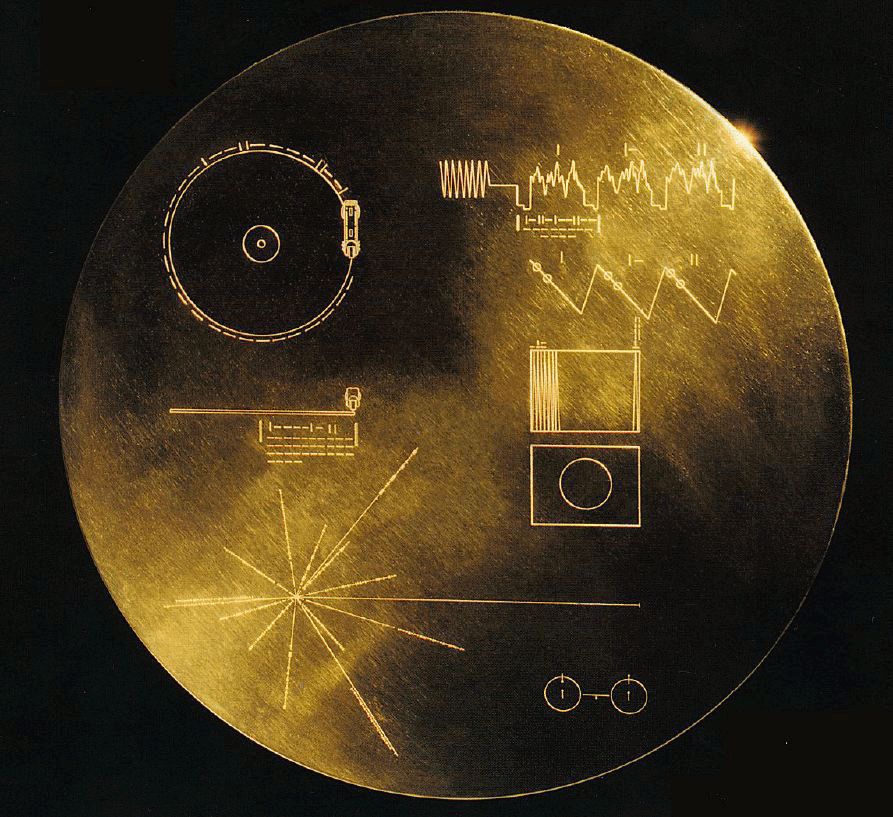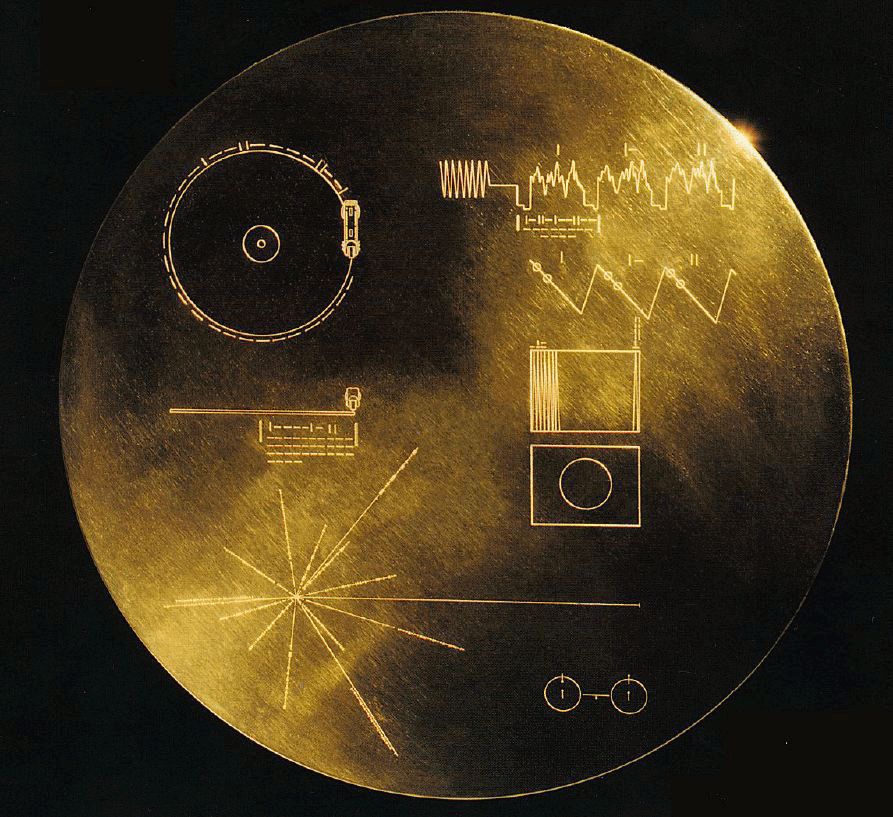
Launched twenty-five years ago, NASA's Voyager 1 and 2 spacecraft are now over 10 billion kilometers from the Sun. Still operational, the Voyagers are being tracked and commanded through the Deep Space Network. Having traveled beyond the outer planets, these remarkable spacecraft are only the third and fourth human built artifacts to escape our solar system, following in the footsteps of Pioneer 10 and 11. A 12-inch gold plated copper disk containing recorded sounds and images representing human cultures and life on Earth, is affixed to each Voyager - a message in a bottle cast into the cosmic sea. The recorded material was selected by a committee chaired by the late Carl Sagan. Simple diagrams on the cover (visible above) represent symbolically the spacecraft's origin and give instructions for playing the disk. The exotic construction of the disks should provide them with a long lifetime as they coast through interstellar space. The two spacecraft will not make a close approach to another planetary system for at least 40,000 years.
Lanzadas hace veinticinco años, las sondas espaciales Voyager 1 y 2 de la NASA se encuentran ahora a más de 10 mil millones de kilómetros del Sol. Aún operativas, las Voyager son rastreadas y comandadas a través de la Red del Espacio Profundo. Habiendo viajado más allá de los planetas exteriores, estas notables naves espaciales son solo el tercero y cuarto artefactos construidos por humanos en escapar de nuestro sistema solar, siguiendo los pasos de Pioneer 10 y 11. Un disco de cobre enchapado en oro de 12 pulgadas que contiene sonidos e imágenes grabados que representan culturas humanas y vida en la Tierra, está adosado a cada Voyager, un mensaje en una botella lanzado al mar cósmico. El material grabado fue seleccionado por un comité presidido por el difunto Carl Sagan. Diagramas simples en la cubierta (visibles arriba) representan simbólicamente el origen de la nave espacial e incluyen instrucciones para reproducir el disco. La construcción exótica de los discos debería proporcionarles una larga vida útil mientras navegan por el espacio interestelar. Las dos naves espaciales no realizarán un acercamiento cercano a otro sistema planetario durante al menos 40,000 años.