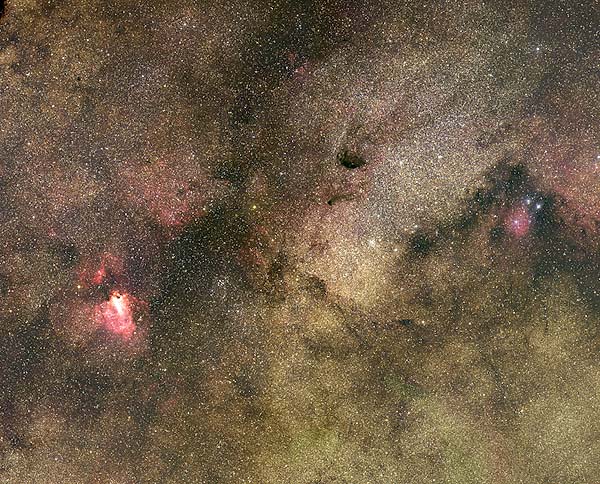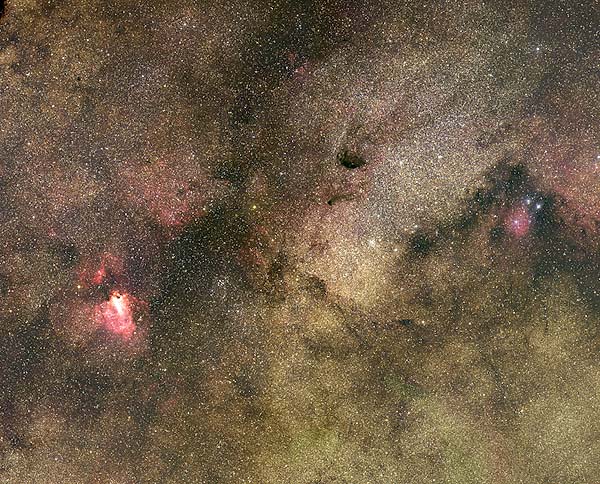
Many vast star fields in the plane of our Milky Way Galaxy are rich in clouds of stars, dust, and gas. First and foremost, visible in the above picture are millions of stars, many of which are similar to our Sun. Next huge filaments of dark interstellar dust run across the image and block the light from millions of more stars yet further across our Galaxy. The bright red region on the left is the Omega Nebula, an emission nebula of mostly hot hydrogen gas also known as M17. A small bright grouping of stars near the image center is the open cluster M18, while the long bright streak of stars just right of center is M24. On the far right of the image is the picturesque red emission nebula IC 1283 flanked by two blue reflection nebulas NGC 6589 and NGC 6590. These objects are visible with a small telescope toward the constellation of Sagittarius.
Muchos y vastos campos estelares en el plano de nuestra Galaxia de la Vía Láctea son ricos en nubes de estrellas, polvo y gas. En primer lugar, visibles en la imagen anterior hay millones de estrellas, muchas de las cuales son similares a nuestro Sol. A continuación, enormes filamentos de polvo interestelar oscuro atraviesan la imagen y bloquean la luz de millones de estrellas más ubicadas aún más lejos en nuestra Galaxia. La región rojo brillante a la izquierda es la Nebulosa de Omega, una nebulosa de emisión compuesta principalmente de gas de hidrógeno caliente, también conocida como M17. Un pequeño agrupamiento brillante de estrellas cerca del centro de la imagen es el cúmulo abierto M18, mientras que la larga franja brillante de estrellas justo a la derecha del centro es M24. En el extremo derecho de la imagen se encuentra la pintoresca nebulosa de emisión roja IC 1283 flanqueada por dos nebulosas de reflexión azules NGC 6589 y NGC 6590. Estos objetos son visibles con un telescopio pequeño hacia la constelación de Sagitario.