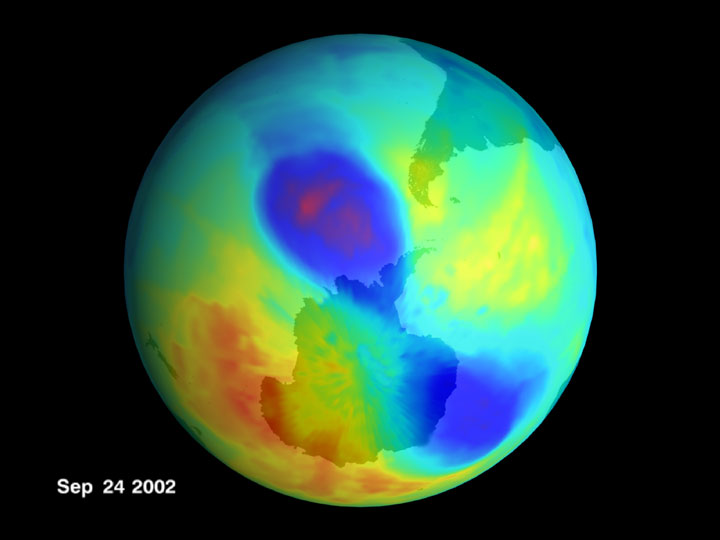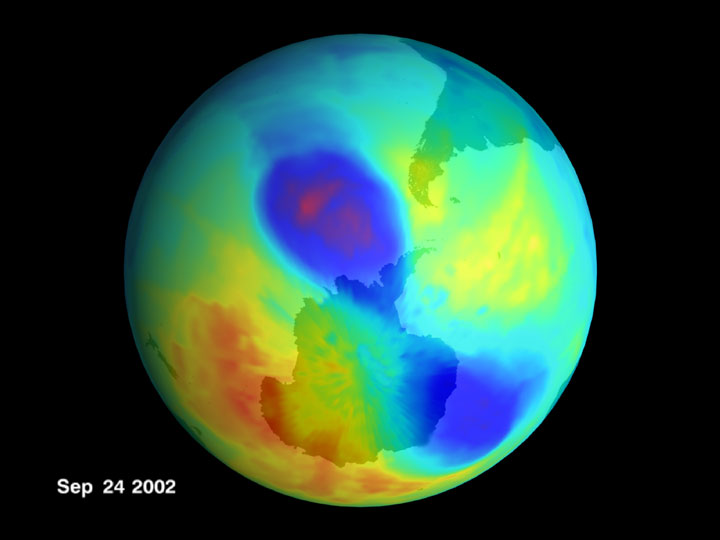
As expected, the ozone hole near Earth's South Pole is back again this year. This time, however, it's smaller than the past two years, and has an unusual double lobe structure. Ozone is important because it shields us from damaging ultraviolet sunlight. Ozone is vulnerable, though, to CFCs and halons being released into the atmosphere. International efforts to reduce the use of these damaging chemicals appear to be having a positive effect on their atmospheric abundance. The smaller size of the ozone hole this year, however, is attributed mostly to warmer than normal air in the surrounding stratosphere. The above picture of the ozone hole was taken on September 24 by TOMS on board the orbiting Earth Probe satellite.
Como era de esperarse, el agujero de ozono cerca del Polo Sur terrestre ha regresado nuevamente este año. Sin embargo, en esta ocasión es más pequeño que en los dos años anteriores y presenta una inusual estructura de lóbulo doble. El ozono es importante porque nos protege de la radiación ultravioleta dañina del Sol. No obstante, el ozono es vulnerable a los CFC y halones que se liberan en la atmósfera. Los esfuerzos internacionales para reducir el uso de estos químicos perjudiciales parecen estar teniendo un efecto positivo en su abundancia atmosférica. El menor tamaño del agujero de ozono este año, sin embargo, se atribuye principalmente al aire más cálido de lo normal en la estratosfera circundante. La imagen anterior del agujero de ozono fue tomada el 24 de septiembre por TOMS a bordo del satélite Earth Probe en órbita.