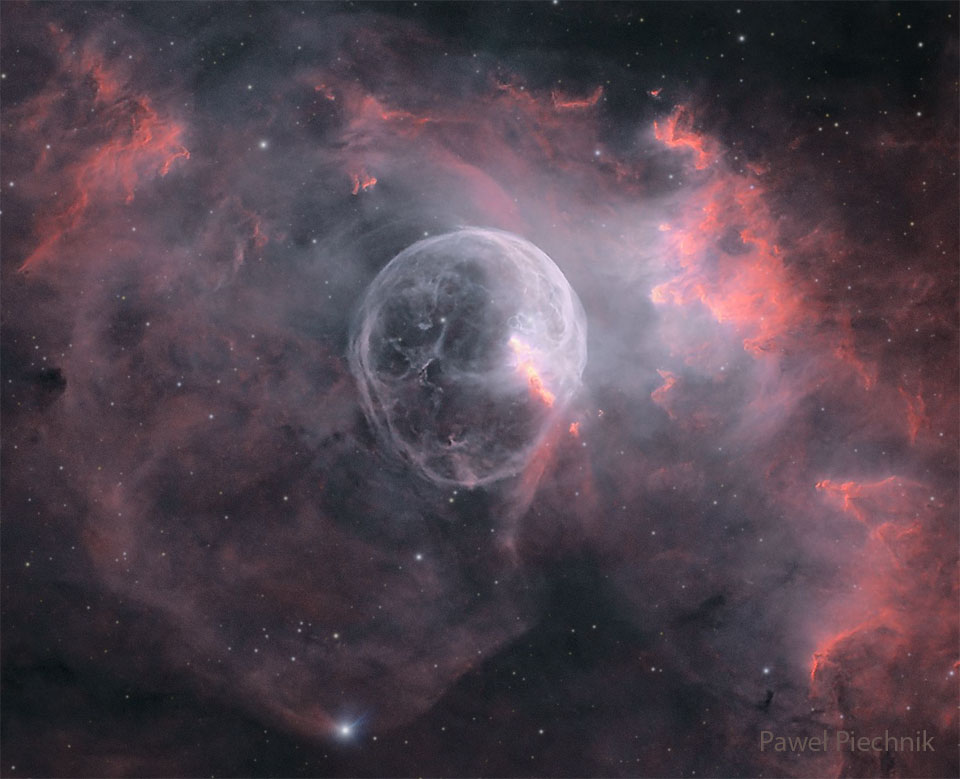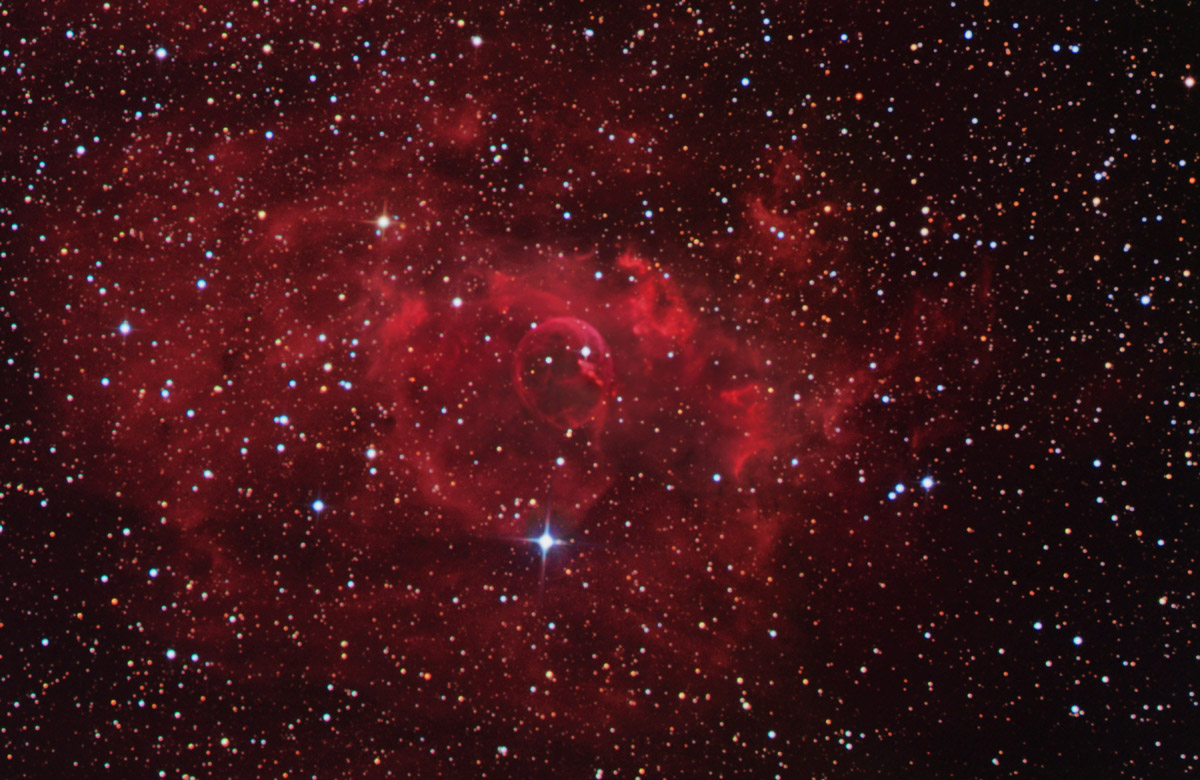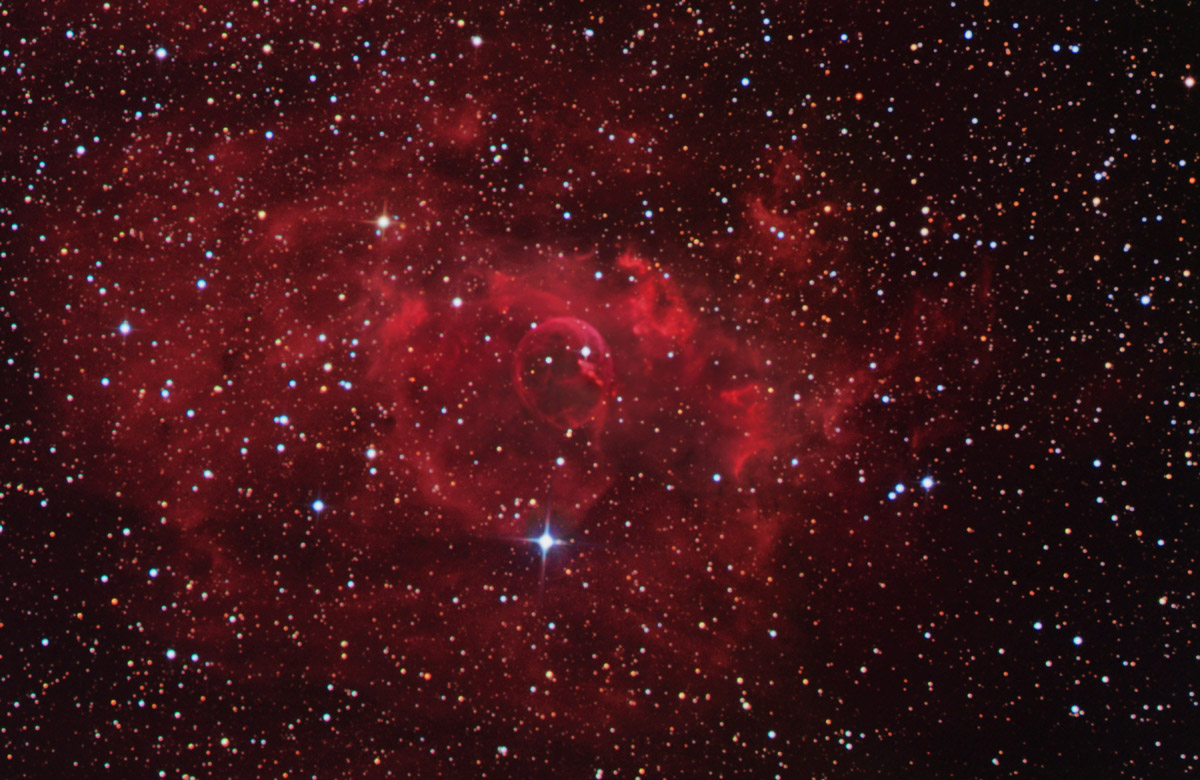
Seemingly adrift in a cosmic sea of stars and gas, this delicate, floating apparition is cataloged as NGC 7635 -- The Bubble Nebula. In this wide-angle view, the Bubble nebula lies at the center of a larger complex of shocked glowing gas about 11,000 light-years distant in the fair constellation Cassiopeia. NGC 7635 really is an interstellar bubble, blown by winds from the brightest star visible within the bubble's boundary. The bubble's expansion is constrained by the surrounding material. About 10 light-years in diameter, if the Bubble nebula were centered on the Sun, the Sun's nearest stellar neighbor, Alpha Centauri, would also be enclosed. This breathtaking picture is a combination of telescopic digital images made through broad color filters along with a narrow filter intended to transmit only the red light emitted by excited hydrogen atoms.
Aparentemente a la deriva en un mar cósmico de estrellas y gas, esta delicada aparición flotante está catalogada como NGC 7635 —La Nebulosa de la Burbuja. En esta vista de gran angular, la nebulosa de la Burbuja se encuentra en el centro de un complejo mayor de gas incandescente y perturbado, ubicado a aproximadamente 11.000 años luz de distancia en la hermosa constelación de Casiopea. NGC 7635 es realmente una burbuja interestelar, soprada por los vientos estelares de la estrella más brillante visible dentro del límite de la burbuja. La expansión de la burbuja está limitada por el material circundante. Con un diámetro de aproximadamente 10 años luz, si la nebulosa de la Burbuja estuviera centrada en el Sol, la estrella más cercana al Sol, Alfa Centauri, también estaría encerrada en ella. Esta imagen impresionante es una combinación de imágenes digitales telescópicas tomadas a través de filtros de color amplios junto con un filtro estrecho destinado a transmitir únicamente la luz roja emitida por átomos de hidrógeno excitados.