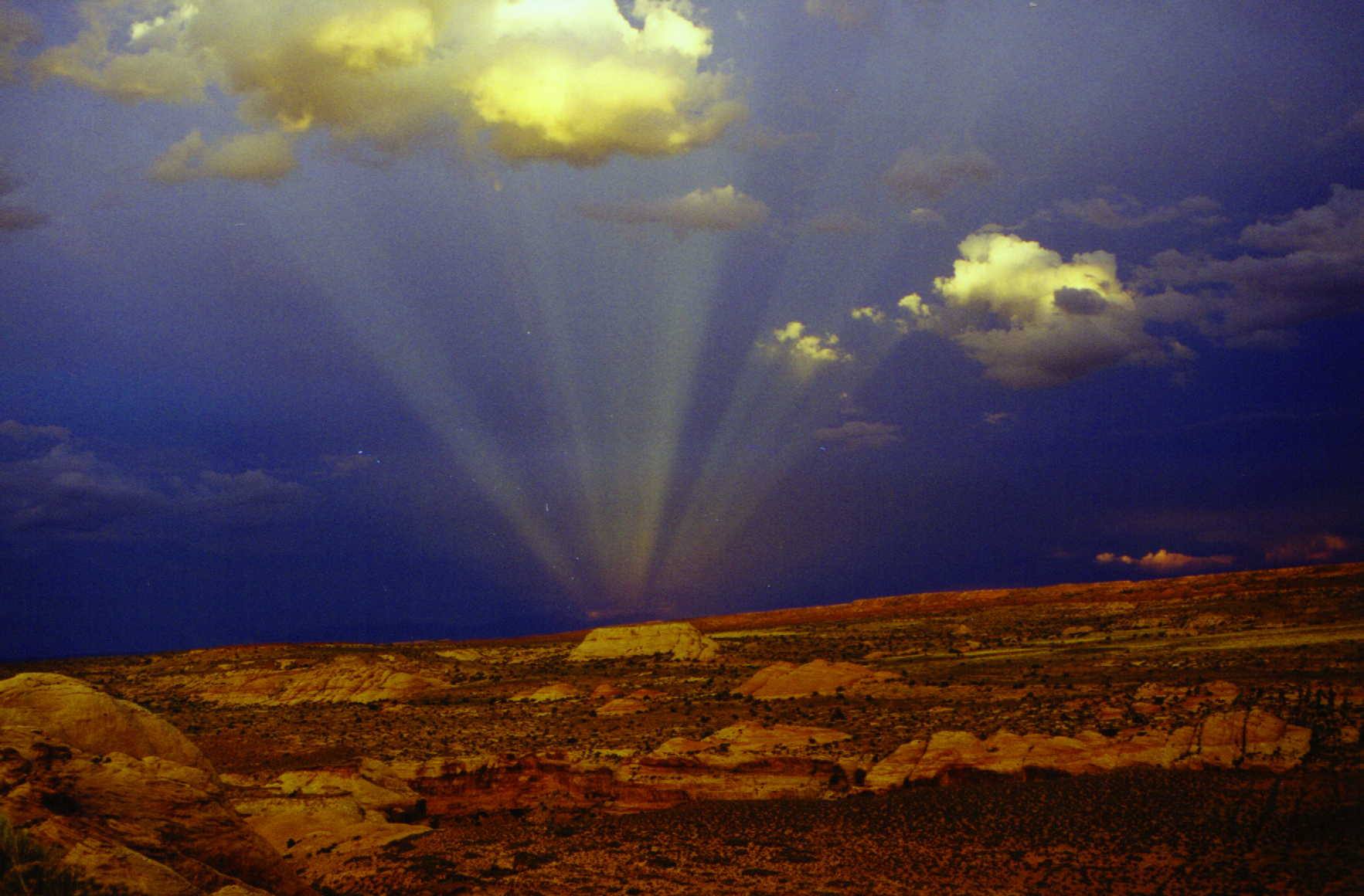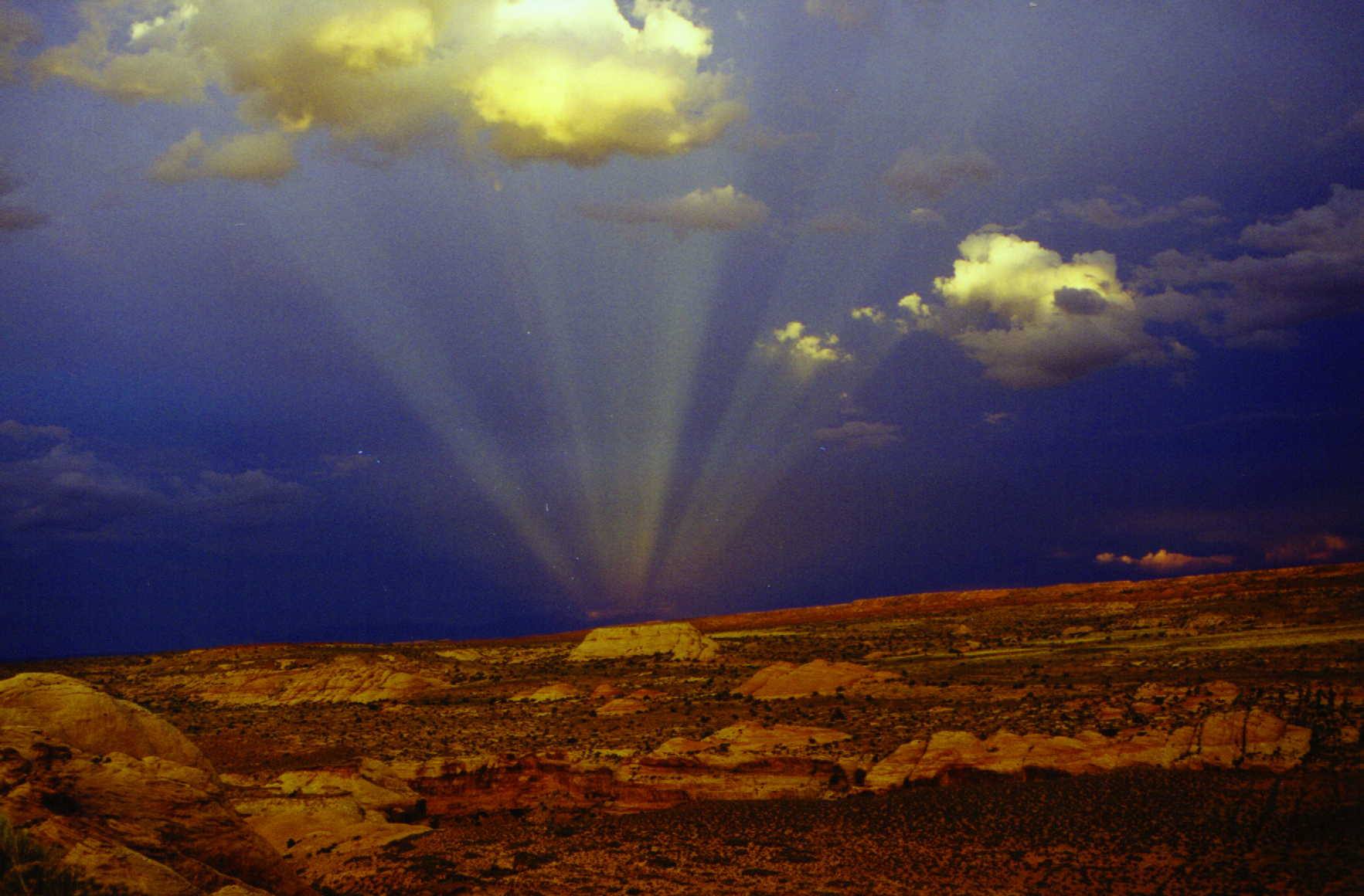
What's happening over the horizon? Although the scene may appear somehow supernatural, nothing more unusual is occurring than a setting Sun and some well placed clouds. Pictured above are anticrepuscular rays. To understand them, start by picturing common crepuscular rays that are seen any time that sunlight pours though scattered clouds. Now although sunlight indeed travels along straight lines, the projections of these lines onto the spherical sky are great circles. Therefore, the crepuscular rays from a setting (or rising) sun will appear to re-converge on the other side of the sky. At the anti-solar point 180 degrees around from the Sun, they are referred to as anticrepuscular rays. While enjoying the sunset after dinner near Horseshoe Canyon in Utah, the photographer chanced to find that an even more spectacular sight was occurring in the other direction just over the canyon -- a particularly vivid set of anticrepuscular rays.
¿Qué está sucediendo en el horizonte? Aunque la escena puede parecer sobrenatural, nada más inusual está ocurriendo que un Sol poniéndose y algunas nubes bien posicionadas. Lo que se muestra son rayos anticrepusculares. Para comprenderlos, comience por visualizar los comunes rayos crepusculares que se ven cada vez que la luz solar se filtra a través de nubes dispersas. Aunque la luz solar viaja efectivamente en líneas rectas, las proyecciones de estas líneas sobre la esfera celeste son círculos máximos. Por lo tanto, los rayos crepusculares de un sol que se pone (o sale) parecerán converger nuevamente en el otro lado del cielo. En el punto antisolar a 180 grados del Sol, se denominan rayos anticrepusculares. Mientras disfrutaba de la puesta de sol después de cenar cerca de Horseshoe Canyon en Utah, el fotógrafo tuvo la suerte de descubrir que un espectáculo aún más espectacular estaba ocurriendo en la otra dirección justo sobre el cañón: un conjunto particularmente vívido de rayos anticrepusculares.