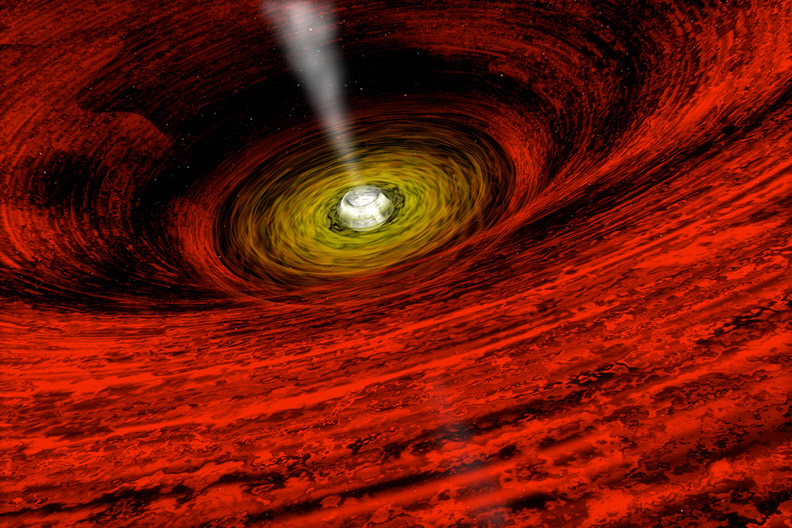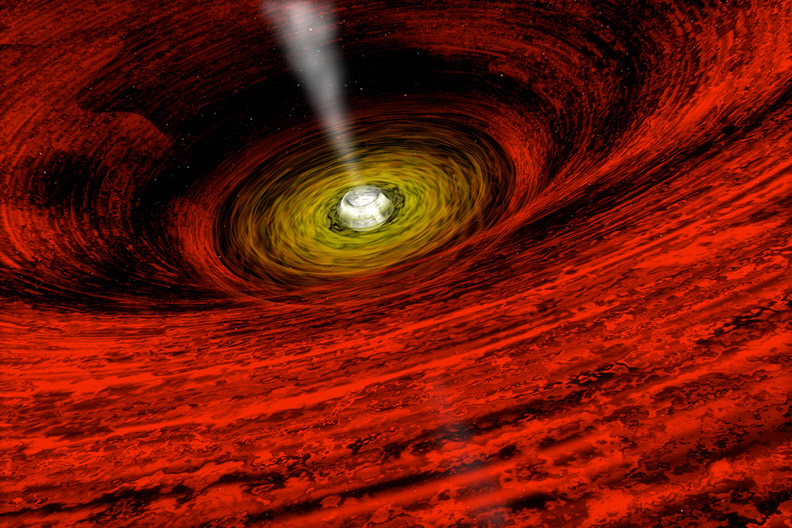
In the center of a swirling whirlpool of hot gas is likely a beast that has never been seen directly: a black hole. Studies of the bright light emitted by the swirling gas frequently indicate not only that a black hole is present, but also likely attributes. The gas surrounding GRO J1655-40, for example, has been found to display an unusual flickering at a rate of 450 times a second. Given a previous mass estimate for the central object of seven times the mass of our Sun, the rate of the fast flickering can be explained by a black hole that is rotating very rapidly. What physical mechanisms actually cause the flickering -- and a slower quasi-periodic oscillation (QPO) -- in accretion disks surrounding black holes and neutron stars remains a topic of much research.
En el centro de un remolino turbulento de gas caliente se encuentra probablemente una bestia que nunca ha sido observada directamente: un agujero negro. Los estudios de la luz brillante emitida por el gas turbulento frecuentemente indican no solo que un agujero negro está presente, sino también sus probables características. El gas que rodea a GRO J1655-40, por ejemplo, ha mostrado un parpadeo inusual a una tasa de 450 veces por segundo. Dado un estimado previo de masa del objeto central de siete veces la masa de nuestro Sol, la tasa de parpadeo rápido puede explicarse por un agujero negro que está rotando muy rápidamente. Los mecanismos físicos que realmente causan el parpadeo —y una oscilación cuasiperiódica más lenta (QPO)— en los discos de acreción que rodean agujeros negros y estrellas de neutrones sigue siendo un tema de gran investigación.