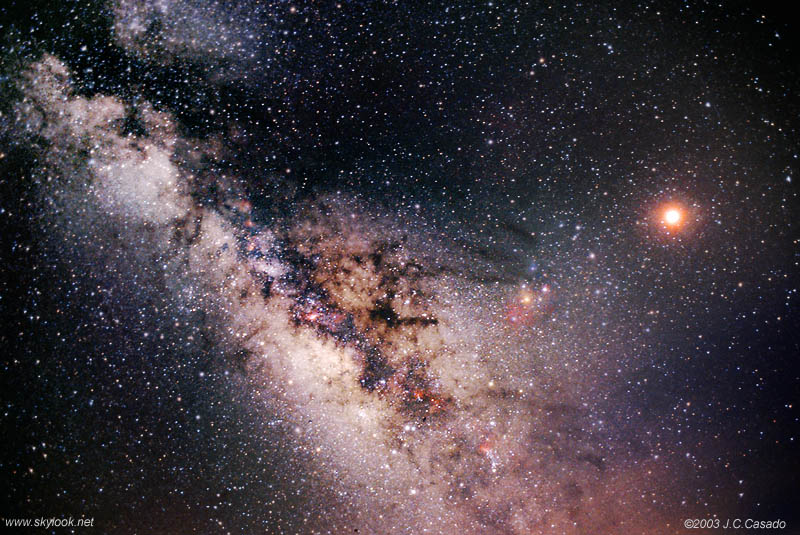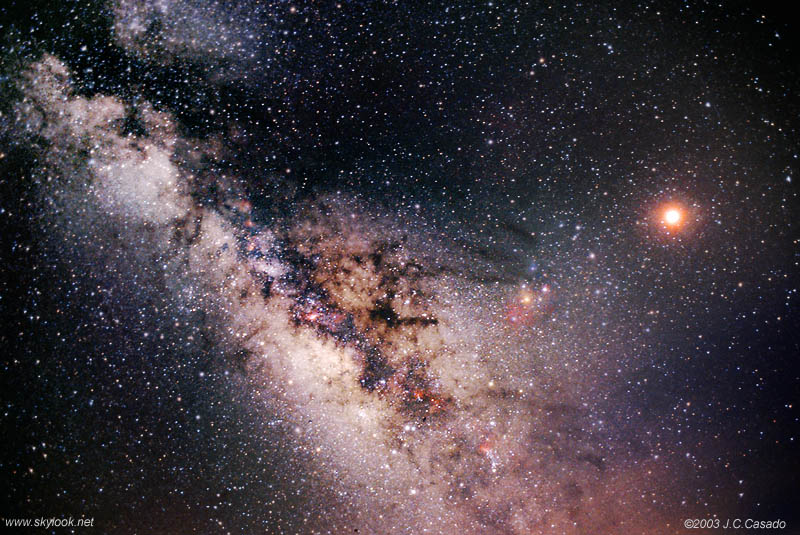
What's behind the Moon? Each month, our Moon passes in front of -- and outshines -- many an interesting star field. Exceptions occur during a new Moon and during a total eclipse. In the background of a new Moon is usually the Sun, an even brighter orb that even more easily outshines everything behind it, except during a total solar eclipse. Even the longest total solar eclipse lasts just a few minutes, while the Sun's corona still remains bright. During a total lunar eclipse, however, the full Moon dims and a majestic star field may present itself for an hour or more. Such was the case during the middle of last month, when a rare glimpse of an eclipsed Moon superposed in front of the disk of our home Milky Way Galaxy was captured. Although fully in the Earth's shadow, the eclipsed Moon is still the brightest object on the right. The above image was captured during sub-zero weather from the Teide 2003 expedition to Mirador del Pico Viejo, a mountain in the Canary Islands, Spain, off the northwest coast of Africa.
¿Qué hay detrás de la Luna? Cada mes, nuestra Luna pasa frente a —y oculta— muchos campos estelares interesantes. Las excepciones ocurren durante una Luna nueva y durante un eclipse total. En el fondo de una Luna nueva suele estar el Sol, un orbe aún más brillante que fácilmente oculta todo lo que hay detrás, excepto durante un eclipse solar total. Incluso el eclipse solar total más largo dura solo unos pocos minutos, mientras que la corona del Sol sigue siendo brillante. Sin embargo, durante un eclipse lunar total, la Luna llena se oscurece y un majestuoso campo de estrellas puede presentarse durante una hora o más. Tal fue el caso a mediados del mes pasado, cuando se capturó un raro vistazo de una Luna eclipsada superpuesta frente al disco de nuestra galaxia de origen, la Vía Láctea. Aunque completamente en la sombra de la Tierra, la Luna eclipsada sigue siendo el objeto más brillante a la derecha. La imagen anterior fue capturada durante una expedición en condiciones bajo cero desde la expedición Teide 2003 al Mirador del Pico Viejo, una montaña en las Islas Canarias, España, frente a la costa noroeste de África.