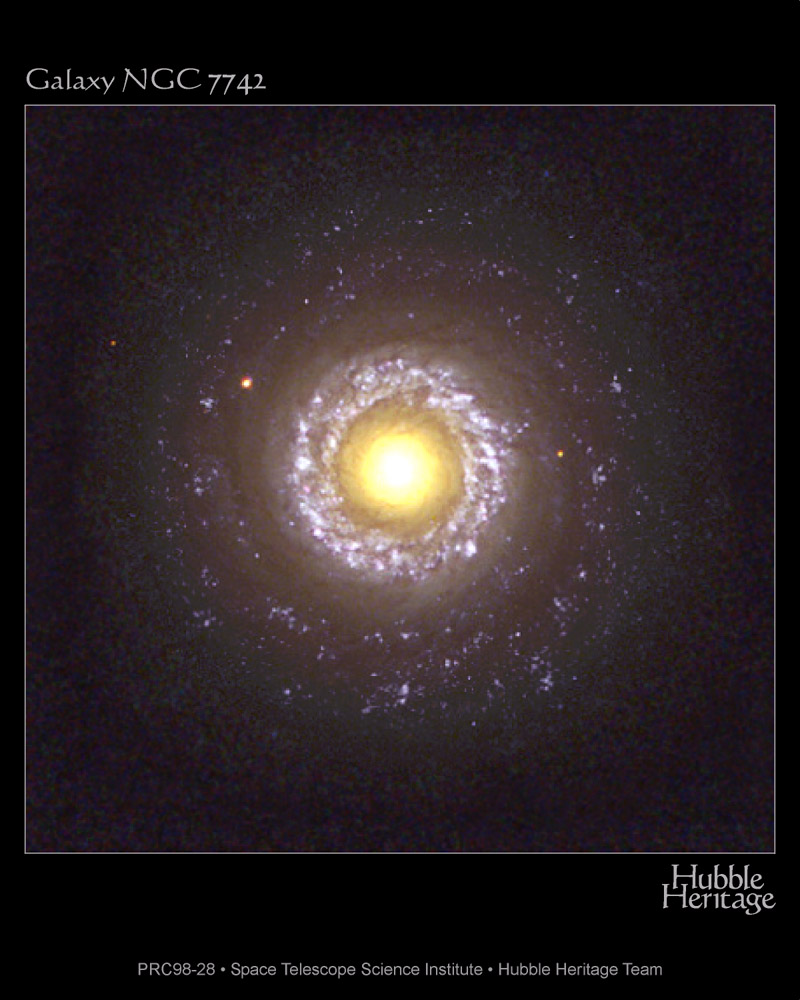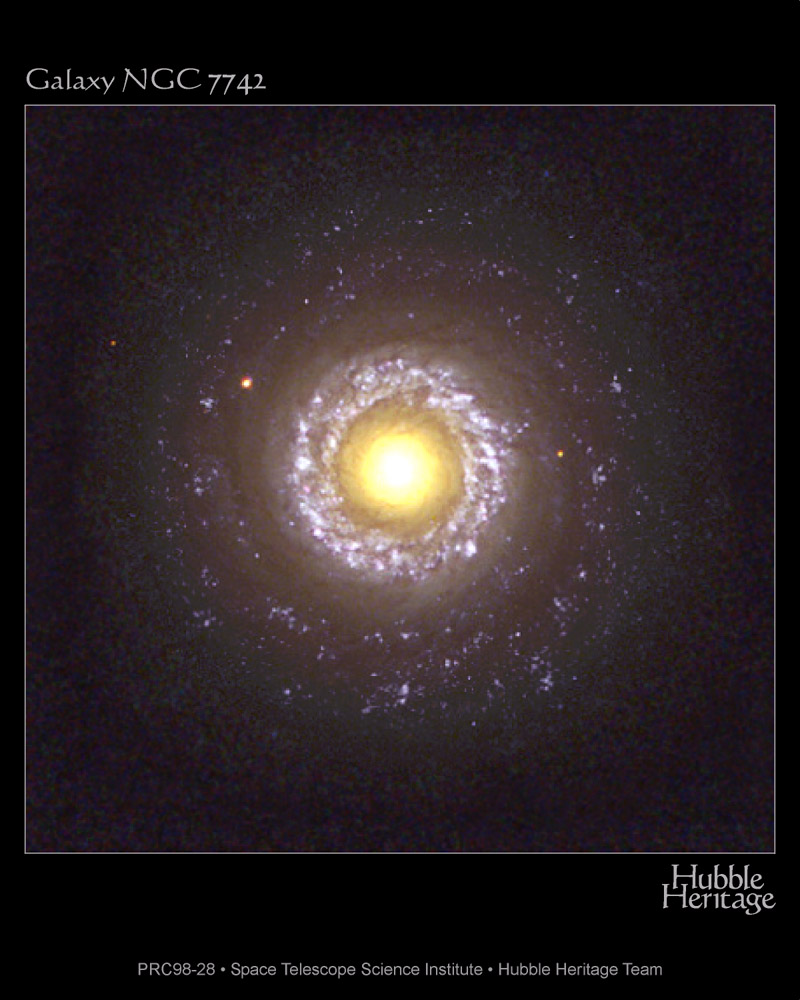
This might resemble a fried egg you've had for breakfast, but it's actually much larger. In fact, ringed by blue-tinted star forming regions and faintly visible spiral arms, the yolk-yellow center of this face-on spiral galaxy, NGC 7742, is about 3,000 light-years across. About 72 million light-years away in the constellation Pegasus, NGC 7742 is known to be a Seyfert galaxy - a type of active spiral galaxy with a center or nucleus which is very bright at visible wavelengths. Across the spectrum, the tremendous brightness of Seyferts can change over periods of just days to months and galaxies like NGC 7742 are suspected of harboring massive black holes at their cores. This beautiful color picture is courtesy of the Hubble Space Telescope Heritage Project.
Aunque podría asemejar a un huevo frito que haya tenido en el desayuno, en realidad es mucho más grande. De hecho, rodeado por regiones de formación estelar teñidas de azul y brazos espirales débilmente visibles, el centro amarillo yema de esta galaxia espiral de frente, NGC 7742, tiene aproximadamente 3.000 años luz de diámetro. A unos 72 millones de años luz de distancia en la constelación de Pegaso, NGC 7742 es conocida por ser una galaxia de Seyfert —un tipo de galaxia espiral activa con un centro o núcleo que es muy brillante en longitudes de onda visibles. En todo el espectro, el tremendo brillo de los Seyferts puede cambiar en períodos de solo días a meses, y se sospecha que galaxias como NGC 7742 albergan agujeros negros masivos en sus núcleos. Esta hermosa imagen a todo color es cortesía del Proyecto Herencia del Telescopio Espacial Hubble.