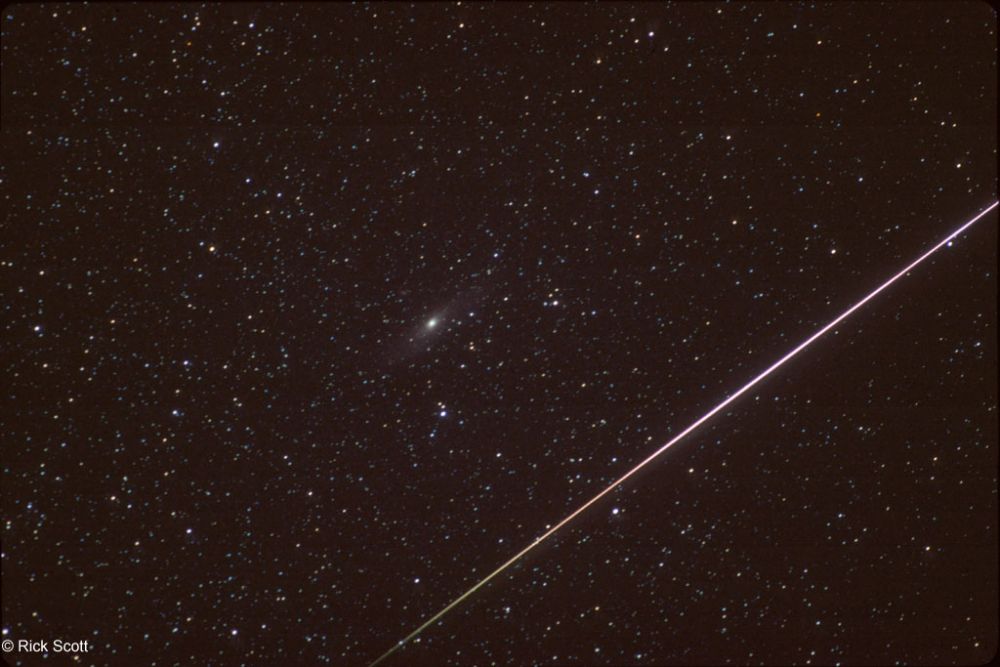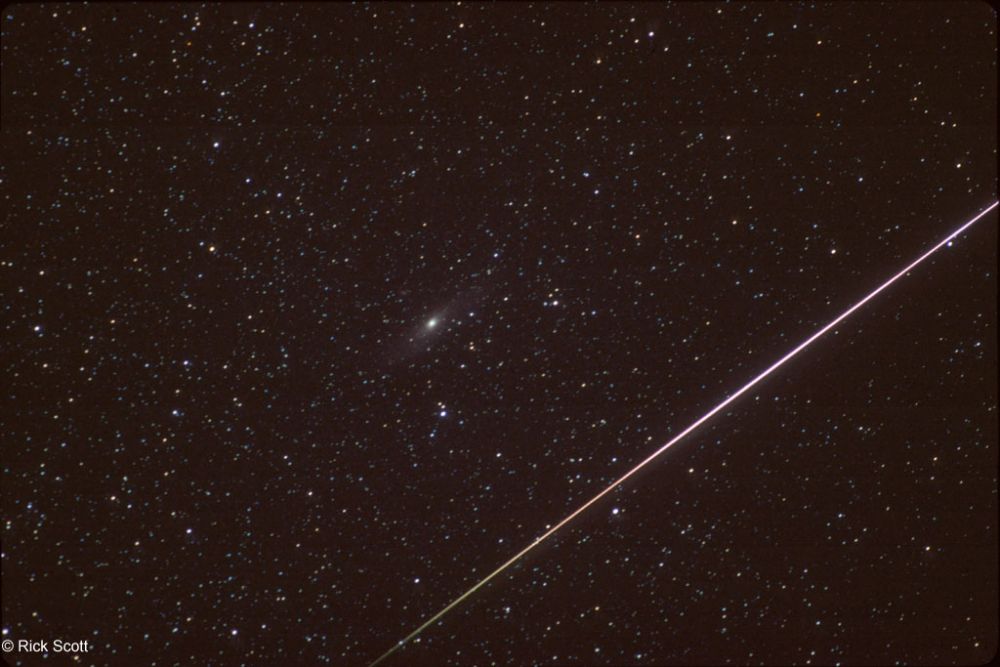
On August 13, 2002, while counting Perseid meteors under dark, early morning Arizona skies, Rick Scott set out to photograph their fleeting but fiery trails. The equipment he used included a telephoto lens and fast color film. After 21 pictures he'd caught only two meteors, but luckily this was one of them. Tracking the sky, his ten minute long exposure shows a field of many stars in our own Milky Way galaxy, most too faint to be seen by the unaided eye. Flashing from lower left to upper right, the bright meteor would have been an easy eyeful though, as friction with Earth's atmosphere vaporized the hurtling grain of cosmic sand, a piece of dust from Comet Swift-Tuttle. Just above and left of center, well beyond the stars of the Milky Way, lies the island universe known as M31 or the Andromeda galaxy. The visible meteor trail begins about 100 kilometers above Earth's surface, one of the closest celestial objects seen in the sky. In contrast, Andromeda, about 2 million light-years away, is the most distant object easily visible to the naked-eye.
El 13 de agosto de 2002, mientras contaba meteoros Perseidas bajo los cielos oscuros y madrugadores de Arizona, Rick Scott se propuso fotografiar sus rastros fugaces pero ardientes. El equipo que utilizó incluía un teleobjetivo y película fotográfica de color rápido. Después de 21 fotografías, había capturado solo dos meteoros, pero afortunadamente este fue uno de ellos. Siguiendo el cielo, su exposición de diez minutos de duración muestra un campo de muchas estrellas en nuestra propia galaxia Vía Láctea, la mayoría demasiado débiles para ser vistas a simple vista. Destellando de abajo a la izquierda hacia arriba a la derecha, el meteoro brillante habría sido fácil de ver, ya que la fricción con la atmósfera terrestre vaporizó el grano de arena cósmica que se precipitaba, un fragmento de polvo del Cometa Swift-Tuttle. Justo por encima y a la izquierda del centro, más allá de las estrellas de la Vía Láctea, se encuentra el universo isla conocido como M31 o galaxia de Andrómeda. El rastro del meteoro visible comienza aproximadamente a 100 kilómetros sobre la superficie terrestre, uno de los objetos celestes más cercanos que se ven en el cielo. En contraste, Andrómeda, ubicada a aproximadamente 2 millones de años luz de distancia, es el objeto más distante fácilmente visible a simple vista.