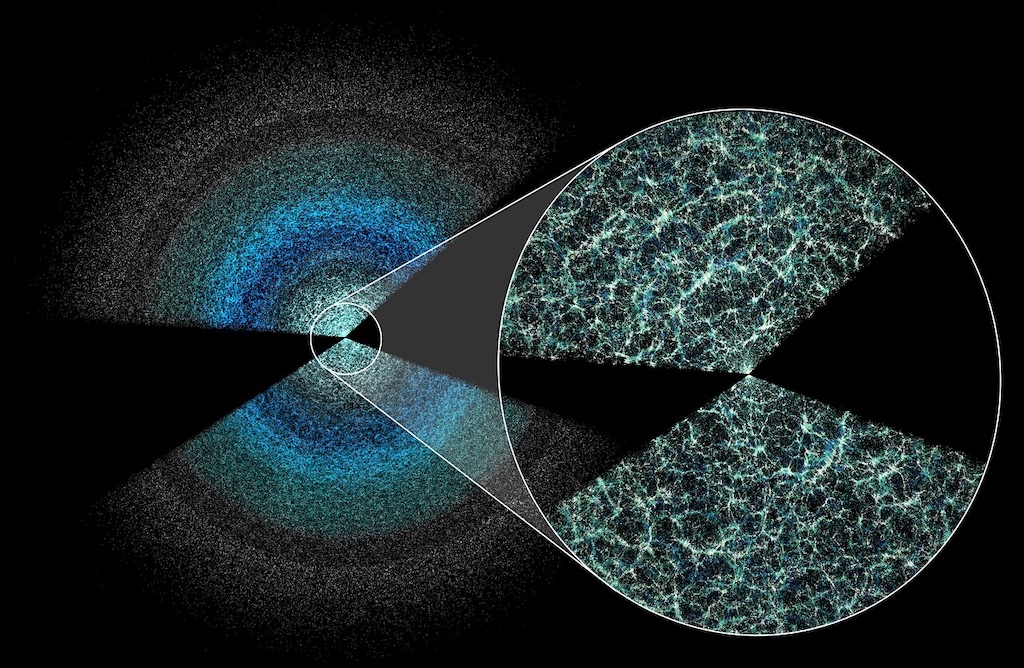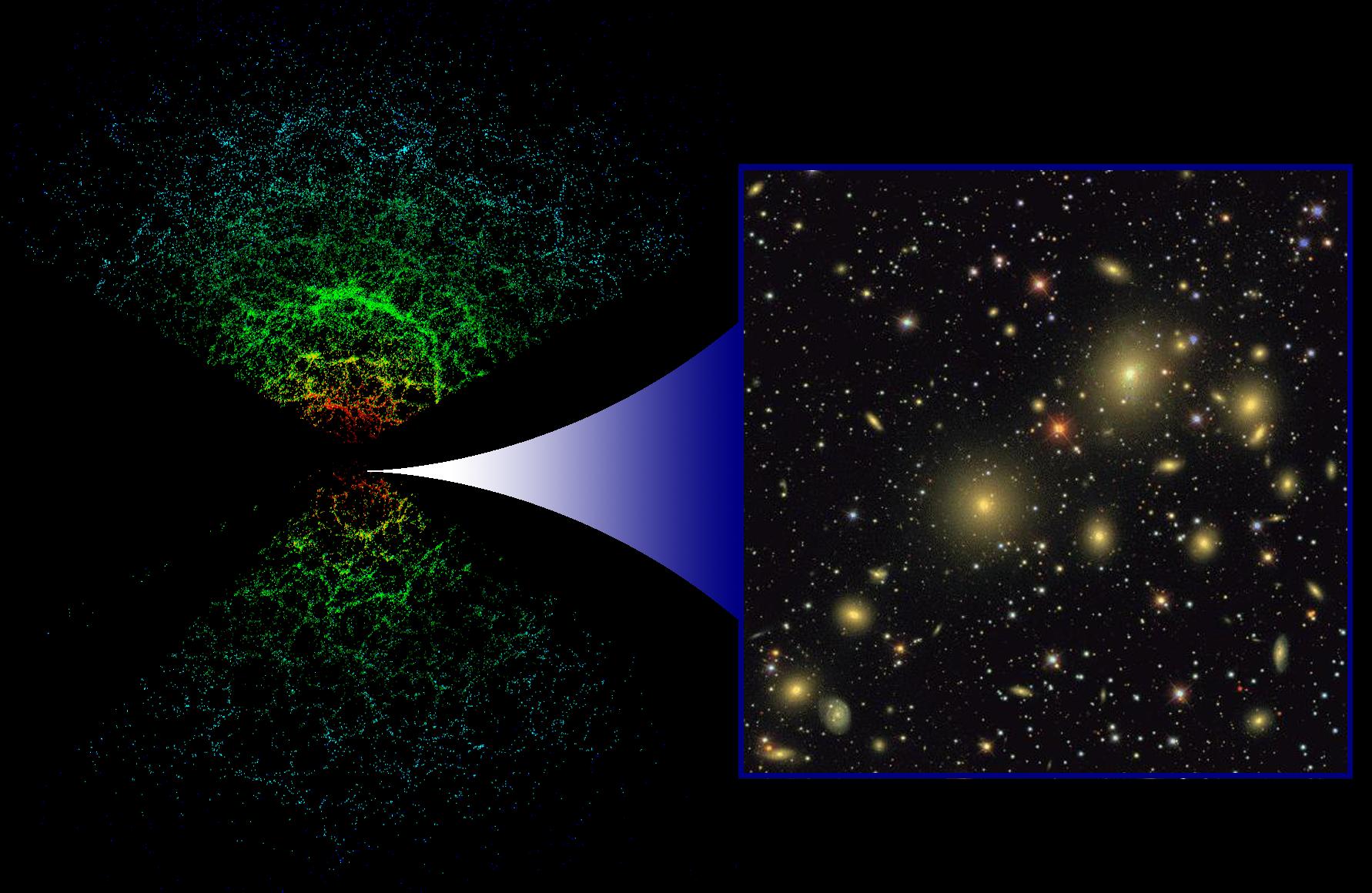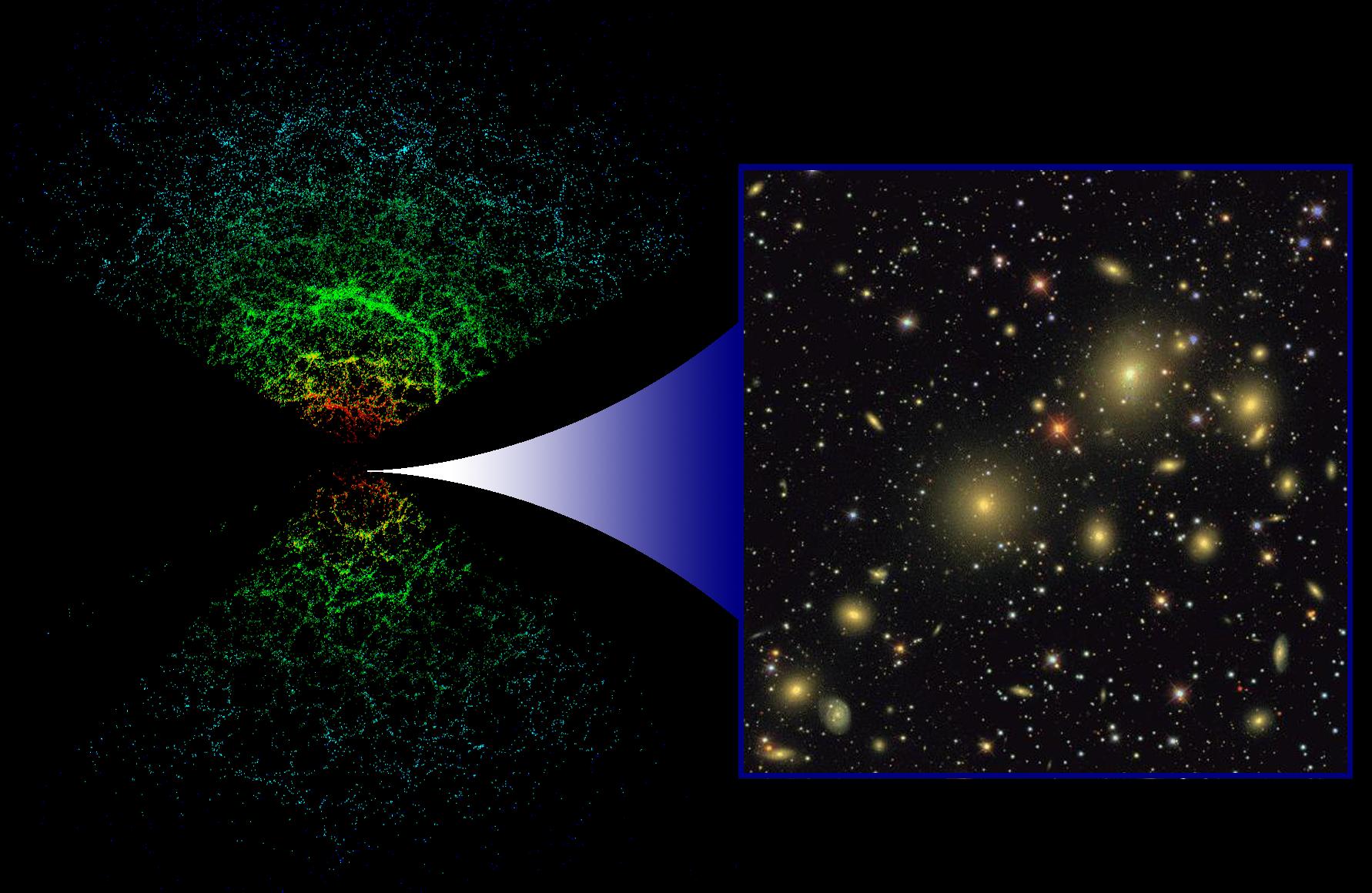
The latest map of the cosmos again indicates that dark matter and dark energy dominate our universe. The Sloan Digital Sky Survey (SDSS) is on its way to measuring the distances to over one million galaxies. Galaxies first identified on 2D images, like the one shown above on the right, have their distances measured to create the 3D map. The SDSS currently reports 3D information for over 200,000 galaxies, now rivaling the 3D galaxy-count of the Two-Degree Field sky map. The latest SDSS map, shown above on the left, could only show the galaxy distribution it does if the universe was composed and evolved a certain way. After trying to match many candidate universes to it, the Cinderella universe that best fits the above map has 5% atoms, 25% dark matter, and 70% dark energy. Such a universe was previously postulated because its rapid recent expansion can explain why distant supernovas are so dim, and its early evolution can explain the spot distribution on the very distant cosmic microwave background.
El último mapa del cosmos vuelve a indicar que la materia oscura y la energía oscura dominan nuestro universo. El Sloan Digital Sky Survey (SDSS) está en camino de medir las distancias a más de un millón de galaxias. Las galaxias identificadas inicialmente en imágenes 2D, como la que se muestra arriba a la derecha, tienen sus distancias medidas para crear el mapa 3D. El SDSS actualmente reporta información 3D para más de 200,000 galaxias, ahora rivalizando con el recuento de galaxias 3D del mapa del cielo del Two-Degree Field. El último mapa del SDSS, mostrado arriba a la izquierda, solo podría mostrar la distribución de galaxias que presenta si el universo estuviera compuesto y hubiera evolucionado de cierta manera. Después de intentar hacer coincidir muchos universos candidatos con él, el universo Cenicienta que mejor se ajusta al mapa anterior tiene 5% de átomos, 25% de materia oscura y 70% de energía oscura. Un universo así fue postulado previamente porque su rápida expansión reciente puede explicar por qué las supernovas distantes son tan débiles, y su evolución temprana puede explicar la distribución de manchas en el fondo cósmico de microondas muy distante.