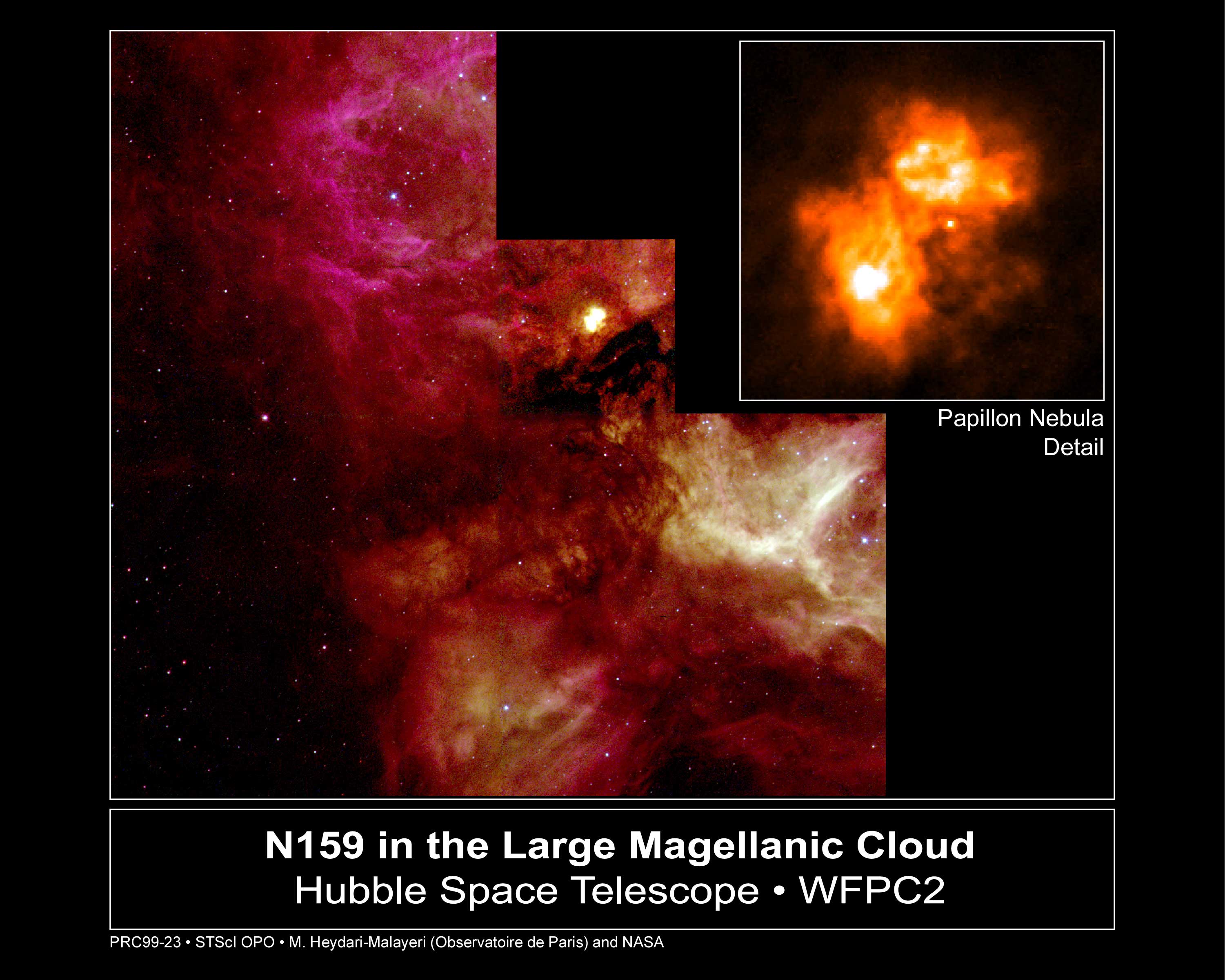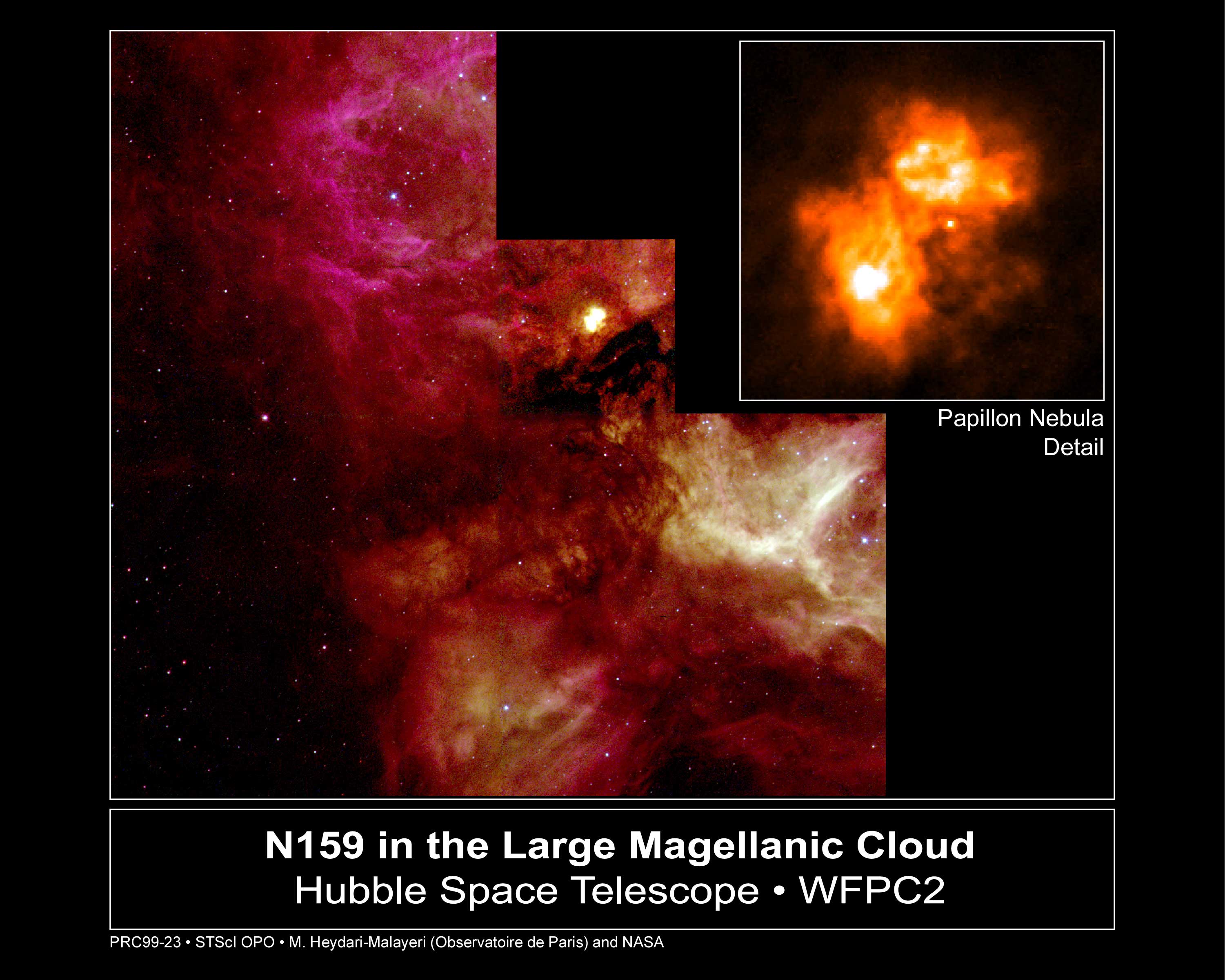
In a search for massive stars, the Hubble Space Telescope has peered into yet another spectacular region of star formation. This nebula, known as N159, spans over 150 light-years and is located in the neighboring Large Magellanic Cloud galaxy, about 170,000 light years distant. Visible in the above picture are bright newborn stars, dark filaments of dust, and red-glowing hydrogen gas. The aptly named Papillon Nebula (French for butterfly), is the unusual central compact cloud, highlighted in the inset. Reasons for the bipolar shape of the Papillon Nebula are currently unknown, but might indicate the presence of unseen high-mass stars and a thick gaseous disk.
En la búsqueda de estrellas masivas, el Telescopio Espacial Hubble ha escrutado otra región espectacular de formación estelar. Esta nebulosa, conocida como N159, se extiende por más de 150 años luz y se localiza en la galaxia vecina de la Gran Nube de Magallanes, a unos 170,000 años luz de distancia. Visibles en la imagen anterior son estrellas recién nacidas brillantes, filamentos oscuros de polvo y gas de hidrógeno que brilla en color rojo. La apropiadamente nombrada Nebulosa Papillón (palabra francesa que significa mariposa), es la inusual nube central compacta, resaltada en el recuadro. Las razones de la forma bipolar de la Nebulosa Papillón son actualmente desconocidas, pero podrían indicar la presencia de estrellas de gran masa no observadas directamente y un disco gaseoso denso.