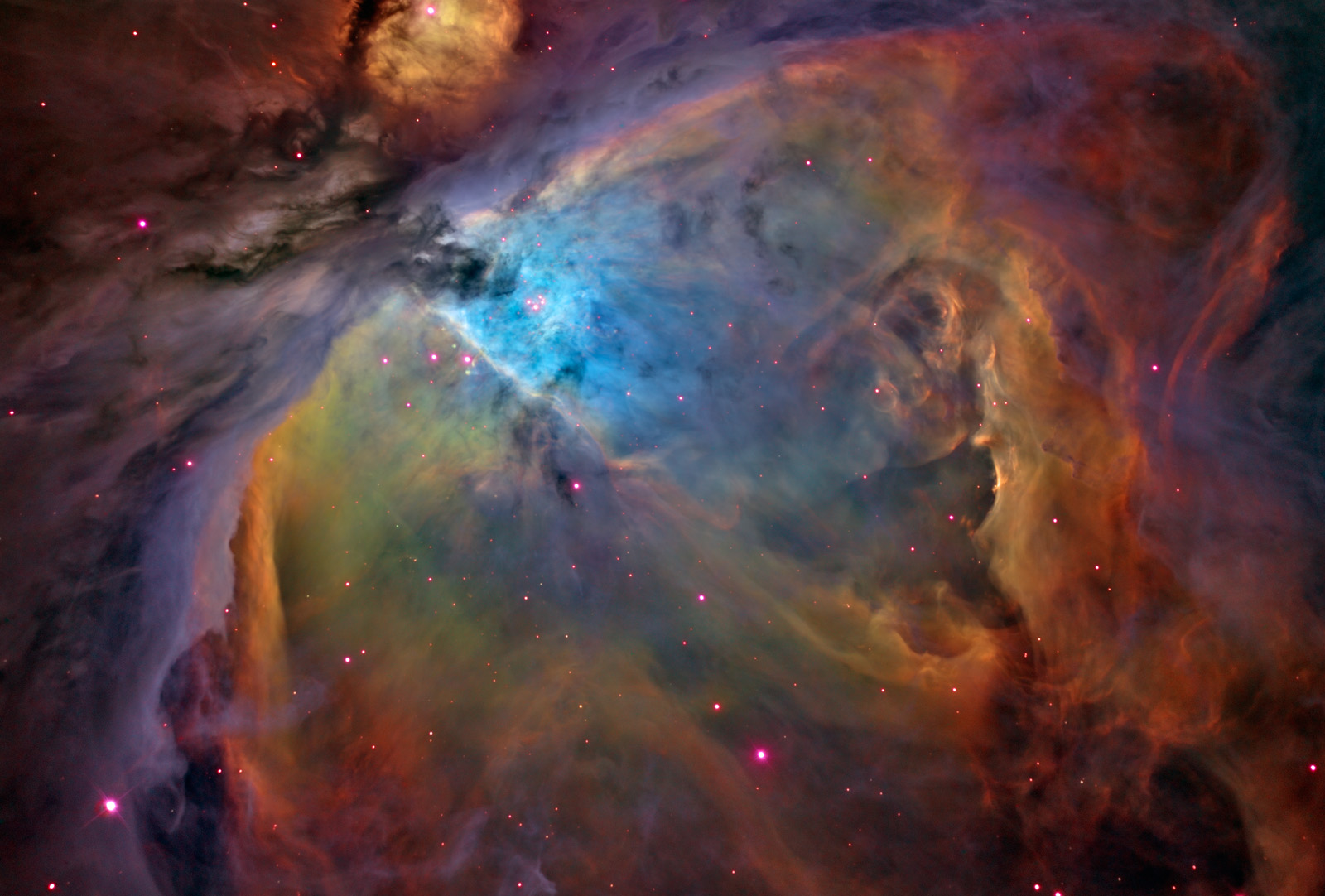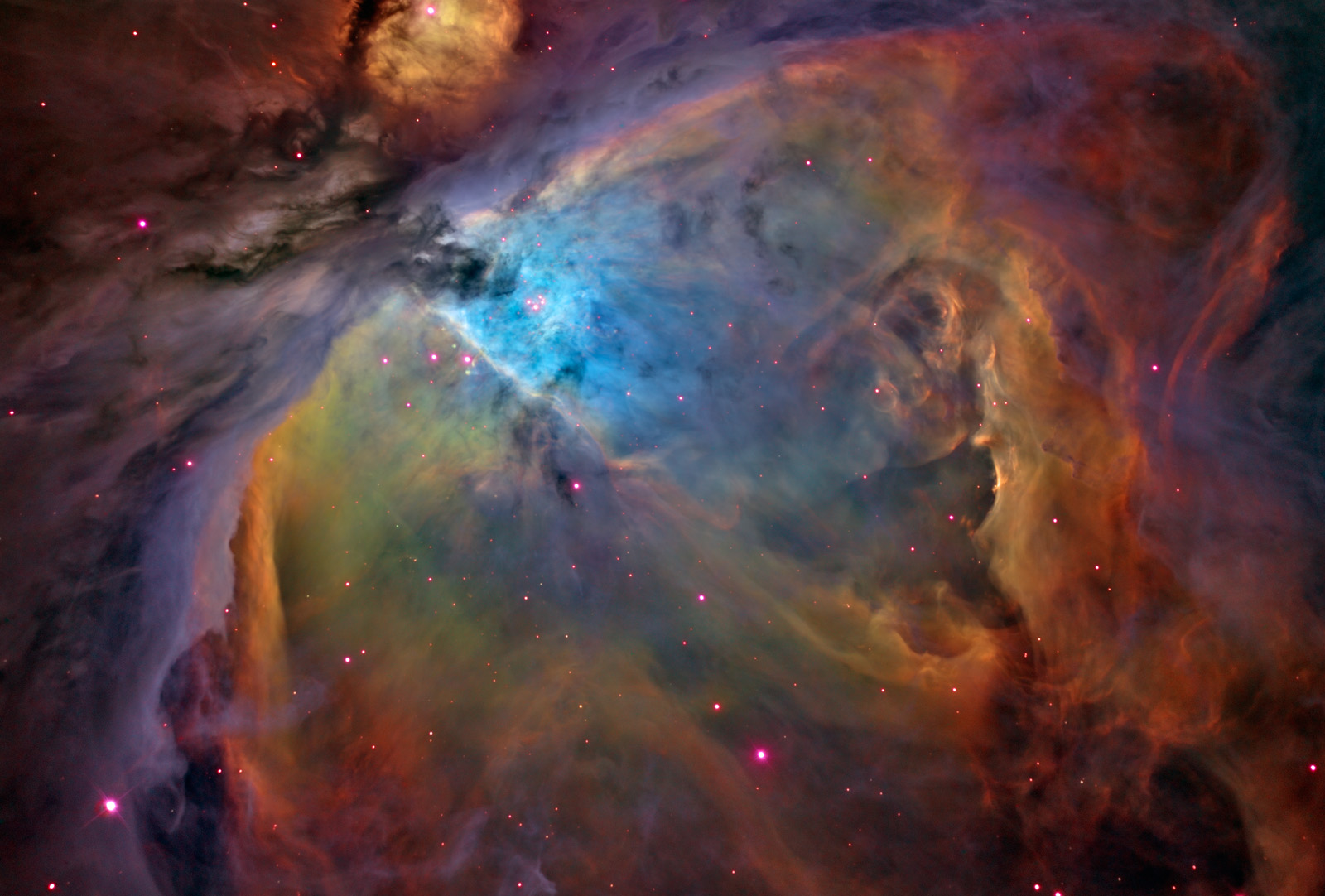
Look up into the sky tonight, and even with a good telescope you won't come across a sight quite like this one. It is a familiar object though, the grand stellar nursery known as the Orion Nebula. But the striking picture combines images taken through three separate filters, each designed to record different emission lines - light from Sulfur, Oxygen, and Hydrogen atoms glowing in the tenuous nebular gas. At such low densities, Sulfur and Hydrogen atoms emit red colors while Oxygen glows green. To distinguish their contributions in the final image, Sulfur was assigned to red, Hydrogen to green, and Oxygen to blue, a color scheme used in mapped-color images of other astronomical nebulae as well. While the result is very different from what the eye might see, the image is still both beautiful and scientifically valuable, tracing elements and conditions within the nearby star forming region.
Si miras hacia el cielo esta noche, incluso con un buen telescopio no encontrarás un espectáculo como este. Sin embargo, es un objeto familiar: la gran guardería estelar conocida como la Nebulosa de Orión. Pero esta imagen sorprendente combina imágenes tomadas a través de tres filtros separados, cada uno diseñado para registrar diferentes líneas de emisión: luz de átomos de Azufre, Oxígeno e Hidrógeno brillando en el gas nebular tenue. Con densidades tan bajas, los átomos de Azufre e Hidrógeno emiten colores rojos mientras que el Oxígeno brilla en verde. Para distinguir sus contribuciones en la imagen final, el Azufre se asignó al rojo, el Hidrógeno al verde y el Oxígeno al azul, un esquema de color utilizado también en imágenes de colores mapeados de otras nebulosas astronómicas. Aunque el resultado es muy diferente de lo que el ojo podría ver, la imagen sigue siendo tanto hermosa como científicamente valiosa, trazando elementos y condiciones dentro de la cercana región de formación estelar.