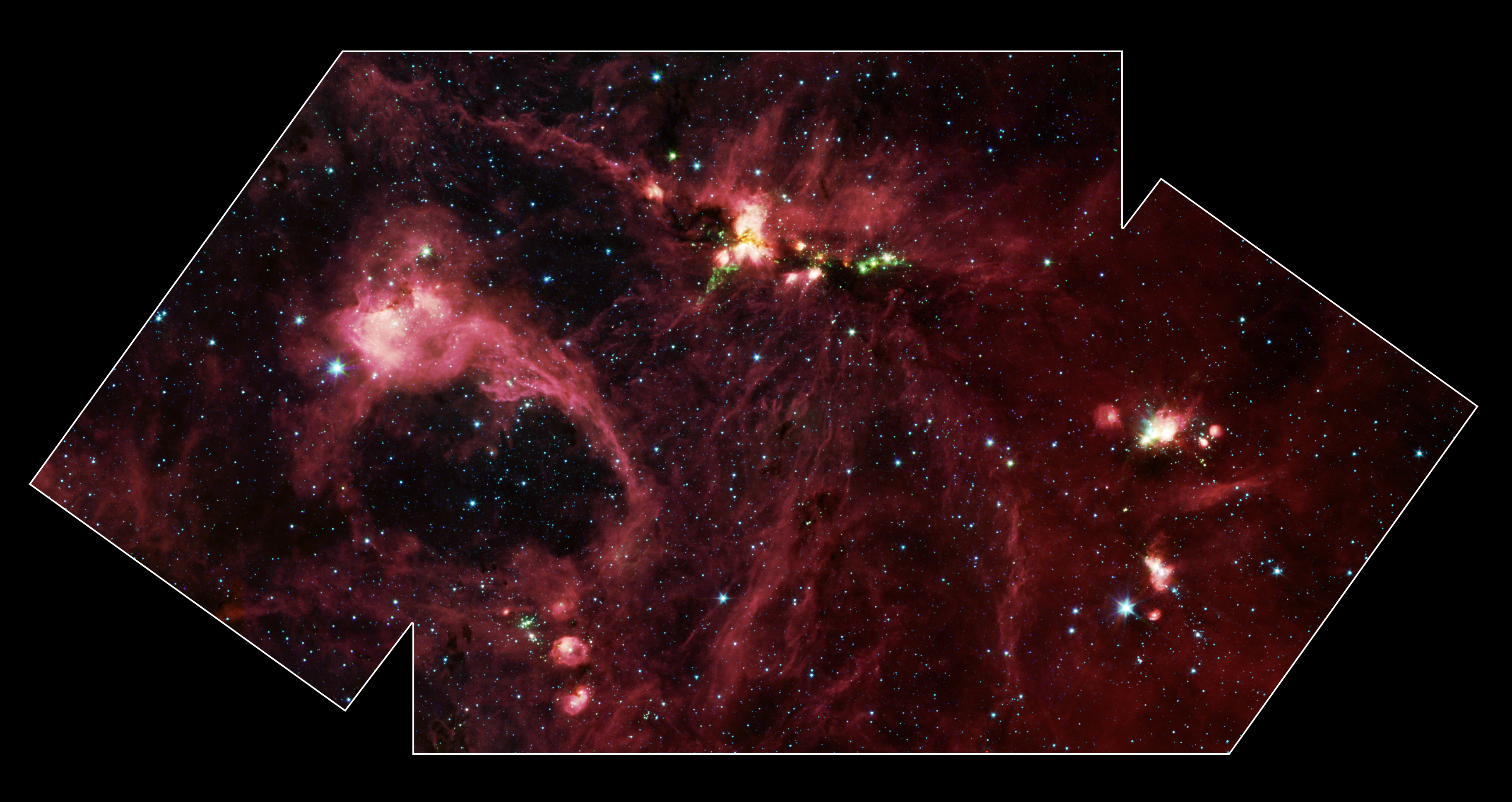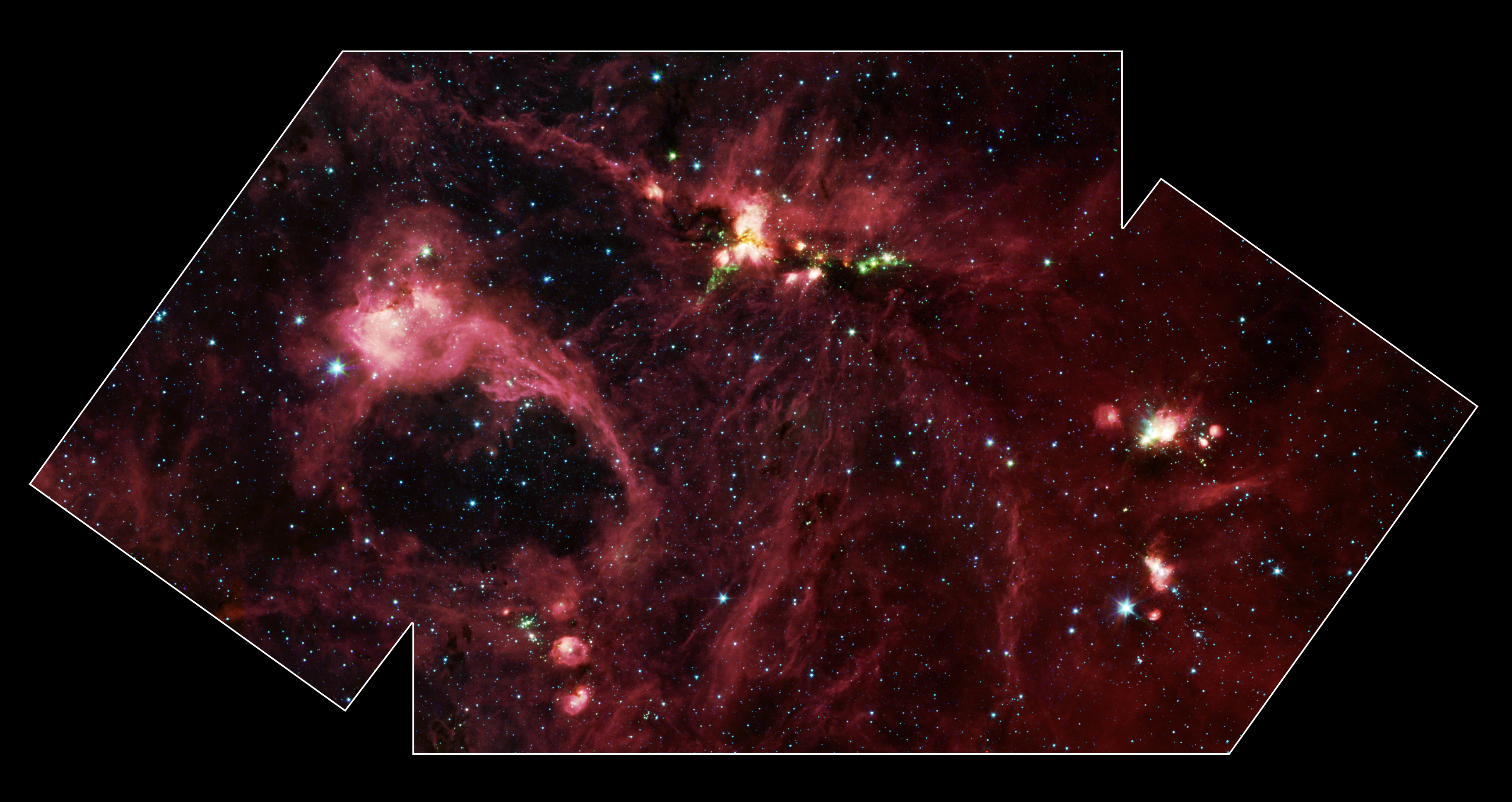
Deep in the normally hidden recesses of giant molecular cloud DR21, a stellar nursery has been found creating some of the most massive stars yet recorded. The orbiting Spitzer Space Telescope's Infrared Array Camera opened the window into the cloud last year in mid- infrared light. The cloud is opaque to visible light because of dense interstellar dust. Noticeable in the above representative color infrared Spitzer image are huge bubbles, a complex tapestry of dust and gas, and very massive stars. The infrared filaments actually glow because of organic compounds known as PAHs. The intricate patterns are caused by complex interactions between interstellar winds, radiation pressures, magnetic fields, and gravity. The pictured region spans about 75 light years and lies about 6,000 light years distant toward the constellation of Cygnus.
En las profundidades normalmente ocultas de la nube molecular gigante DR21, se ha descubierto un vivero estelar que está creando algunas de las estrellas más masivas jamás registradas. La Cámara de Matriz Infrarroja del Telescopio Espacial Spitzer en órbita abrió la ventana a la nube el año pasado en luz infrarroja media. La nube es opaca a la luz visible debido al polvo interestelar denso. Notable en la imagen infrarroja representativa de color de Spitzer anterior son enormes burbujas, un tapiz complejo de polvo y gas, y estrellas muy masivas. Los filamentos infrarrojos brillan gracias a compuestos orgánicos conocidos como HAPs (Hidrocarburos Aromáticos Policíclicos). Los patrones intrincados son causados por interacciones complejas entre vientos interestelares, presiones de radiación, campos magnéticos y gravedad. La región representada abarca aproximadamente 75 años luz y se encuentra a unos 6000 años luz de distancia hacia la constelación del Cisne.